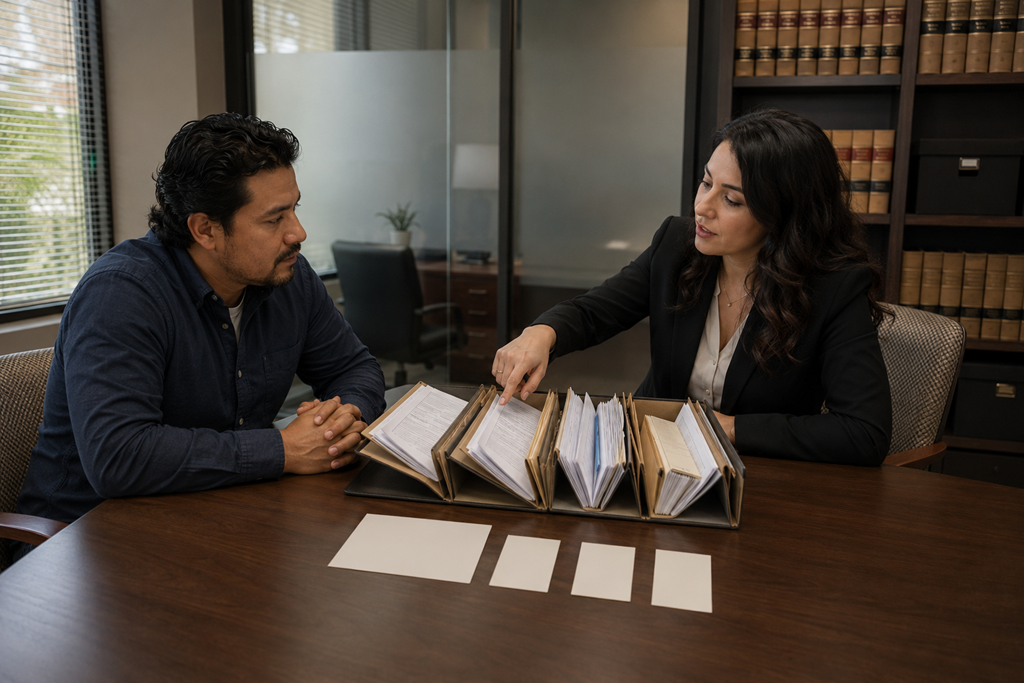
Preparing financial documents before a bankruptcy consultation usually means gathering records that show what you own, what you owe, what money comes in, where it goes, and what has recently changed. You do not need a perfect binder or every answer before making the appointment. A clear set of records, honest notes about missing information, and a few focused questions can help a lawyer understand your situation more efficiently.
For many Sacramento-area residents, this preparation feels more difficult than expected. Financial information may be spread across online accounts, unopened mail, tax folders, vehicle paperwork, old emails, and statements from several creditors. Some records may be missing, while others may be difficult to understand.
The goal is not to solve every financial problem before the consultation. It is to give the lawyer a reasonably accurate picture of your situation so the conversation can focus on the questions that matter most.
Start With the Financial Story, Not a Perfect Filing System
A bankruptcy lawyer will generally need to understand several broad parts of your financial life:
- What income enters your household
- What regular expenses your household pays
- Which individuals, lenders, agencies, or businesses you owe
- What property and financial accounts you have
- Whether anything significant has recently changed
Official bankruptcy forms reflect these same broad categories by requesting information about property, debts, income, expenses, and previous financial activity.
You do not need to complete bankruptcy forms before meeting with a lawyer unless the lawyer’s office specifically asks you to do so. For an initial consultation, organizing your existing records into understandable groups is usually more useful than trying to interpret legal forms on your own.
A simple accordion folder, document box, or set of digital folders can work. The organization does not need to look professional. It only needs to help you and the lawyer locate information without repeatedly searching through an unrelated pile.
Gather Records That Show Where Your Money Comes From
Begin with documents that help explain household income.
Depending on your circumstances, these might include:
- Recent pay statements
- Records of self-employment or contract income
- Benefit or pension statements
- Rental income records
- Recent tax returns
- Bank statements showing regular deposits
- Records of support payments or other recurring income
Someone with irregular hours, seasonal work, commission income, gig income, or a small business may not have one document that tells the entire story. In that situation, bring several records that show the pattern as clearly as possible.
Do not worry if the amounts change from month to month. Variations are part of the information the lawyer may need to understand.
It can also help to write a brief note identifying income that recently started, stopped, increased, or decreased. The note does not need to explain the legal significance. It simply gives the lawyer a reason to ask the right follow-up questions.
Separate Household Expenses From General Spending
Expense records help show what it takes to maintain the household each month.
Useful records may include housing payments, utilities, insurance, food, transportation, childcare, medical costs, support obligations, and other recurring expenses. You may also have less frequent costs that do not appear every month, such as vehicle registration, home repairs, school expenses, or annual insurance payments.
The purpose is not to defend every purchase or make your spending look unusually disciplined. It is to provide a realistic picture.
One common mistake is preparing a budget based on what someone believes they should be spending rather than what they actually spend. That can make the consultation less useful because the lawyer may be evaluating numbers that do not reflect everyday life.
Bank statements, billing records, payment histories, and a simple list of recurring costs can help fill in the gaps. When an amount is uncertain, mark it as an estimate rather than presenting it as an exact figure.
Put Debt Records Into Clear Groups
Debt documents are often the most scattered part of consultation preparation.
Try to collect recent statements, collection notices, payment histories, loan documents, medical bills, tax notices, court papers, and correspondence from creditors. Group papers from the same creditor together, even when the account has been transferred to a collection company.
It may be useful to separate debts connected to property from debts that are not. For example, vehicle loans and mortgages can be placed apart from credit cards, personal loans, and medical accounts.
You do not need to decide which legal category applies to every debt. That is something to discuss with the lawyer.
You should also include debts that feel informal or uncomfortable to mention, such as money owed to relatives, former business partners, friends, landlords, or service providers. A consultation is more productive when the lawyer receives the complete picture rather than only the debts that appear on a credit report.
Include Records of Property and Financial Accounts
Bankruptcy preparation is not limited to debt. A lawyer will also need to understand what you own or have an interest in.
Relevant records may include:
- Checking and savings account statements
- Vehicle titles or loan records
- Mortgage statements or property records
- Retirement and investment account statements
- Life insurance information
- Business ownership records
- Records for valuable personal property
- Information about money someone else owes you
This does not mean every household object needs its own photograph, receipt, and estimated value before the first meeting. The lawyer can explain what level of detail is appropriate for your situation.
The important point is not to leave something out because it seems unimportant, difficult to value, jointly owned, or unavailable in paper form. Write it down and ask about it.
Flag Recent Financial Changes Without Trying to Interpret Them
Certain financial events may lead to additional questions during a bankruptcy consultation.
Examples may include selling property, transferring ownership, closing an account, receiving an inheritance, making a large payment, repaying a family member, taking a cash advance, starting a business, or experiencing a major change in income.
Bring any records you have and write down approximate details when records are incomplete.
You do not need to determine whether an event will affect a bankruptcy case. That requires advice based on the specific circumstances. Your responsibility during preparation is to disclose the event clearly enough for the lawyer to evaluate it.
Avoid trying to make your finances look simpler by moving money, transferring property, selectively repaying people, destroying records, or changing ownership before receiving individual legal advice. Keeping the existing financial picture intact can help the lawyer understand what has actually happened.
Missing Documents Should Be Identified, Not Hidden
Most people do not arrive at a first consultation with every requested record.
A bank account may have been closed. An old creditor may no longer send statements. Tax paperwork may be stored elsewhere. A former spouse or business partner may control certain records. An online account may be temporarily inaccessible.
Instead of delaying the consultation indefinitely, create a short list of what is missing.
For each missing item, note:
- What the document is
- Where it may be located
- Whether you have tried to request it
- Whether another record shows similar information
This allows the lawyer to distinguish between information that is unavailable and information that was unintentionally omitted.
It also gives the lawyer an opportunity to tell you which missing documents matter most and which ones may not be necessary at that stage.
Keep Business and Personal Records Distinct
Sacramento small business owners, independent contractors, landlords, and people with side income may have financial activity that crosses between personal and business accounts.
Do not combine everything into one unexplained pile.
Keep business bank statements, leases, tax records, invoices, payroll information, equipment records, and business debts together. Keep personal household records in a separate group.
When an expense or account was used for both purposes, mark it rather than trying to force it into one category.
The separation helps the lawyer see how the business and household affect each other. It may also reveal questions that would be difficult to identify from personal records alone.
Bring Questions Along With the Paperwork
A consultation is not only an opportunity to hand over documents. It is also a chance to understand what information is important and what the next steps may involve.
Useful questions may include:
- Which records do you need before evaluating my situation?
- How far back should the records cover?
- Should I bring originals, copies, or digital files?
- What should I do when a statement is missing?
- Should business and personal records be handled differently?
- Are there recent transactions you want me to identify?
- What financial changes should I avoid making before receiving advice?
- What additional information would help you explain my options?
You may also want to ask how the lawyer’s office protects financial documents, how records should be delivered, and whether there is an intake form to complete before a follow-up meeting.
Honest Organization Is More Useful Than Impressive Organization
The most helpful consultation file is not necessarily the thickest or most polished one.
A smaller set of accurate records, clearly separated into income, expenses, debts, assets, and recent financial activity can be more useful than several boxes of unsorted paper. A short note explaining what is missing can be more valuable than quietly leaving out an incomplete account.
Preparing this way may also help you notice patterns before the consultation. You may discover duplicate collection accounts, expenses that fluctuate widely, income that is not reflected in pay statements, or debts connected to property you no longer use.
Those observations are not legal conclusions. They are starting points for a more focused conversation.
Bankruptcy can have significant legal and financial consequences, and the appropriate documents and options depend on the individual situation. The United States Courts recommends seeking guidance from a qualified attorney because of those long-term consequences. A Sacramento-area bankruptcy lawyer can explain which records are relevant, what additional information may be needed, and how the law applies to your particular circumstances.
The practical takeaway is simple: gather what you have, organize it into understandable groups, identify what is missing, and be candid about recent financial changes. You do not need to arrive with every answer. You need to provide enough accurate information for the lawyer to begin asking the right questions.