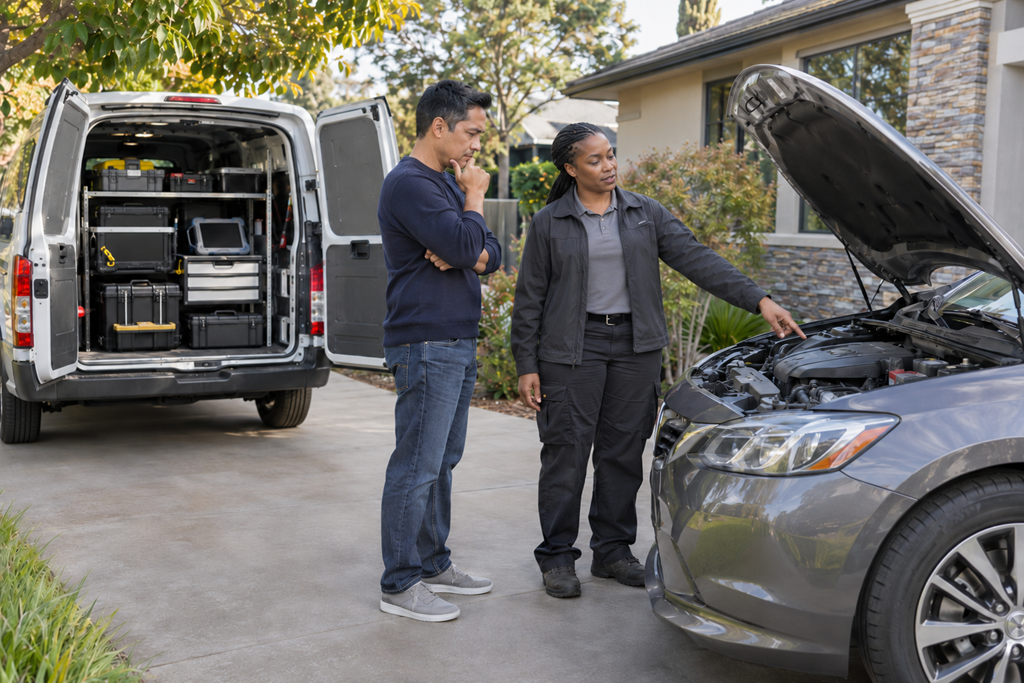
A mobile mechanic can be the right fit when your vehicle needs work that can reasonably be completed where it is parked, without the equipment or controlled environment of a repair shop. But convenience alone should not determine your choice. The type of problem, the location of your vehicle, the mechanic’s capabilities, and what happens if the repair cannot be finished on-site all deserve consideration before you schedule a visit.
For Sacramento-area drivers balancing work schedules, family responsibilities, transportation needs, and unexpected vehicle problems, having a mechanic come directly to the vehicle can be appealing. It may eliminate the need to arrange transportation to a repair shop or spend part of the day waiting for service.
However, there is an important difference between a service that is convenient to schedule and one that is appropriate for your vehicle's needs.
Understanding that difference can help you choose between mobile service, a traditional repair shop, or an initial diagnostic appointment without committing to work prematurely.
Start by identifying what you need the mechanic to accomplish
Before comparing mobile mechanics, consider what you actually need from the appointment.
Not every service call begins with the same objective. Some vehicle owners know exactly what maintenance they need, while others are dealing with an unexplained symptom.
Your situation may fall into one of three general categories.
You need a specific maintenance service
You may already know that your vehicle needs scheduled maintenance or a straightforward service that does not necessarily require a traditional automotive repair facility.
In this situation, your primary questions concern whether the mechanic offers the service, has the appropriate equipment, can work at your location, and can provide suitable parts or materials for your vehicle.
The scope of the appointment may be relatively easy to establish before the mechanic arrives.
You need help identifying a problem
Perhaps your vehicle struggles to start, makes an unfamiliar noise, displays a warning light, or behaves differently than usual.
Here, the objective is not necessarily to complete a repair immediately. It may be to determine what is causing the problem and what kind of repair is appropriate.
A mobile diagnostic appointment could be useful even if the eventual repair needs to take place at a shop.
You need a previously identified repair
You may have received a diagnosis from another automotive professional and are now exploring whether the recommended repair can be completed at your home or workplace.
In this case, ask whether the mobile mechanic accepts outside diagnoses or requires an independent evaluation before proceeding.
A previous diagnosis can provide helpful information, but the mechanic may need to confirm it before accepting responsibility for the repair.
Knowing which situation applies to you helps prevent misunderstandings about what the appointment is intended to accomplish.
Understand which types of work may be suitable for mobile service
Mobile mechanics vary considerably in experience, equipment, vehicle knowledge, and the services they offer.
One provider may concentrate on routine maintenance and minor repairs, while another may carry specialized diagnostic equipment and handle more involved mechanical work.
Depending on the vehicle, working conditions, and provider capabilities, mobile services may include:
- Battery testing and replacement.
- Certain starting and charging system repairs.
- Oil and filter changes.
- Spark plug and ignition component replacement.
- Some brake services.
- Selected belt, hose, and accessible component replacements.
- Warning light diagnostics.
- Certain pre-purchase vehicle inspections.
- Evaluations of vehicles that will not start.
These are examples of work that may be suitable for mobile service, not a universal list of what every mobile mechanic can perform.
Even a seemingly straightforward repair can become more complicated because of component accessibility, vehicle design, specialized tools, or additional problems discovered during inspection.
For example, replacing an accessible component on one vehicle may be a reasonable mobile repair. Replacing a similar component on another vehicle may require substantial disassembly or specialized equipment.
The name of the repair does not always tell you whether mobile service is appropriate.
Recognize when a repair shop may be the better environment
A traditional automotive repair shop offers capabilities that may be difficult to reproduce in a driveway or parking area.
Depending on the facility, these may include vehicle lifts, specialized diagnostic equipment, alignment systems, dedicated workstations, controlled lighting, and access to additional technicians.
A shop may be more appropriate when the work involves:
- Extensive engine or transmission repairs.
- Complicated electrical problems requiring prolonged testing.
- Repairs that require specialized lifting or support equipment.
- Wheel alignment or tire balancing.
- Extensive disassembly.
- Manufacturer-specific programming or calibration.
- High-voltage hybrid or electric vehicle work requiring specialized facilities.
- Multiple interconnected problems that require extended evaluation.
Some mobile mechanics may offer specialized services within these areas. Others may reasonably decline them.
A mechanic who explains that a particular repair requires a shop is not necessarily less qualified. Recognizing the limits of the available working environment can be a sign of sound professional judgment.
The important distinction is whether the provider has the resources to perform the specific work appropriately, not whether the business operates from a service vehicle or a permanent facility.
Compare your vehicle's condition with the available service options
The condition of your vehicle can influence whether mobile service, a shop appointment, or towing is the more appropriate next step.
Vehicle situation | Option worth considering | What to clarify |
|---|---|---|
Routine maintenance is due | Mobile mechanic | Service scope and vehicle compatibility |
Vehicle will not start at home | Mobile diagnostic visit | Whether the problem can be evaluated and potentially repaired on-site |
A specific repair has been confirmed | Mobile mechanic or repair shop | Equipment, accessibility, and repair requirements |
Warning lights or unexplained symptoms | Diagnostic appointment | Testing capabilities and possible follow-up |
Extensive mechanical work is anticipated | Repair shop | Specialized equipment and expected downtime |
Vehicle is in an unsafe or unsuitable location | Roadside assistance or towing | How to arrange appropriate professional assistance |
If you are experiencing serious braking or steering problems, overheating, smoke, a strong fuel smell, or another potentially dangerous condition, do not drive the vehicle simply to reach a more convenient service location. Arrange appropriate professional assistance.
A mobile mechanic may be able to evaluate a vehicle where it is already parked, provided the location is suitable. In other circumstances, towing may be necessary.
You do not need to determine the mechanical cause yourself. You do need to communicate the symptoms and circumstances accurately.
Consider whether your parking location is suitable for automotive work
One of the most overlooked differences between mobile mechanics and traditional repair shops is that the customer must provide an appropriate service location.
A mechanic may have the necessary experience and equipment but still be unable to perform the work because of where the vehicle is parked.
Private driveways and residential garages
A spacious, level driveway with adequate access around the vehicle may be suitable for many mobile services.
However, a narrow driveway, steep surface, crowded garage, or restricted overhead clearance may limit the work that can be performed.
The mechanic may also need nearby space to park a service vehicle and unload equipment.
Apartments and shared residential parking
Sacramento-area renters and residents of shared housing should consider whether automotive service is permitted in their parking areas.
Even when a vehicle is assigned a parking space, property management may restrict repair work, commercial service vehicles, or activities that could affect neighboring vehicles and common areas.
Clarifying these conditions beforehand can prevent an appointment from being interrupted or canceled.
Workplace parking areas
Having a vehicle serviced while you work may sound convenient, but the arrangement depends on property permission, parking access, vehicle access, and the nature of the work.
Consider whether you will be available if the mechanic needs additional authorization, vehicle information, or access to the keys.
Outdoor working conditions
Sacramento's hot summers and periods of seasonal rain can influence outdoor service conditions.
Limited shade, high temperatures, wet surfaces, or poor lighting may affect whether certain work can reasonably be performed at a particular time.
Ask the provider about location and weather requirements rather than assuming that every appointment can proceed under every condition.
Decide whether an initial diagnosis would be valuable on its own
A common misunderstanding is that paying a mobile mechanic to visit automatically means paying for a completed repair.
In practice, diagnosis and repair may be separate stages.
Consider a vehicle that occasionally fails to start. The underlying problem could involve the battery, starter, charging system, electrical connections, or another component.
A mobile mechanic may need to perform an evaluation before identifying which repair, if any, is appropriate.
The diagnostic appointment may result in:
- Identification of a problem that can be repaired during the visit.
- Identification of a problem that requires additional parts and another appointment.
- A recommendation for more extensive testing.
- A determination that the vehicle needs a repair shop.
- Findings that narrow the possible causes without establishing a definitive diagnosis.
None of these outcomes automatically means the appointment was unsuccessful.
An evaluation can still provide value when it helps you understand the problem, avoid an unsupported repair, or determine which service environment is appropriate.
Before booking, establish whether you would consider the diagnostic information worthwhile even if the vehicle remains unrepaired afterward.
That distinction can help you set realistic expectations for the service.
Compare the full cost of mobile service with the shop alternative
It is easy to assume that mobile mechanics should always charge less because they do not operate a traditional repair facility.
However, mobile businesses may have expenses associated with travel, service vehicles, portable equipment, parts transportation, scheduling, and working at different locations throughout the day.
A traditional shop has different operating expenses and may be able to complete certain work more efficiently because its equipment and resources are already in place.
Neither business model is automatically less expensive.
Understand how the mobile service is priced
Before scheduling, determine whether the estimate or quoted charge includes:
- Travel or service-call fees.
- Diagnostic testing.
- Labor.
- Replacement parts and materials.
- Applicable taxes or other charges.
- Additional visits, when necessary.
- Any diagnostic fee credit toward an approved repair.
Also ask whether a fee remains payable if the mechanic determines that the repair cannot be performed at your location.
A lower initial appointment fee may not represent a lower overall cost if it covers a narrower evaluation or requires additional visits.
Include the cost of getting your vehicle to a shop
When comparing options, consider transportation and logistical expenses alongside the repair estimate.
For example, a shop visit might involve arranging a tow, coordinating a ride home, taking time away from work, or leaving the vehicle overnight.
Mobile service could reduce some of those inconveniences when the work is suitable for on-site completion.
On the other hand, paying for a mobile evaluation followed by towing and a separate shop diagnosis could increase the overall expense.
The more uncertain or complex the vehicle problem, the more important it becomes to understand what each service option is likely to accomplish.
Evaluate the mechanic's capabilities, not just the service advertised
The term “mobile mechanic” describes how a service is delivered. It does not, by itself, establish the provider's qualifications or suitability for a particular vehicle.
When comparing Sacramento-area mobile mechanics, consider whether the provider regularly works on your vehicle's make, model, age, and type of problem.
A mechanic experienced with conventional gasoline-powered vehicles may not necessarily have the specialized knowledge or equipment required for certain European vehicles, diesel engines, hybrids, or electric vehicles.
The same principle applies to different mechanical and electrical systems.
Ask about relevant experience, available diagnostic equipment, business insurance, and professional qualifications.
California vehicle owners can also use the California Bureau of Automotive Repair's online resources to verify an automotive repair business's registration status and review consumer information about estimates, repair authorization, and service documentation.
Reviews can provide additional context, particularly when customers describe how the provider handled unexpected findings, explained repair options, communicated delays, or responded to concerns after the appointment.
Look beyond reviews that mention only convenience or fast arrival. Those qualities may matter, but they do not establish whether the mechanic is equipped to address your particular problem.
Find out what happens if the repair cannot be completed on-site
A mobile mechanic appointment may begin with a reasonable expectation that the repair can be completed, only for the situation to change after inspection.
The mechanic might discover an additional problem, find that a replacement part is unavailable, encounter an access limitation, or determine that specialized equipment is necessary.
Before scheduling, understand how the provider handles these situations.
Will the mechanic return with additional parts? Does the business work with a repair facility? Would you be responsible for arranging towing? Will you receive diagnostic findings that you can share with another mechanic?
It is also worth asking how unfinished work would be handled if the vehicle could not be returned to an operable condition during the appointment.
These questions become particularly important when the vehicle is your primary transportation.
If you depend on it for commuting, taking children to school, attending appointments, or operating a small business, consider making alternative transportation arrangements when the extent of the repair is uncertain.
A mobile appointment can be a practical choice without necessarily being a complete solution. Understanding the possible next steps makes that arrangement easier to evaluate.
Understand who is responsible for the work after the mechanic leaves
With a traditional repair shop, you generally know where to return if a concern arises after the repair.
Mobile service may involve a different follow-up process.
Before approving work, ask whether the business provides a warranty on parts, labor, or both, and request clarification about how warranty-related concerns are handled.
Important distinctions include whether:
- The mechanic returns to your location for follow-up service.
- Additional travel or diagnostic charges could apply.
- Warranty coverage depends on who supplied the replacement parts.
- Another technician may handle the follow-up.
- You will receive written documentation of the completed work.
If you purchase your own replacement parts, clarify whether the mechanic accepts customer-supplied components and how that arrangement affects responsibility if a part fails or the repair needs to be repeated.
You should also understand which business is responsible for the repair if you book through an online service platform that dispatches independent mechanics.
These details may not influence the initial appointment, but they can become important if the original concern returns.
Prepare the information that helps a mechanic determine service fit
You can make the first conversation more productive without attempting to diagnose or repair the vehicle yourself.
Have the following information available when contacting a mobile mechanic:
- The vehicle's year, make, model, and approximate mileage.
- The engine type or vehicle identification number, if requested.
- A plain-language description of the symptoms.
- When the problem began and whether it happens consistently.
- Any warning lights or messages you have noticed.
- Relevant recent maintenance or repair history.
- Whether the vehicle starts and its last known operating condition.
- The parking location and any access restrictions.
- Previous diagnostic findings or repair estimates, if available.
- Any scheduling or transportation limitations that affect the appointment.
Describe what you have observed rather than presenting an assumed diagnosis.
For example, explaining that your vehicle sometimes fails to start after being parked overnight gives the mechanic more useful context than insisting that a particular component needs replacement without supporting findings.
Photographs of the parking area or existing dashboard warnings may also help the provider understand the situation before arriving. Do not attempt to reproduce a potentially dangerous symptom just to document it.
Questions worth asking before booking a mobile mechanic
You do not need to conduct a lengthy interview with every provider. A focused conversation should help establish whether mobile service is appropriate for your needs.
Consider asking:
- Do you regularly work on vehicles like mine?
- Based on what I have described, would you recommend mobile service or a repair shop?
- Will the appointment involve diagnosis, repair, or both?
- What equipment or working conditions will you need at my location?
- What will I be charged if the repair cannot be completed on-site?
- How will you explain unexpected findings before performing additional work?
- What happens if the vehicle needs more extensive testing or shop-based repairs?
- What parts and labor warranty do you offer, and how is follow-up service handled?
- Will I receive an itemized estimate and documentation of the completed work?
Pay attention to whether the answers address your specific vehicle and circumstances.
An appropriate provider may not be able to tell you exactly what is wrong before inspecting the vehicle. However, the business should be able to explain how it approaches that uncertainty.
Warning signs that deserve a second look
Mobile service can be particularly appealing when transportation problems disrupt your normal routine. That inconvenience can also make it tempting to accept the first available appointment without reviewing the arrangement carefully.
Consider slowing down or contacting another provider if you encounter:
- Promises to complete virtually any automotive repair at any location.
- A definitive diagnosis without sufficient supporting information or evaluation.
- Unclear business identity or difficulty verifying registration.
- Reluctance to explain service-call or diagnostic charges.
- Pressure to approve replacement parts before the need is established.
- Dismissal of reasonable questions about parking conditions or equipment limitations.
- No understandable process for approving additional work.
- Unclear warranty or follow-up arrangements.
- Unwillingness to provide appropriate service documentation.
An uncertain repair price or the possibility of additional testing is not necessarily a warning sign. Automotive problems can be difficult to evaluate before a technician examines the vehicle.
The more meaningful concern is whether uncertainty is being communicated responsibly or replaced with unsupported promises.
Use five considerations to make your decision
Before choosing mobile service, evaluate how well the following considerations align with your situation.
Consideration | What supports choosing a mobile mechanic |
|---|---|
Vehicle needs | The required evaluation or repair is within the provider's mobile capabilities. |
Working location | The vehicle is accessible, and service is permitted and appropriate at that location. |
Provider experience | The mechanic has relevant experience, equipment, and qualifications. |
Overall value | The anticipated service, costs, and convenience make sense compared with the shop alternative. |
Follow-up arrangements | You understand what happens if additional repairs, another visit, or warranty service becomes necessary. |
If several of these considerations remain unresolved, an initial conversation or diagnostic appointment may be more appropriate than committing to a specific repair.
If the required work clearly exceeds the mobile provider's capabilities, arranging a shop appointment directly may be the more practical approach.
Choose the service environment that fits the vehicle's needs
A mobile mechanic does not need to replace your traditional repair shop to be a useful option.
You might use mobile service for suitable maintenance, accessible repairs, or initial evaluations while continuing to rely on a repair facility for more complicated mechanical work.
For Sacramento-area vehicle owners, the most useful approach is to treat mobile service as another way to obtain appropriate automotive care rather than assuming it is always the most convenient, affordable, or complete solution.
When the mechanic's capabilities, working location, vehicle condition, and service expectations align, mobile service can make considerable practical sense.
When they do not, choosing a repair shop is not a missed opportunity. It is simply choosing a service environment better suited to the work.
The goal is not merely to find a mechanic willing to come to your vehicle. It is to find an appropriate way to have your vehicle evaluated and serviced.