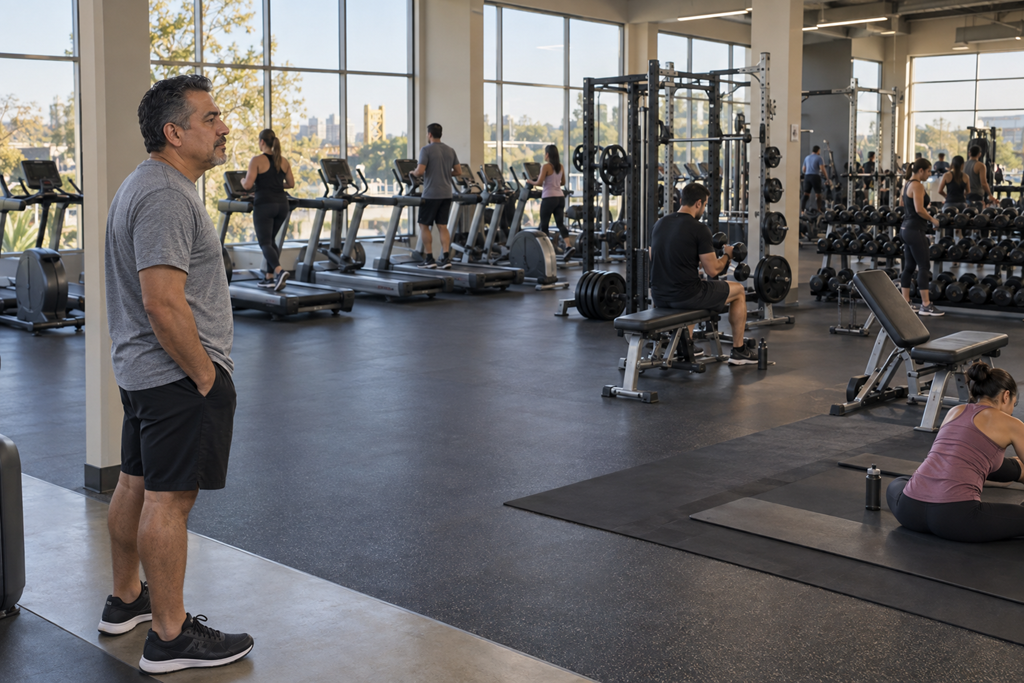
A good fitness center is not simply the one with the most equipment, the newest machines, or the lowest advertised rate. Before joining, look at whether the space actually supports the way you expect to work out: when you would visit, what equipment you would use, how crowded key areas become, how the facility is maintained, and whether the membership terms are clear.
It is easy to be impressed during a quick tour. The equipment may be neatly arranged, the front desk may feel welcoming, and the list of amenities may sound extensive. But joining a fitness center is usually less about what looks appealing for 15 minutes and more about what will make sense during an ordinary week.
For Sacramento-area residents comparing fitness centers, the useful question is not simply, “Is this a nice gym?” It is, “Would this place realistically work for the way I plan to use it?”
Visit When You Would Actually Work Out
A fitness center can feel very different depending on when you visit.
A midmorning tour may show plenty of open equipment and quiet workout areas. If you expect to exercise after work, however, that may not tell you much about the experience you would actually have.
When possible, spend some time at the facility during the hours you would normally use your membership. You do not necessarily need to conduct a formal inspection. Simply notice what the environment is like.
Look at whether the equipment you care about appears reasonably accessible, whether people seem to be waiting for popular areas, and whether moving between different parts of the facility feels comfortable.
This matters because a fitness center can have an impressive amount of equipment overall while still feeling inconvenient if the particular equipment you want is consistently difficult to use at your preferred time.
A realistic visit often tells you more than an amenities list.
Pay Attention To The Parts Of The Gym You Would Actually Use
A long list of features can make a membership sound valuable, but not every feature has equal importance.
One person may care primarily about treadmills and stationary bikes. Someone else may spend most of a workout around free weights, resistance machines, stretching areas, or group classes.
Focus on your likely routine.
If you mainly expect to use strength equipment, the existence of a pool or specialty room may have little effect on your decision. Likewise, an extensive weight area may not matter much if your routine centers on cardio equipment and classes.
This can help keep the decision practical. Instead of asking whether the fitness center has “a lot,” consider whether it has enough of what you are actually likely to use.
The Layout Can Affect The Experience More Than It First Appears
Two fitness centers with similar equipment can feel very different because of how that equipment is arranged.
Notice the physical relationship between the areas you would use.
Can you move naturally from one part of your workout to another? Are exercise areas packed closely together or reasonably spaced? Is there an appropriate place to stretch or warm up without blocking circulation? If you would use lockers or personal-belongings storage, does the transition from those areas to the workout floor seem convenient?
None of these details needs to be perfect.
The point is to notice whether the environment feels workable rather than assuming that every facility with similar equipment will provide the same experience.
For someone who expects to visit several times a week, small layout frustrations can become much more noticeable over time.
Look Beyond The Front Lobby When Judging Maintenance
The reception area is often one of the most polished parts of a fitness center. It should not be the only area you notice.
Walk through the spaces that receive repeated daily use.
Equipment surfaces, flooring, locker areas, restrooms, stretching spaces, drinking stations, and storage areas can give you a broader sense of how the facility is maintained.
You are not looking for a building that appears untouched. A frequently used fitness center will naturally show signs of normal use.
What matters more is whether the overall environment appears consistently cared for and whether obvious maintenance concerns seem to be addressed rather than ignored.
If you notice something you are unsure about, asking how equipment or facility issues are handled can be more informative than trying to make assumptions from a single observation.
Notice How The Facility Feels During Normal Use
Atmosphere is difficult to capture on a membership brochure.
Some fitness centers feel energetic and social. Others feel quieter and more independent. Some have music playing prominently, while others may have distinct activity levels in different areas.
There is no universally correct atmosphere.
The better question is whether the environment would make it reasonably easy for you to follow your preferred routine.
Notice how people move through the facility, whether workout areas feel unusually congested, how staff members interact with members, and whether the overall setting feels compatible with the way you prefer to exercise.
A facility can be well run and still be a poor personal fit. Recognizing that distinction can make comparing local options easier.
Try The Real Experience When A Trial Visit Is Available
If a fitness center offers an appropriate guest visit, trial period, or other opportunity to experience the facility before joining, use that time to test your normal routine rather than trying every amenity.
Go through the type of workout you would realistically perform.
You may quickly notice things that are difficult to recognize during a guided tour: equipment availability, walking space, noise, temperature, storage convenience, transitions between workout areas, or how easy it is to settle into the environment.
A trial visit is most useful when you treat it as a preview of ordinary membership rather than a special occasion.
The question is not whether you can have one good workout there. It is whether the environment seems capable of supporting many ordinary workouts over time.
Understand What The Membership Actually Includes
A fitness center can feel like a good physical fit while the membership details remain unclear.
Before joining, make sure you understand what you are agreeing to.
Ask what is included in the membership level you are considering, whether certain classes or areas have separate requirements or charges, how billing works, what the cancellation process involves, and whether there are other fees or conditions you should know about.
If something is explained verbally, compare that explanation with the written membership terms before committing.
This is not about expecting problems. It is simply easier to make a decision when the financial and practical expectations are understandable from the beginning.
A Few Useful Questions Can Reveal A Lot
You do not need to conduct a lengthy interview with the staff. A few practical questions can help fill gaps that are difficult to answer by observation alone.
Consider asking:
- When is the fitness center typically busiest?
- Are there times when certain equipment areas are especially busy?
- What is included with this membership level?
- Are any classes, amenities, or services separate from the basic membership?
- Is there a guest or trial option before joining?
- How are equipment problems reported and handled?
- What are the membership cancellation and billing terms?
- Are there any additional fees I should understand before enrolling?
Clear, straightforward answers can make comparison easier. If basic questions repeatedly produce vague or changing explanations, it may be worth slowing down before making a commitment.
Do Not Let One Impressive Feature Decide Everything
A common mistake is allowing one standout feature to dominate the decision.
It could be a particularly attractive facility, a large cardio section, a pool, an extensive free-weight area, premium locker rooms, or a promotional membership offer.
Those features may genuinely matter to you. They simply should not distract from the ordinary experience you will have after joining.
A beautiful facility that is inconvenient during your usual workout time may not serve you as well as a simpler facility that consistently fits your schedule and routine.
Likewise, a low advertised membership rate may not tell the whole story if you have not yet reviewed what is included and how the membership works.
The strongest comparison usually comes from looking at the facility as something you would repeatedly use, not something you are visiting once.
Think About Whether The Membership Fits Your Routine, Not An Idealized One
People sometimes evaluate a fitness center based on the routine they hope they will adopt rather than the routine they are realistically likely to maintain.
That can make extras seem more important than they really are.
If you expect most visits to involve 45 minutes of cardio and basic strength training, evaluate how well the facility supports that pattern. If scheduled classes are central to your plans, look closely at the class experience and whether the schedule works for you.
The more closely your evaluation resembles your actual habits, the easier it becomes to separate meaningful features from attractive extras.
The Best Evaluation Is Usually A Practical One
Choosing a fitness center does not require finding a facility with every possible feature.
You are trying to determine whether the place makes sense for your schedule, preferred activities, comfort level, and membership expectations.
For Sacramento-area residents comparing local fitness centers, seeing the facility during realistic conditions can make the decision much easier. Observe the areas you would use, pay attention to how the space functions, understand the membership terms, and ask about anything that remains unclear.
A fitness center that fits your real routine is usually more useful than one that simply makes the strongest first impression.