Evaluating a mobile mechanic before scheduling repairs is less about judging how quickly someone can come to you and more about understanding how clearly they explain the work, what they can realistically handle at your location, and what happens if the repair turns out to be more involved than expected. A good fit should leave you with a clear sense of the service scope, the communication process, and what you are agreeing to before any work begins.
Mobile repair can be appealing because the mechanic comes to the vehicle instead of requiring you to bring the vehicle to a traditional shop. That convenience can also make it easy to focus mainly on availability: Who can come out soon? Who can look at the car where it sits?
Those questions matter, but they do not tell you much about how the provider approaches the actual repair decision.
Before scheduling, it helps to understand whether the mechanic has taken enough time to understand the situation, whether the work appears suitable for mobile service, and how the provider handles uncertainty when the cause of a problem is not yet clear.
Convenience Does Not Automatically Mean the Service Is a Good Fit
A mobile mechanic may save you from arranging a trip to a repair facility, but the ability to come to your location is only one part of the service.
The more useful question is whether the provider appears prepared to handle your particular situation in that location.
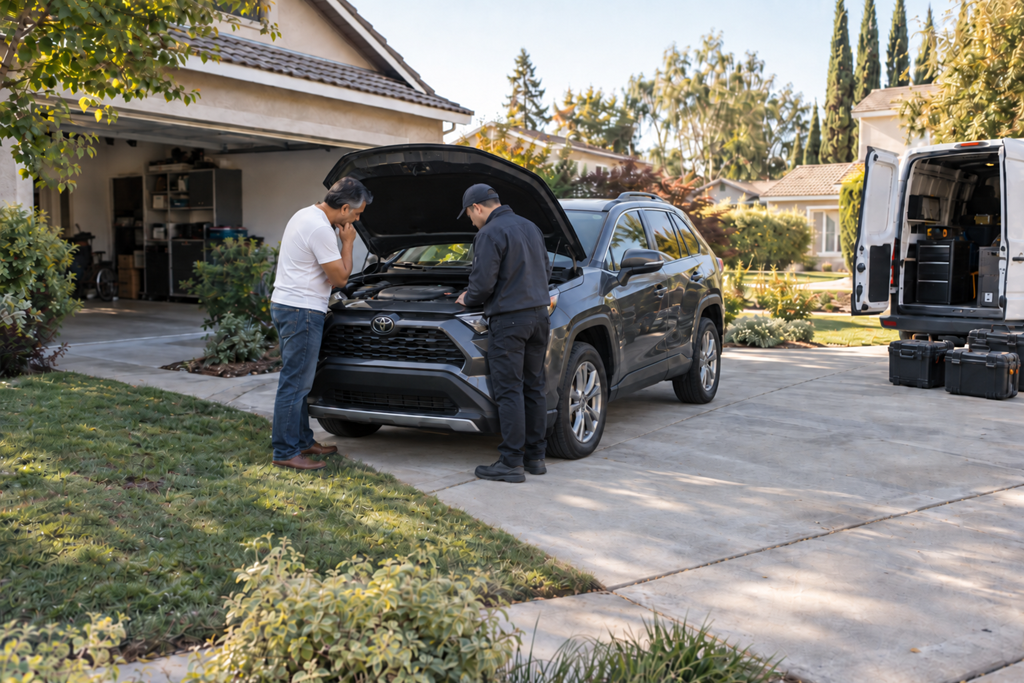
A Sacramento resident with a vehicle parked in a residential driveway may have a very different service situation from someone whose vehicle is in an apartment parking space, at a workplace, or along a curb. The repair itself matters, but so do access, available working space, vehicle position, and the equipment the mechanic expects to use.
A provider does not need to know every detail before arriving. Some problems cannot be understood without examining the vehicle.
What matters is whether the mechanic can explain what they know so far, what still needs to be determined, and whether the visit is primarily for diagnosis, repair, or both.
Notice How the Mechanic Defines the Job Before Accepting It
One useful sign is how the provider responds when you first describe the problem.
A thoughtful mobile mechanic may ask about the vehicle, what you have noticed, where the vehicle is located, whether it can be moved, and whether anyone has already inspected or worked on the issue.
Those questions do not guarantee that the mechanic will immediately know what is wrong. In fact, a provider who acknowledges that more information is needed may be giving you a more realistic picture than someone who promises a specific repair based on a short description.
Try to separate two questions:
Can this mechanic come look at the vehicle?
and
Has this mechanic already determined exactly what the vehicle needs?
Those are not always the same thing.
An initial visit may reveal information that changes the expected repair. Knowing how the mechanic handles that possibility can be more useful than trying to get absolute certainty before the vehicle has been examined.
The Place Where the Vehicle Sits Can Affect the Appointment
With mobile service, the repair location becomes part of the service environment.
Consider where the vehicle is parked and whether there is reasonable room around it. A tight parking space, sloped surface, busy access area, shared parking arrangement, or other physical limitation may affect what work can realistically be performed there.
You do not need to decide on your own whether the location is suitable.
Instead, describe the setting accurately before scheduling and let the provider explain whether it creates any limitations for the work being discussed.
This is especially useful when the mechanic would otherwise arrive expecting one kind of working environment and discover something very different.
A few extra details beforehand can help both sides develop more realistic expectations for the visit.
Make Sure You Understand What the Appointment Actually Includes
One of the easiest misunderstandings with mobile repair is assuming that scheduling an appointment automatically means the vehicle will be completely repaired during that visit.
Sometimes that may happen. Other times, the first visit may involve evaluating the problem, confirming what parts are needed, or determining whether the repair is practical at the vehicle's current location.
Before scheduling, ask what the provider expects the visit to include.
You may want to understand whether there is a separate diagnostic or service-call charge, whether an estimate will be discussed before additional work begins, how parts are handled, and how the provider communicates if the scope changes.
The goal is not necessarily to obtain an exact final total before the vehicle has been inspected.
The goal is to know how the provider moves from uncertainty to an approved repair.
That distinction can prevent a lot of confusion.
Pay Attention to How Uncertainty Is Communicated
Vehicle problems do not always fit neatly into a short phone description.
A sound, warning light, starting problem, leak, vibration, or other symptom may have more than one possible cause. A mobile mechanic may need to inspect or test the vehicle before explaining what repair is appropriate.
That uncertainty is not automatically a problem.
The more important question is how the provider talks about it.
There is a meaningful difference between:
“I would need to inspect it before I can tell you exactly what it needs.”
and a provider who gives a definite answer without enough information while being unable to explain how that conclusion was reached.
Before scheduling, you are not trying to test whether the mechanic can diagnose everything remotely. You are evaluating whether the provider communicates the limits of what can reasonably be known before the appointment.
Ask What Happens If the Repair Becomes More Involved
This is one of the most useful questions to discuss with a mobile mechanic before work begins.
Mobile service naturally has practical limits. A repair that initially appears manageable at the vehicle's location may turn out to require different equipment, additional parts, more space, or a different service environment.
That does not necessarily mean anyone made a mistake.
What matters is whether there is a clear process when the original plan changes.
Ask how the mechanic would handle a situation in which the vehicle cannot be repaired as expected during the visit. Find out when they would stop, what they would explain to you, and whether you would have a chance to discuss the next step before additional work or charges are added.
A clear answer can tell you a great deal about how the provider manages unexpected situations.
A Few Questions Can Reveal a Lot Before You Schedule
You do not need to conduct a long interview. A short conversation can often give you enough information to decide whether you are comfortable moving forward.
Useful questions can include:
- What information do you need from me before deciding whether this can be handled as a mobile repair?
- Is this appointment expected to be diagnostic, a repair visit, or possibly both?
- Is the location where my vehicle is parked suitable for the work you expect to perform?
- What charges should I understand before you arrive?
- How will you handle it if you discover that additional work or parts are needed?
- What happens if the repair cannot reasonably be completed at my location?
The value of these questions is not just in the answers themselves.
Notice whether the mechanic answers clearly, distinguishes what is known from what still needs to be determined, and gives you enough information to understand what you are scheduling.
Vague Answers Are More Important Than a Polished Sales Pitch
A provider does not need to sound polished or rehearsed to communicate well.
Straightforward answers are usually more useful than impressive promises.
It may be worth slowing down if you cannot get a clear explanation of what the appointment is for, what the initial charges cover, how additional work is approved, or what happens if the problem exceeds what can be handled onsite.
Similarly, be cautious about treating speed alone as proof that a provider is the right choice.
A mechanic who can arrive quickly may be convenient, but availability does not answer questions about scope, communication, or how unexpected findings will be handled.
The evaluation is not about finding perfection. It is about reducing avoidable uncertainty before someone begins working on your vehicle.
You Do Not Need Every Answer Before Booking
There is a balance here.
It would be unrealistic to expect a mobile mechanic to know exactly what is wrong with every vehicle before seeing it. Asking for absolute certainty can create the wrong expectation on both sides.
You are looking for something simpler: a provider who can explain what they know, what they need to inspect, what the visit is expected to accomplish, and how decisions will be handled if the situation changes.
That gives you a much better basis for evaluating the service than convenience alone.
For Sacramento-area consumers considering mobile repair, the most useful pre-scheduling conversation is often the one that makes the boundaries of the service easier to understand. When you know what the mechanic expects to do, what the location allows, how costs and added work will be discussed, and what happens if the repair cannot be completed onsite, you can schedule with a clearer picture of what comes next.