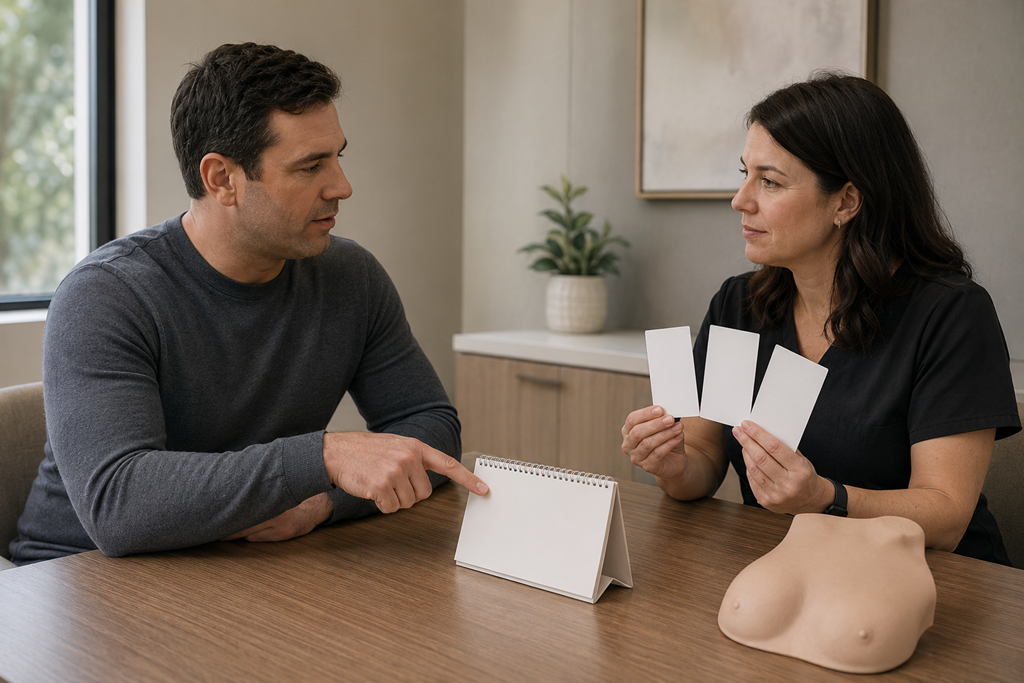
Before meeting with a gynecomastia surgeon, separate your questions into three subjects: where scars may appear, what the healing period may involve, and what result is realistically possible for your body.
These topics overlap, but they are not the same. A small incision does not automatically mean a simple recovery. Early swelling does not show the final contour. A strong improvement does not necessarily mean perfect symmetry or completely invisible scars.
Preparing specific questions helps you move beyond general reassurance and understand what the proposed surgery could mean in your daily life.
It Is Reasonable To Ask Detailed Appearance Questions
Some men hesitate to ask about scars or cosmetic results because they worry about sounding overly concerned with appearance. Others feel uncomfortable questioning a surgeon’s expectations.
These concerns are part of the decision.
Gynecomastia surgery is intended to change the appearance and contour of the chest, so it is appropriate to ask where incisions may be placed, how noticeable they could become, and what the surgeon believes can realistically be improved.
The goal is not to demand a guarantee. It is to understand the tradeoffs well enough to decide whether the possible result is worth the surgery, recovery, and permanent changes involved.
Ask Where Your Scars May Be Located
The phrase “minimal scarring” may sound reassuring, but it does not tell you where an incision may be placed or how long it may be.
Gynecomastia surgery can involve liposuction, tissue excision, skin removal, or a combination of techniques. Incision patterns vary according to the tissue being treated, the amount of excess skin, whether the areola needs adjustment, and the surgeon’s planned approach.
Useful questions include:
- Where would you expect to place the incisions in my case?
- How long might each incision be?
- Would any scar extend beyond the edge of the areola?
- Could excess skin require a longer incision?
- How might my skin characteristics or previous scarring affect the appearance?
- Can I see healed examples from patients whose starting anatomy and procedure were similar to mine?
Ask the surgeon to point out the likely locations on an anatomical model or photograph. That can be more informative than hearing that the scars will be “small” or “well hidden.”
Surgical incision lines are permanent, although they commonly become less noticeable as they mature. The degree of fading and visibility can vary.
Clarify What “Healing” Means
Healing is not one single milestone.
A person may feel comfortable walking around before being ready to lift heavy objects. He may return to desk work before resuming a physically demanding job. The incisions may close before swelling has fully resolved, and the chest may continue changing after normal activities have resumed.
Instead of asking only, “How long is recovery?” describe the activities that matter in your life.
Tell the provider whether your routine includes:
- Lifting, pushing, pulling, or overhead work
- Driving for long periods
- Caring for children or another family member
- Sleeping on your side or stomach
- Strength training or upper-body exercise
- Wearing fitted uniforms or protective equipment
- Traveling shortly after the procedure
Then ask when each activity may reasonably be resumed and what could cause that estimate to change.
Questions about dressings, stitches, compression garments, activity restrictions, follow-up appointments, and when to contact the surgical team are all appropriate parts of recovery planning.
Ask What The Early Chest May Look And Feel Like
People can become discouraged when they expect to see a finished chest immediately after surgery.
The early appearance may be affected by swelling, bruising, dressings, compression, healing incisions, and temporary differences between the two sides. The final result may take several months to become apparent as swelling settles and incision lines mature.
Before surgery, ask:
- What appearance would be considered normal during early healing?
- Which changes tend to improve with time?
- What symptoms or visual changes should prompt a call to the office?
- How often will you evaluate my healing?
- At what point do you usually begin assessing the longer-term contour?
- When would it be reasonable to judge the result?
The provider should explain both the expected course and the situations that require professional attention. Do not rely on a general recovery timeline found online as a substitute for instructions based on your procedure and health history.
Define What A Successful Result Means In Your Case
“Flatter chest” can mean different things to different people.
One patient may mainly want less projection under a fitted shirt. Another may be concerned about puffy areolas, loose skin, uneven fullness, or the transition between the chest and surrounding areas.
Explain what you notice and what change matters most to you. Then ask the surgeon to describe what appears achievable rather than simply confirming that the surgery will “look good.”
Helpful questions include:
- Which part of my chest shape is most likely to improve?
- What feature may not change as much as I expect?
- How much symmetry is realistic?
- How could my skin firmness affect the final contour?
- Is there a possibility of remaining fullness, loose skin, indentation, or contour variation?
- Could the nipple or areola position look different after healing?
- How do you evaluate whether a result needs more time or further treatment?
A thoughtful answer should include limits and uncertainties, not only benefits. Surgical risks, possible complications, and likely outcomes should be discussed before a patient gives informed consent.
Use Before-And-After Photographs Carefully
Photographs can help you understand a surgeon’s work, but they should not be treated as a catalog from which you select a guaranteed chest shape.
When reviewing examples, ask whether the patient had a similar amount and distribution of tissue, comparable skin firmness, and the same general surgical technique being considered for you.
Also ask:
- How long after surgery was the final photograph taken?
- Was the patient still healing?
- Are the posture, camera distance, and lighting consistent?
- What differences between that patient and me could affect the outcome?
- Is this a typical result for a comparable case or an unusually favorable example?
The most dramatic transformation may not be the most useful comparison. A less dramatic case that closely resembles your starting anatomy can sometimes provide more realistic information.
Do Not Let One Question Replace Another
Several common misunderstandings can leave a person less prepared than he realizes.
“The incision is small, so recovery should be easy”
Incision length alone does not explain how much tissue is being treated, whether compression or drains may be involved, or how long physical restrictions may apply.
“I can see the change immediately, so that must be the result”
An initial reduction may be visible, but swelling and healing can temporarily affect the contour. Early appearance and final appearance are different subjects.
“The scar will be hidden, so I will never notice it”
A scar may be positioned along a natural border and still remain visible under certain lighting, at close range, or while it is maturing.
“A before-and-after photo shows what I will look like”
The photograph shows what happened for another patient. It can demonstrate possibilities and technique, but it cannot promise the same result for a different body.
“The provider will tell me everything without being asked”
A qualified provider should explain the procedure and its risks, but the consultation becomes more useful when you explain your priorities, responsibilities, and concerns.
Pay Attention To How The Questions Are Answered
The quality of communication can be as important as the specific wording of an answer.
A useful explanation should connect the proposed technique to your anatomy. It should distinguish likely outcomes from possibilities and acknowledge that recovery can vary.
Be cautious when communication depends on absolute statements such as:
- There will be no visible scar.
- You will look completely normal right away.
- Your chest will be perfectly symmetrical.
- Everyone heals on the same schedule.
- You do not need to think about complications.
- You have to schedule immediately to receive the proposed result.
A provider does not need to predict every detail with certainty. However, you should receive enough information to understand the plan, the limitations, the recovery expectations, and what support is available if healing does not go as expected.
Bring Questions That Reflect Your Actual Life
A long list copied from the internet may be less useful than a short list connected to your circumstances.
Before a Sacramento-area consultation, write down:
- The chest feature you most want to discuss
- Your biggest concern about scarring
- The work, exercise, or caregiving activity that may affect recovery
- An upcoming responsibility that could influence timing
- What you would consider a worthwhile improvement
- Anything about your past healing or scarring that concerns you
Leave space to take notes. If a provider uses an unfamiliar medical term, ask for a plain-language explanation rather than assuming you understand it.
You may also bring a trusted adult partner, relative, or friend if having another listener would help you remember the discussion. The consultation should give you room to think, not pressure you to make an immediate decision.
Better Questions Lead To More Realistic Expectations
Preparing questions about scarring, healing, and results is not about predicting the future perfectly. It is about understanding the proposed tradeoffs before committing to surgery.
Ask where the scars may be. Ask how recovery could affect your responsibilities. Ask what improvement is realistic for your anatomy and when the result can be evaluated fairly.
A qualified provider should address personal risks, candidacy, recovery instructions, and expected outcomes based on your individual situation. This article is educational and is not a substitute for medical advice.