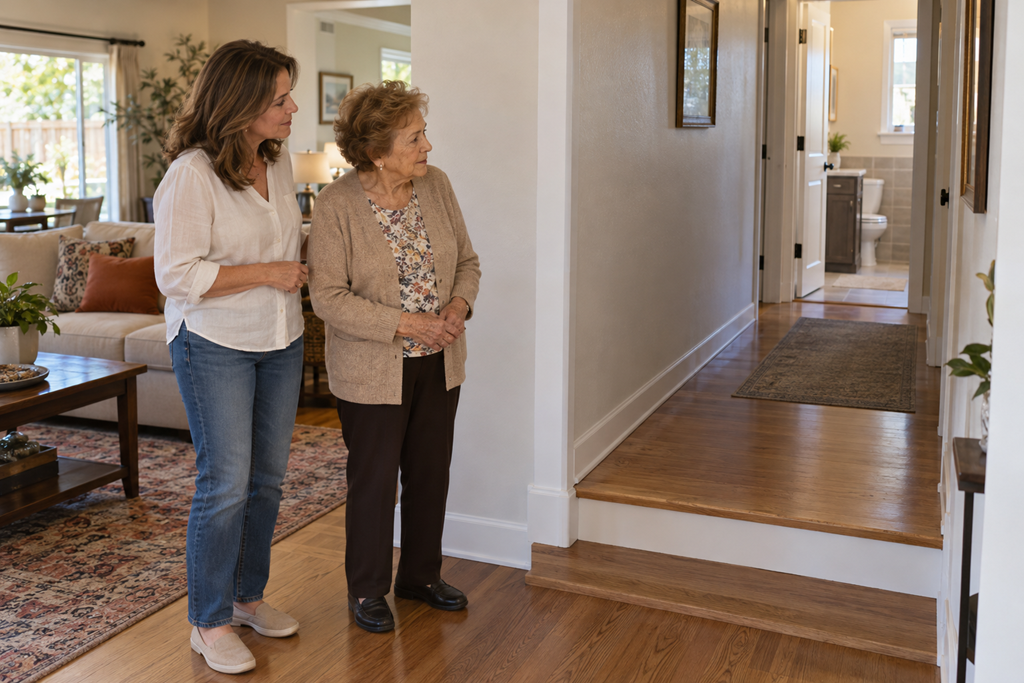
Falls, mobility, and home layout are worth discussing early when a family is considering senior care services because home surroundings can affect what kind of help an older adult may need. A person may manage familiar routines comfortably while still finding certain doorways, steps, bathrooms, or walking routes difficult. Talking about those details before choosing support can make provider conversations more useful and help everyone understand what assistance is realistic.
For many Sacramento-area families, conversations about senior care begin with familiar concerns. An older parent may need help preparing meals, getting to appointments, managing household routines, or having someone available for companionship.
Questions about mobility and the home's physical layout may come later, especially when the older adult has lived in the same house for years.
However, understanding how someone moves through their home can be just as important as identifying the daily tasks they need help completing.
Familiar Surroundings Do Not Always Mean Every Routine Is Easy
An older adult may feel comfortable in a home they know well, even when certain activities have gradually become more difficult.
Perhaps the bedroom is upstairs, the bathroom has a narrow entrance, or the route from the living room to the kitchen includes a small step.
These details may not seem significant during a general conversation about companionship or household assistance.
But they can influence how senior care services should be discussed and whether a provider's available support matches the household's needs.
The important distinction is that feeling comfortable at home and being able to navigate every part of that home easily are not necessarily the same thing.
Recognizing this difference does not mean assuming that an older adult needs extensive assistance. It means understanding their actual routines before making decisions about support.
Why Fall Concerns Belong In The First Conversation
Families sometimes wait until a fall occurs before discussing mobility-related concerns with a senior care provider.
A more useful approach is to talk about existing difficulties, previous falls, or concerns about moving through the home before arranging services.
The conversation might include situations such as getting out of bed, walking to the bathroom, using stairs, or moving between indoor and outdoor areas.
These are ordinary activities, but they can reveal important differences between what an older adult can manage independently and where assistance may be appropriate.
It is also helpful to distinguish between a service provider who offers companionship and routine household support and one whose staff can provide appropriate hands-on assistance.
Not every senior care service includes the same responsibilities, staff preparation, or level of physical support.
If someone needs assistance with transfers, walking, or other mobility-related activities, families should ask providers to explain whether those tasks fall within their services and how staff determine whether they can provide that assistance appropriately.
Concerns about the causes of falls, changes in walking ability, or an individual's medical risks should be discussed with a qualified healthcare professional rather than assessed independently by a senior care worker or family member.
The Home Layout Can Change What Support Looks Like
Two older adults with similar daily routines may need different arrangements because their homes are organized differently.
One person may live in a single-story house with a bedroom and bathroom close together. Another may have a similar level of independence but need to navigate stairs, longer hallways, or a separate entrance to reach commonly used spaces.
Even furniture placement and the distance between frequently used rooms can become relevant when discussing assistance.
For Sacramento-area households, the practical question is not whether a home is old, new, large, or small.
It is whether the existing layout supports the older adult's current routines and the type of assistance being considered.
This can also affect conversations about caregiver scheduling. For example, help needed at particular times of day may be different from general companionship during a flexible afternoon visit.
Understanding the physical environment gives families a more accurate starting point when comparing service arrangements.
Small Difficulties Are Easy To Leave Out
One reason mobility concerns can be overlooked is that older adults and family members may describe support needs differently.
An older adult might say they manage well because they can complete most daily activities independently.
A family member may notice that certain activities take longer or that the person has begun avoiding part of the home.
Neither observation necessarily tells the whole story.
An older adult might also adapt routines without mentioning those adjustments. Using a different bathroom, avoiding a staircase, or limiting trips outside may become so familiar that these choices no longer seem worth discussing.
These patterns do not automatically establish a particular care requirement.
They do, however, provide useful information about how daily life is actually working.
When appropriate, involving the older adult directly in the conversation can help distinguish personal preferences from activities that have become difficult.
The goal is to understand support needs without unnecessarily limiting the person's independence or overlooking their preferences.
What To Ask A Senior Care Provider Before Arranging Services
Once the household has a clearer picture of everyday movement and the home's layout, a few focused questions can make provider discussions more productive.
Consider asking:
- What types of mobility-related assistance are included in your services?
- How do you determine whether a caregiver can safely provide the assistance someone needs?
- Can the proposed caregiver help with the specific routines we have described?
- How do you handle concerns about stairs, bathrooms, entrances, or other areas of the home?
- What happens if an older adult's mobility or support needs change after services begin?
The answers should make the provider's responsibilities and limitations easier to understand.
Families should also clarify how caregivers communicate observations or concerns, who receives those updates, and whether staffing arrangements can accommodate the required level of assistance.
A provider who clearly explains what its staff can and cannot do gives families a better basis for comparison than one who simply promises to handle every situation.
Discussing Mobility Early Does Not Mean Making Immediate Changes
An early conversation about falls and home layout is not the same as deciding that someone needs major home modifications, specialized equipment, or a higher level of care.
Those decisions depend on individual circumstances and, where appropriate, professional assessment.
Sometimes the initial discussion simply reveals that the family needs more specific information before choosing a provider.
In other situations, it may show that the support originally being considered does not fully address the older adult's daily needs.
For example, a family looking primarily for companionship may discover that assistance with certain personal routines is also important. That distinction can affect which providers are appropriate to contact.
It is better to identify these differences during the selection process than to assume all senior care services offer interchangeable support.
A Better Starting Point For Senior Care Decisions
Falls, mobility, and home layout deserve attention early because they connect the older adult's everyday experience with the practical responsibilities of a senior care provider.
Families do not need to predict every future change or settle every concern before contacting a provider.
They simply need a realistic understanding of how the older adult uses the home, which activities feel manageable, and where additional support may need to be discussed.
That information can lead to more useful provider conversations, clearer expectations, and a senior care arrangement that better reflects the person's actual routines.