A door does not have to stop working completely to affect how secure or usable a home feels. A door that sticks, drags, will not latch consistently, shifts in the frame, or needs extra force to close can turn an ordinary entry into a repeated daily frustration. It can also make it harder to know whether the door is closing and locking the way you expect.
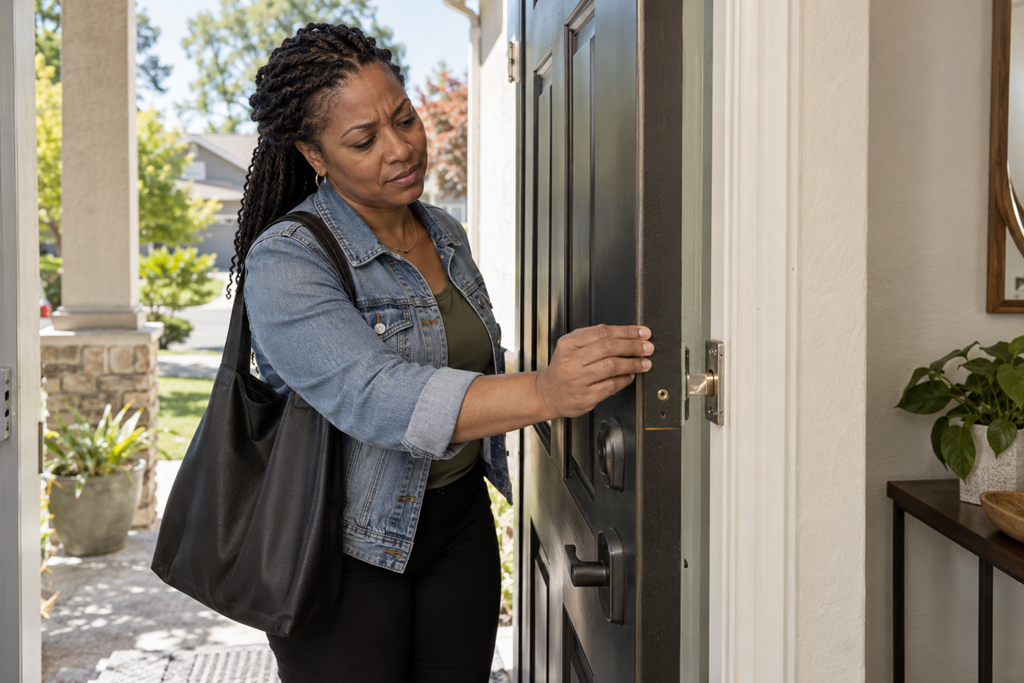
Many door problems start as small annoyances. You may have to lift the handle slightly, pull the door toward you before turning the lock, give it an extra push, or check it twice before walking away. Because the door still opens and closes, it can be easy to treat the issue as something you simply live with.
The important distinction is that a door can be functional without working properly.
A Door That “Still Works” May Not Be Working Consistently
One of the easiest door problems to overlook is inconsistency.
The door may close normally one day and resist the next. The latch may catch if the door is pushed firmly but not during an ordinary close. The deadbolt may turn smoothly sometimes and feel tight at other times.
That inconsistency matters because people naturally adjust their habits around it. Instead of noticing the door itself, you may start thinking, “This door just needs an extra push.”
Over time, that workaround can become so familiar that the underlying problem fades into the background.
For Sacramento-area homeowners, seasonal temperature changes, sun exposure, and periods of dry or wet weather can sometimes make an existing fit or alignment issue more noticeable. That does not automatically identify the cause, but changes in how a door behaves are worth paying attention to.
Security Depends on the Door Closing the Way It Is Supposed To
Door security is not only about the strength of a lock.
The door, frame, latch, deadbolt, hinges, and surrounding components need to work together so the door closes and locks predictably.
If a latch does not engage consistently, a deadbolt becomes difficult to operate, or the door does not settle into the frame normally, the concern is not necessarily that the entire door has failed. The practical concern is that you may no longer be able to rely on the same closing and locking routine every time.
That can lead to uncertainty.
Did the latch catch?
Did the door close completely?
Did the lock engage normally, or did it only seem to?
A door problem does not automatically mean a home is unsecured. But a door that cannot be closed or locked reliably is worth discussing with a qualified professional rather than relying indefinitely on extra force or a familiar workaround.
Daily Use Can Be Just as Important as the Lock
Security tends to get the most attention, but everyday usability matters too.
A front, side, patio, or garage-entry door may be used many times during an ordinary week. A small problem can become surprisingly disruptive when it affects every arrival and departure.
A sticking or dragging door can be especially noticeable when someone is carrying groceries, bringing in packages, helping children through the doorway, letting a pet outside, or simply trying to leave the house without thinking about the door.
The issue may also change how other people use the home. A workaround that feels routine to one household member may be confusing to a guest, family member, housesitter, or someone who does not know that the door needs a particular pull or push before it will latch.
That is one reason usability problems should not be dismissed simply because you have learned how to work around them.
The Symptom Does Not Always Tell You What the Solution Is
A difficult door does not automatically mean the entire door needs to be replaced.
Problems with closing, latching, dragging, or locking can involve different parts of the door system. The condition of the door itself, hinges, hardware, frame, threshold, weatherstripping, and surrounding opening may all be relevant to an evaluation.
That is useful to remember when comparing local door service providers.
If the first thing you notice is a sticking door, for example, the better question is not necessarily, “How much does a new door cost?”
A more useful starting point is, “What is causing this door to behave this way, and what options make sense for the condition you see?”
That leaves room for a provider to explain whether the concern appears limited, whether several components are involved, and why repair, adjustment, or replacement is being discussed.
Repeated Workarounds Can Hide How Much the Problem Has Changed
Door problems often become normalized gradually.
Maybe the door originally needed a little extra pressure. Later, you started pulling on the handle while turning the deadbolt. Then you noticed a new scrape near the threshold or a larger gap in one area of the frame.
Because each change happened slowly, the overall difference may be easy to miss.
Looking at the pattern can be more helpful than focusing on one isolated symptom.
A door that behaves differently from week to week, requires increasingly specific handling, or no longer closes and locks in the ordinary way may deserve a professional evaluation even if it has never become completely unusable.
The goal is not to assume the worst. It is to understand what has changed before deciding what kind of service is appropriate.
A Door Evaluation Should Help Explain the Cause, Not Just Sell the Fix
When speaking with a Sacramento-area door professional, the explanation you receive can be as useful as the recommendation.
A provider should be able to help you understand what they observed and how that observation relates to the problem you described.
Useful questions can include:
- What appears to be causing the door to stick, drag, or latch inconsistently?
- Is the concern mainly with the door, hardware, frame, or another part of the opening?
- Is repair or adjustment reasonable to consider, or is replacement being recommended?
- If replacement is recommended, what condition makes replacement the better option?
- Will the proposed work address both normal daily operation and reliable closing and locking?
You do not need to diagnose the door yourself before requesting an estimate. The purpose of asking questions is to understand the recommendation well enough to compare options.
The Best Next Step Is Understanding What Has Changed
A troublesome door can be easy to tolerate because it often continues working in some form. But the need to push, pull, lift, retry, or double-check the door is useful information.
Those small interruptions can affect both everyday convenience and your confidence that the door has closed and locked as intended.
Before deciding whether to repair or replace a door, focus on how the door behaves, whether the problem is becoming more frequent, and how clearly a local professional can explain the cause and available options. That gives you a better basis for making a door service decision without assuming that every problem requires the same solution.