Many common garage door repairs can be completed during a single service visit, but the actual repair time can range from less than an hour to several hours, and some jobs take longer when a specific part must be ordered. The repair itself is only one part of the timeline: diagnosis, safe access, door condition, and parts availability can all affect how long the appointment takes.
For Sacramento-area homeowners, that distinction can matter when a garage door problem interferes with parking, storage, home access, or the normal use of the garage. A repair that sounds simple over the phone may turn out to involve a different component once the door is inspected, while a problem that seems serious may sometimes have a relatively straightforward repair.
The most useful expectation is not that every repair has a fixed duration. It is that the technician first needs to identify what is actually causing the problem before giving you a more meaningful estimate of how long the work should take.
A Short Repair Can Still Require Time to Diagnose
Homeowners naturally tend to describe garage door problems by what they see: the door will not open, it stops partway, it moves unevenly, the opener makes noise, or the remote appears to have stopped working.
Those symptoms do not always identify the repair.
A door that will not open, for example, could involve the opener, a spring, a cable, a sensor-related issue, or another part of the system. That means the first portion of a service visit may be spent determining which component is actually responsible.
Once the cause is clear, the repair itself may be relatively quick.
This is one reason it can be difficult for a garage door company to promise an exact completion time based only on a brief description over the phone.
Some Common Repairs Are Often Completed in One Visit
Many routine garage door problems can be addressed during the initial appointment when the technician identifies the issue and has the appropriate parts available.
The following are useful general expectations rather than promises for a particular door.
Broken spring replacement can be relatively quick
A standard broken garage door spring is a good example of a repair that may sound major but can sometimes be completed fairly quickly by an experienced professional. Garage door manufacturer Clopay notes that professional spring replacement commonly takes about 30 minutes to an hour, depending on the situation.
That does not mean every spring-related service call will take the same amount of time. The door configuration, number and type of springs, condition of related components, accessibility, and availability of the correct replacement spring can all affect the appointment.
Garage door springs also operate under substantial tension, so spring work is an area where professional evaluation is especially important rather than attempting to shorten the timeline through risky DIY work.
Sensor, remote, or control problems may be among the shorter visits
When a problem is isolated to a relatively simple control, sensor, adjustment, or programming issue, the service itself may take less time than a repair involving the door's lifting system.
The complication is that a symptom that appears to involve a remote or sensor may ultimately come from wiring, the opener, door alignment, or another underlying problem.
The initial symptom therefore tells you less about repair time than the final diagnosis does.
Cables, rollers, and track-related problems vary more
Problems involving cables, rollers, brackets, or tracks can range from an isolated component issue to a situation involving several connected parts.
A technician who discovers one worn roller may be dealing with a very different scope of work from someone evaluating a door that is moving unevenly because several components have been affected.
These repairs may still be completed during one appointment, but the amount of work becomes much harder to estimate until the entire door has been evaluated.
Opener Problems Can Range From a Small Repair to Several Hours of Work
A garage door opener problem is another reason repair times vary widely.
Sometimes the underlying problem involves a relatively limited component or adjustment. In other situations, the service decision may shift from repairing the existing opener to replacing it.
A complete opener replacement is naturally more involved than correcting an isolated opener problem. Home Depot's installation guidance, for example, budgets roughly three to four hours for installing a garage door opener, particularly when an existing unit also has to be removed.
The practical lesson for a homeowner is not to assume that every problem described as an "opener repair" represents the same amount of work.
Ask what was actually diagnosed and whether the proposed service involves repairing a component, replacing a component, or replacing the opener itself.
Parts Availability Can Matter More Than the Actual Labor
One of the easiest garage door repair timelines to misunderstand involves replacement parts.
A technician may need relatively little time to physically install a component, yet the repair may not be completed that day if the correct part is not available.
This can be especially relevant when a door requires a specific panel or section, an unusual spring specification, a compatible opener component, or another part that cannot simply be substituted with whatever happens to be on the service vehicle.
In that situation, there are really two timelines:
The hands-on repair time is how long the actual work takes once the right part is available.
The total resolution time includes diagnosis, locating or ordering the part, scheduling the return visit, and completing the repair.
That distinction can help explain why two homeowners with seemingly similar problems may have very different experiences.
A Replacement Panel Is a Good Example
Suppose a garage door has one damaged section and the technician determines that the section can be replaced rather than the entire door.
The physical replacement may not necessarily represent an unusually long project. The larger timing question may be whether a matching replacement section is readily available.
Door model, size, design, finish, age, and manufacturer compatibility can affect what can be sourced.
For the homeowner, asking only "How long does it take to replace the panel?" may therefore miss the more important question:
How long will it take to get the correct panel and complete the repair?
That is often a much more useful scheduling question.
Related Damage Can Change an Initially Simple Timeline
Garage door components do not operate completely independently from one another.
A service call that begins with one obvious symptom may reveal another condition that affects how the door moves or how safely the original problem can be corrected.
That does not automatically mean the repair is becoming unnecessarily complicated. It may simply mean the original symptom did not show the full scope of the problem.
The important consumer question is whether the technician can explain what changed.
If additional work is being recommended, you should be able to understand which additional component is involved, why it matters to the repair being performed, and whether it changes the expected completion time.
Access to the Garage Can Also Affect the Appointment
The condition around the garage door matters too.
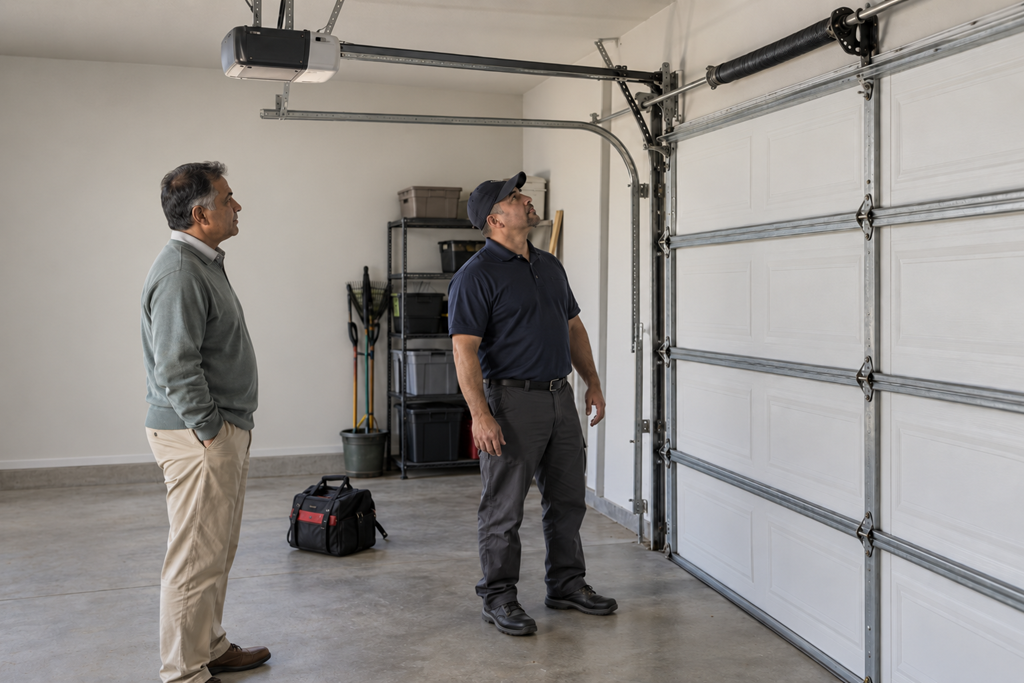
A technician may need reasonable access to the interior side of the door, the opener, tracks, springs, or other relevant components. Heavy storage, shelving, vehicles, or other belongings immediately around the work area can complicate access.
You generally do not need to diagnose the problem or prepare the garage as though you were doing the repair yourself.
The simpler goal is to ask the garage door company whether anything should be moved before the appointment.
That gives the technician a better opportunity to inspect the system efficiently without the homeowner guessing which component needs attention.
The Service Window Is Not the Same as the Repair Time
Another common source of confusion is mixing up appointment scheduling with hands-on repair time.
A company may give you a service arrival window that spans several hours. That does not mean the repair itself is expected to take that entire period.
Similarly, a technician may spend time inspecting and testing the door before performing a relatively short repair.
When planning your day, it can help to separate three questions:
- When should I expect the technician to arrive?
- Once the problem is diagnosed, approximately how long should the repair take?
- Is there any reason a second appointment might be required?
Those questions provide a more realistic picture than simply asking how long "garage door repair" takes in general.
Ask for a Revised Time Estimate After the Diagnosis
The most useful time estimate often comes after the technician has inspected the door.
Before work begins, you can ask:
- What appears to be causing the problem?
- Is this likely to be completed during this visit?
- Do you already have the required part?
- About how long should the repair itself take?
- Is anything else affecting the timeline?
- Would any additional recommended work change the expected completion time?
These questions are not about rushing the technician. They are about understanding the scope of the appointment and avoiding surprises.
A provider should be able to explain the difference between what is known before inspection and what becomes clear after diagnosis.
Be Cautious With Exact Promises Made Before Anyone Sees the Door
A very precise repair-time promise given before the door has been evaluated may be less useful than it sounds.
Some repairs are predictable enough that an experienced company can provide a reasonable general range based on your description. But a responsible estimate may still include conditions such as confirming the diagnosis, verifying the door configuration, and having the proper parts available.
That qualification is useful rather than evasive.
Garage doors contain interconnected mechanical and electrical components, and some parts operate under substantial tension. A technician who takes enough time to determine what is wrong before committing to a repair plan is giving you more meaningful information than someone simply attaching a fixed duration to a symptom.
Plan Around the Scope, Not Just the Repair Name
For many common garage door repairs, the hands-on work can fit comfortably within one service appointment. A standard spring replacement may sometimes take roughly an hour, while a full opener replacement can require several hours. Other repairs fall somewhere in between or take longer overall when diagnosis, related damage, or parts availability changes the scope.
The most useful question for a Sacramento-area homeowner is therefore not simply, "How long does this kind of repair take?"
Ask what your particular door needs, whether the required parts are available, whether the repair should be completed during the initial visit, and what could cause that estimate to change.
That gives you a much more practical timeline for planning your day and evaluating what a local garage door professional is proposing.