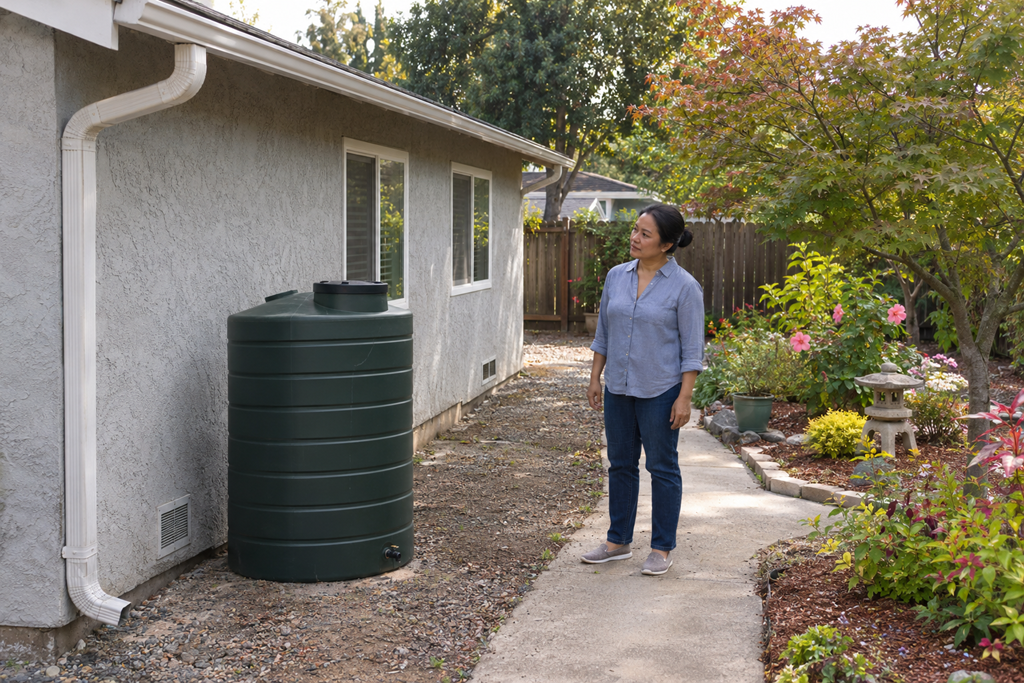
A rainwater collection system may be a useful addition to a Sacramento-area property, but only when the water has a clear purpose and the site can accommodate collection, storage, overflow, and maintenance. A small rain barrel can suit one garden area, while a larger system may require more planning than its expected benefits justify. The right choice depends less on the appeal of saving rainwater and more on how the system would function on your particular property.
For homeowners considering rainwater collection, the challenge is often determining whether an attractive idea translates into a practical improvement. A property may have plenty of roof area but limited storage space. A convenient downspout may be far from the landscaping that needs water. A larger tank may hold more water but require additional site preparation and upkeep.
Sacramento's pattern of seasonal rainfall and extended dry periods makes it especially important to consider when water will be collected and when it will actually be needed.
Before purchasing equipment or requesting installation estimates, it helps to evaluate the property's physical characteristics, intended water use, ongoing responsibilities, and available alternatives.
Start with what you want the collected water to accomplish
The first decision is not which collection system to buy. It is whether the property has a specific, practical use for captured rainwater.
Homeowners may be interested in rainwater collection for several reasons:
- Supplementing water used for ornamental landscaping.
- Watering container plants or selected garden areas.
- Supporting a broader water conservation plan.
- Capturing some roof runoff for later use.
- Reducing dependence on conventional irrigation for certain outdoor tasks.
These goals are related, but they do not necessarily require the same system.
Someone who wants supplemental water for a small planting area may have different needs from someone considering a substantial storage tank to serve several areas of a property.
Separate useful water collection from general water-saving expectations
A rainwater collection system does not automatically produce meaningful water savings.
Its usefulness depends on whether the collected water replaces water that would otherwise be used for an appropriate purpose.
For example, a rain barrel that regularly supplies a nearby ornamental planting area has a defined function. A large tank that remains full because the homeowner rarely uses its contents may offer less practical value than expected.
It helps to identify:
- Which outdoor areas would use collected water.
- Whether those areas are close to a suitable storage location.
- How frequently water would be needed.
- Whether the property already has efficient irrigation.
- Whether someone will consistently use and maintain the system.
The more specific the intended use, the easier it becomes to evaluate whether collection is worth pursuing.
Recognize the limits of collected rainwater
Water collected from a roof should not be assumed safe for drinking, cooking, bathing, or other household uses.
Even rainwater that appears clear can contain contaminants from roofing materials, debris, animals, and the surrounding environment.
Outdoor nonpotable uses and household plumbing applications are different projects. Indoor use, drinking-water applications, and certain irrigation uses may involve additional water-quality requirements, treatment, approvals, and specialized professional evaluation.
For most homeowners exploring basic collection, starting with a clearly defined, appropriate outdoor use keeps the decision easier to understand.
Evaluate whether your roof and drainage layout support collection
A property's roof is the starting point for most residential rainwater collection systems.
However, roof size alone does not determine whether collection is practical.
The existing arrangement of gutters, downspouts, roof surfaces, and surrounding landscaping can make a significant difference.
Where does the rainwater currently go?
Consider the path water follows during rainfall.
Water may travel from a roof section into a gutter, through a downspout, and into a landscaped area, drainage extension, or another existing drainage feature.
A collection system changes part of that route.
Before considering equipment, identify:
- Which downspouts are reasonably accessible.
- Whether gutters and downspouts appear to be functioning properly.
- Whether runoff is already directed away from important structures.
- Whether a storage container could be positioned near an appropriate collection point.
- Whether that location connects conveniently to the intended water-use area.
Homeowners can observe these conditions safely from ground level without climbing roofs or modifying drainage components.
Roof condition and materials can affect the decision
Not every roof surface is equally suitable for every intended use.
Roofing materials, coatings, accumulated debris, nearby trees, and possible contaminants can affect the quality of collected water.
A professional may need to evaluate whether the proposed collection area is appropriate, particularly if the homeowner intends to use the water around edible plants.
Collection should not be treated as a substitute for needed gutter, roof, or drainage repairs.
If an existing drainage component is damaged or performing poorly, that condition may deserve attention before additional equipment is introduced.
Consider the difference between collection potential and usable water
A roof may direct a substantial amount of runoff toward one downspout during a storm.
That does not mean all of the water can be stored or used.
The amount available for practical use depends on several factors:
- Rainfall reaching the selected roof area.
- The portion of runoff entering the collection system.
- Storage capacity available when rain begins.
- Losses or diversions associated with the system.
- How frequently stored water is used.
- The amount of water the intended application requires.
A system may fill quickly during wet weather and still provide only a limited supply during a prolonged dry period.
The important question is not simply how much rainwater a roof could produce, but how much useful water the property can capture, store, and consume.
Decide whether storage can fit the property without creating new problems
Water storage is often the most visible part of a rainwater collection project.
The choice between a compact rain barrel and a larger storage system affects much more than capacity.
It can change where equipment can be placed, how the area is used, how the system is maintained, and what supporting work may be necessary.
A small collection system may be enough
For a homeowner interested in supplemental water for a limited outdoor area, a basic rain barrel may be worth evaluating.
Potential advantages include:
- A relatively compact physical footprint.
- A simpler intended use.
- Fewer components than many larger systems.
- Easier integration into a limited outdoor watering routine.
However, smaller systems still require appropriate support, secure placement, screened openings, overflow management, and access for maintenance.
A small container is not automatically suitable simply because it fits beside the house.
Larger storage systems involve different tradeoffs
Larger tanks or cisterns may offer more storage capacity, but they also introduce considerations that may not apply to a simple collection setup.
These can include:
- Greater space requirements.
- Increased weight when filled.
- More demanding foundation or support considerations.
- Additional plumbing or water-distribution components.
- Greater installation complexity.
- More extensive maintenance access requirements.
- Potential impacts on property circulation and future improvements.
A larger system should be evaluated according to its useful capacity, not just its physical size.
If the property cannot use much of the stored water, increased capacity may not justify the additional expense and complexity.
Think about how the storage location affects daily life
An installation location can look suitable during an initial walkthrough but become inconvenient after equipment is installed.
For example, a tank positioned near a downspout might interfere with access to a side-yard gate, utility equipment, outdoor storage, or a frequently used walkway.
Look at the proposed location from several perspectives.
Could it obstruct access needed for maintenance or emergency services? Would it interfere with landscaping work? Could it make moving equipment through the yard more difficult?
A useful system should fit the property's normal activities rather than requiring continual workarounds.
Storage tanks also need appropriately designed, stable support. Because stored water is heavy, homeowners should not assume an existing patio surface, raised platform, or narrow strip of ground can safely support a proposed tank without evaluation.
Make overflow management part of the decision
One of the most important questions is what happens when the storage container becomes full.
A rainwater collection system does not eliminate roof runoff.
During sufficient rainfall, the system will reach its available capacity, and additional water must have an appropriate place to go.
This means overflow planning is a necessary part of evaluating property suitability.
A full tank still needs a drainage plan
Consider what could happen if overflow were directed toward:
- A building foundation.
- A garage or exterior doorway.
- A narrow area between buildings.
- A patio or walkway.
- A neighboring property.
- A landscaped area that already experiences standing water.
These locations are not automatically unsuitable in every circumstance, but they deserve evaluation before installation.
A proposed collection system should preserve or appropriately modify existing drainage performance rather than create a new water-management problem.
Collection does not necessarily solve existing drainage problems
Homeowners sometimes consider rainwater collection because they notice considerable runoff during storms.
That observation may identify an opportunity for collection, but it does not establish that storage is the right drainage solution.
If water regularly accumulates near the foundation, enters a structure, or flows across an important access area, the underlying drainage conditions may need professional assessment.
A rain barrel may temporarily capture some runoff while leaving the property's broader drainage problem unresolved.
In particular, a full barrel cannot continue collecting the same volume of incoming water.
When the primary concern is drainage rather than water reuse, it makes sense to evaluate the drainage issue separately before deciding whether rainwater storage should be part of the solution.
Match expected water availability to Sacramento's seasons
Sacramento-area homeowners need to consider the relationship between seasonal rainfall and periods when outdoor watering demand may be highest.
Rainwater collection can be practical, but it should not be viewed as a continuous source of water throughout the year.
A system that fills during rainy periods may provide useful supplemental water. Its ability to support a landscape during extended dry weather depends on the amount stored, how rapidly that water is used, and when additional rainfall occurs.
Collection timing and water demand may not align
Consider two separate questions:
When is water likely to enter the system?
Rainfall supplies the collection system, so water availability depends on actual weather and available storage capacity.
When does the property need the water?
A garden or landscape may require more supplemental watering during periods when little rainfall is available.
The difference between these two periods is a central planning consideration.
A small rain barrel may be useful after rain but empty long before the next substantial storm.
A larger cistern may extend the availability of stored water, although its usefulness still depends on actual supply and demand.
Neither option guarantees that rainwater will cover an entire irrigation season.
Set realistic expectations about water savings
The potential benefit of a rainwater collection system should be considered in relation to the amount of water it can realistically replace.
A homeowner may find value in reducing some outdoor water use, supporting a particular planting area, or incorporating collected water into a broader conservation routine.
However, substantial reductions in water bills or complete irrigation independence should not be assumed.
Any proposed savings estimate should explain the assumptions behind it, including the collection area, expected use, and storage limitations.
A system can be worthwhile for a modest, clearly defined purpose without delivering dramatic financial benefits.
Consider the maintenance responsibilities before choosing a system
Rainwater collection equipment needs ongoing attention.
The appropriate level of maintenance depends on the system's design, storage arrangement, surrounding conditions, and intended use.
A homeowner who prefers a low-maintenance property should consider these responsibilities before committing.
What routine care might involve
Depending on the installation, maintenance responsibilities may include:
- Checking accessible inlet screens and debris barriers.
- Observing whether gutters and collection components are functioning as intended.
- Inspecting storage containers for visible leaks or deterioration.
- Keeping openings appropriately covered and secured.
- Checking whether overflow components remain clear.
- Following the manufacturer's cleaning and inspection recommendations.
- Monitoring whether the system continues to serve its intended purpose.
A system located beneath trees or in an area with frequent debris may require additional attention.
Larger or more complex installations may also require professional servicing.
Mosquito prevention deserves particular attention
Stored water must be protected against mosquito access.
Open containers, damaged screens, poorly sealed openings, and neglected equipment can create conditions that allow mosquitoes to reproduce.
A suitable rainwater collection system should include appropriate measures to exclude mosquitoes, along with a realistic inspection and maintenance plan.
If the homeowner cannot comfortably maintain those protective features, the system may not be a good fit without an ongoing service arrangement.
Will the system still be maintained after the initial excitement?
This is a practical question worth considering.
A homeowner may be enthusiastic about installation but less interested in cleaning filters, inspecting equipment, or managing stored water over time.
If the system requires more attention than expected, its long-term usefulness can decline.
Maintenance needs should influence equipment selection from the beginning rather than becoming an afterthought.
Compare a rain barrel, larger system, or simpler alternative
Not every property needs a dedicated rainwater storage system.
Sometimes a modest installation is appropriate. In other situations, a larger project may be justified by a clearly identified use. Some homeowners may decide that improving existing irrigation or landscaping practices better serves their immediate goals.
The following comparison can help organize the decision.
Option | Potential fit | Main consideration |
|---|---|---|
Small rain barrel | Limited supplemental outdoor watering | Restricted capacity and the need for convenient access |
Larger tank or cistern | Defined outdoor uses requiring more stored water | Greater space, support, installation, and maintenance demands |
More complex collection system | Multiple approved uses or specialized distribution needs | Additional design, water-quality, plumbing, and professional requirements |
Irrigation or landscape improvements instead | Properties primarily seeking lower outdoor water use | May address demand without adding storage equipment |
Postpone installation | Unclear water use, drainage concerns, or insufficient space | Allows time to resolve property conditions and evaluate priorities |
These options are not mutually exclusive.
For example, a homeowner may improve irrigation practices first and consider a small collection system later.
Likewise, an existing rain barrel does not prevent a property owner from reevaluating storage needs if circumstances change.
The right approach is the one that serves a defined purpose without introducing unnecessary complexity.
Understand what can affect installation cost and project scope
Rainwater collection costs can vary considerably because the equipment is only one part of the project.
A basic installation with a suitable existing downspout may involve a different scope from a larger system that requires extensive site preparation or water distribution.
Factors that can affect the overall expense include:
- Storage capacity and tank materials.
- Existing gutter and downspout conditions.
- Distance between collection and storage locations.
- Ground conditions and support requirements.
- Accessibility of the installation area.
- Overflow and drainage arrangements.
- Pumps, filtration, or other equipment where appropriate.
- Water-distribution requirements.
- Applicable permits or professional evaluations.
- Ongoing maintenance and replacement components.
A lower-priced storage container does not necessarily produce the lowest overall project cost.
Similarly, a more expensive system is not automatically a better choice.
The decision should be based on how the proposed components work together and whether the final arrangement serves the property's needs.
Consider total ownership responsibilities
Beyond the initial purchase or installation expense, homeowners should think about future upkeep.
Some systems may require occasional replacement of screens, seals, fittings, or other components. More involved systems may require periodic professional attention.
Ask whether maintenance tasks can be handled safely and conveniently, and whether future service access has been considered.
A system that is difficult to inspect or maintain may become less appealing over time, even if the initial estimate appears reasonable.
Know when professional evaluation is especially useful
Some rainwater collection projects are relatively straightforward to discuss, while others involve multiple property systems or constraints.
Professional evaluation becomes particularly important when the proposed project involves substantial storage, structural support concerns, modifications to existing drainage, specialized water distribution, or household plumbing.
It may also be useful when:
- The property has recurring runoff or drainage concerns.
- The proposed tank location has limited space or uneven conditions.
- Gutters or downspouts may need modification.
- The collection area has questionable roof materials or contamination concerns.
- The homeowner intends to use captured water around edible crops.
- Pumps, treatment components, or complex controls are being considered.
- The intended use involves plumbing fixtures or other regulated applications.
The appropriate professional depends on the actual work being proposed.
A rainwater collection installer, qualified plumbing professional, drainage specialist, or another appropriately qualified provider may be involved.
Homeowners should also confirm applicable local requirements with the authority responsible for their property's jurisdiction rather than assuming that every rain barrel or storage system is treated the same way.
Questions worth asking before requesting an installation
A focused conversation can reveal whether a provider has considered the property as a complete system.
Useful questions include:
- Which roof area and downspout would you recommend using, and why?
- How does the proposed storage capacity relate to my intended water use?
- Where will water go when the storage system is full?
- What site preparation or changes to existing drainage would be necessary?
- What maintenance will I be responsible for, and how frequently should the system be inspected?
- Are there water-quality limitations for my intended use?
- Which permits, approvals, or specialized qualifications might apply to this installation?
- What is included in the estimate, and which additional expenses could arise?
A provider should be able to explain the reasoning behind the recommended system in language the homeowner understands.
When the answers remain unclear, it is reasonable to request additional details before approving the project.
Recognize when the property may not be a good fit
Rainwater collection can be appealing even when the property presents practical limitations.
Recognizing those limitations early can prevent unnecessary equipment purchases or poorly planned installations.
Reasons to reconsider or postpone a project may include:
- No clear, regular use for the collected water.
- Insufficient space for appropriate storage.
- A proposed location that blocks important access.
- Unresolved drainage or runoff problems.
- An inability to establish safe overflow handling.
- Storage requirements that substantially exceed likely useful water collection.
- Maintenance responsibilities the homeowner is unwilling or unable to manage.
- An expectation that a basic system will supply unlimited water during dry periods.
- Unclear water-quality or regulatory requirements for the intended use.
These conditions do not necessarily make rainwater collection impossible.
They may mean that a smaller system, a different location, professional evaluation, or another water-management approach would be more appropriate.
Be cautious of recommendations that overlook property conditions
A proposal deserves closer review when the installer emphasizes equipment size or potential savings without adequately discussing the property's layout and water use.
Other reasons to ask for clarification include:
- No explanation of overflow management.
- Little consideration of storage support or access.
- Vague descriptions of required gutter modifications.
- Unclear maintenance responsibilities.
- Promises of water savings without supporting assumptions.
- Failure to address relevant water-quality limitations.
- Pressure to approve a large installation before the property's needs are established.
These concerns are reasons to seek further information, not automatic proof that a provider is unqualified.
Prepare a simple property-fit assessment before moving forward
Before purchasing equipment or arranging a consultation, homeowners can organize the information needed to make the decision more productive.
This does not require measuring roof runoff, climbing onto the roof, modifying equipment, or attempting technical design work.
A few basic observations are enough to begin.
Property-fit checklist
- Intended use: Identify the specific outdoor areas that would benefit from collected water.
- Collection location: Note which gutters and downspouts appear accessible from ground level.
- Available space: Identify potential storage areas that would not interfere with everyday access.
- Existing drainage: Record any visible signs of recurring pooling, overflow, or water movement concerns.
- Seasonal expectations: Consider when collected water would be available versus when it would be needed.
- Maintenance: Decide who would inspect and maintain the system.
- Project priorities: Determine whether water collection is more important than other irrigation, landscaping, or drainage improvements.
- Professional questions: Prepare a short list of concerns about storage, overflow, cost, and intended use.
Photographs taken safely from accessible areas can also help a provider understand the property before an on-site evaluation.
For rental properties or homes subject to association requirements, the property owner or appropriate management authority may need to be involved before modifications are considered.
Use the assessment to narrow the decision
Once the information is organized, most homeowners can place their situation into one of three general categories.
A basic system appears worth exploring.
There is a specific outdoor use, convenient collection location, manageable storage space, and no obvious unresolved drainage concern.
The idea is promising, but the property needs further evaluation.
The homeowner has a worthwhile use in mind, but questions remain about storage support, overflow, roof suitability, distribution, or project complexity.
Another improvement should probably come first.
The property has no defined use for collected water, significant drainage concerns, limited storage space, or maintenance expectations that do not fit the homeowner's routine.
These categories are planning aids, not substitutes for an individualized evaluation.
Choose a system that serves the property, not just the idea
A rainwater collection system is most useful when its purpose, location, capacity, and maintenance requirements fit together.
For some Sacramento-area homeowners, a compact rain barrel may provide a practical supplement for a limited outdoor watering need. Others may have the space and defined water demand to justify professional evaluation of a larger system.
Some properties may benefit more from improving drainage, irrigation, or landscaping before adding storage equipment.
The most useful decision is not necessarily whether rainwater collection is possible. It is whether the proposed system would provide enough practical value to justify the space, expense, and responsibilities it introduces.
Start with the intended water use, evaluate the actual property conditions, and compare solutions that address those needs without creating avoidable complications.