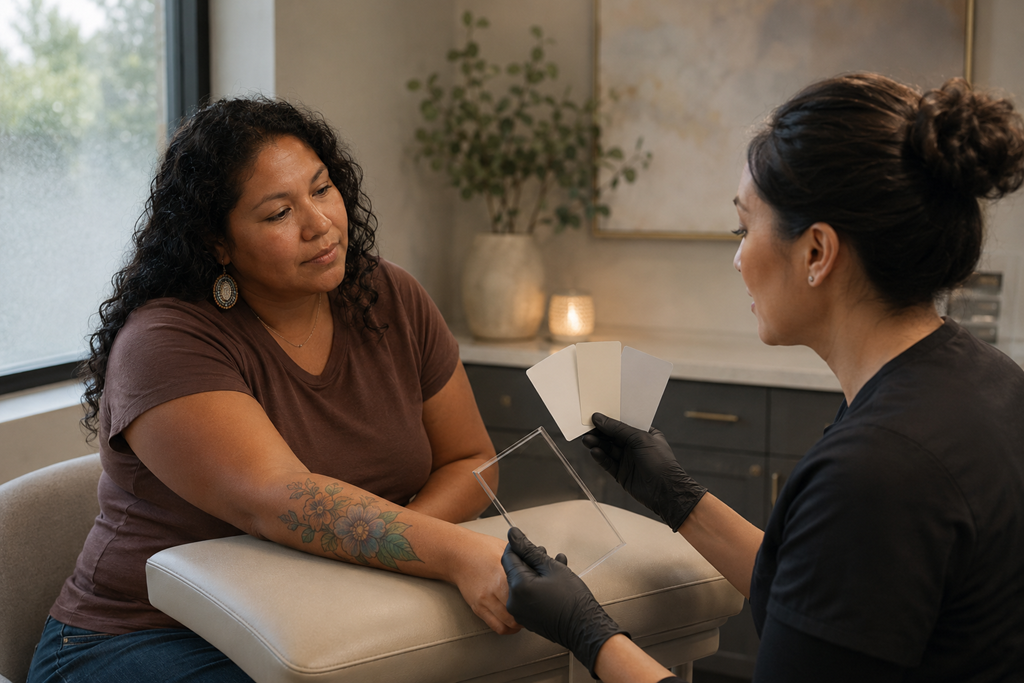
The color, size, and age of a tattoo can shape a removal consultation, but none of those details works as a simple prediction on its own. Ink colors absorb laser energy differently, larger tattoos may involve more treated area, and older tattoos may already show some fading. A qualified provider still needs to look at the tattoo itself, the ink density, layering, placement, skin characteristics, and the result you hope to achieve before discussing what may be realistic.
That distinction matters because many people enter a consultation expecting a quick calculation: a small tattoo should be easy, an old tattoo should disappear faster, or a black tattoo should require a predictable number of appointments. In practice, those details begin the conversation rather than settle it.
Color Can Change How a Provider Approaches the Tattoo
Laser tattoo removal works by directing particular wavelengths of light toward tattoo pigment. Because ink colors absorb light differently, one color may respond differently from another even when both appear in the same design.
Black and dark blue inks are often considered more straightforward to target. Greens, reds, yellows, pale colors, and blended shades may require different considerations. White, flesh-colored, and some cosmetic pigments can be especially unpredictable because they may darken when treated. A multicolored tattoo may therefore raise more questions than a design made with one dark pigment.
The color name alone does not reveal everything a provider needs to know. Two inks that both look green, for example, may have different formulations, depths, densities, or mixtures beneath the skin. A provider may be able to discuss likely patterns, but the visible color cannot guarantee a particular response.
For Sacramento-area patients comparing tattoo removal providers, the useful question is not simply, “Can you remove this color?” A more informative discussion addresses which colors appear more predictable, which may respond more slowly, and whether the provider has an appropriate approach for each part of the design.
Size Usually Affects Scope More Than Certainty
A larger tattoo generally creates a larger treatment area. That can influence appointment length, overall planning, cost discussions, and how a provider divides the work into manageable sections.
Size does not automatically tell you how stubborn the tattoo will be. A small, densely packed cover-up may contain more concentrated pigment and multiple ink layers. A larger tattoo with light shading and wide areas of unmarked skin may present a different situation.
This is why a provider may examine more than the tattoo’s outer dimensions. Ink density, layering, location, existing scarring, and changes in the surrounding tissue can all contribute to the evaluation. Clinical assessment models have included factors such as color, ink amount, placement, scarring, skin characteristics, and layering rather than relying on size alone.
When reviewing a quote or preliminary estimate, ask how the tattoo’s size affects the proposed service. A clear answer should distinguish between the amount of skin being treated and the difficulty of breaking down the individual pigments.
An Older Tattoo Is Not Automatically an Easy Tattoo
Tattoo age is easy to misunderstand because older tattoos often look softer or less saturated than they once did. That visible fading may become part of the provider’s assessment, but it does not reveal the tattoo’s complete history.
An older tattoo may still contain dense pigment below the surface. It may have been retouched, covered, scarred, or created with several kinds of ink. A newer tattoo may be simple in color but highly saturated. Age cannot show how deeply the ink was placed or how consistently the tattoo was applied.
Instead of treating age as a shortcut, think of it as background information. A provider may ask:
- Approximately when the tattoo was created
- Whether it has been retouched or covered
- Whether parts of it have faded unevenly
- Whether the area has developed raised or scarred skin
- Whether it has received previous removal treatment
These details help explain what the provider is seeing, but they should not be turned into a guaranteed timeline.
The Three Factors Often Work Together
Color, size, and age become more useful when considered together.
A small, older black line tattoo may lead to one kind of conversation. A large, recently applied design containing saturated greens, yellows, and layered cover-up ink may lead to another. A large but lightly shaded black-and-gray tattoo could differ from both.
This does not mean one tattoo can be ranked as “easy” and another as “impossible” from a photograph. It means the provider should be able to explain which features appear more predictable and where uncertainty remains.
The interaction among these factors can also explain why two people with similarly sized tattoos may receive different estimates. The size may be comparable while the pigment colors, density, depth, layering, skin response, placement, or desired endpoint differ.
Fading and Full Removal Are Different Goals
Another important part of the consultation is defining what “removal” means to you.
Some people want the tattoo reduced enough to make a future cover-up easier. Others hope to make it much less noticeable. Some are interested in the possibility of the most complete clearance that can reasonably be achieved.
Those goals can change the conversation about color, size, and age. A difficult pigment may still fade enough to support a cover-up, even when complete clearance is less predictable. A large tattoo may be addressed selectively rather than uniformly. A faded older tattoo may still leave visible pigment or changes in the skin.
Laser removal commonly requires multiple treatments, and complete removal without remaining pigment, scarring, or skin-color changes cannot be promised. Potential risks can include pain, infection, scarring, incomplete treatment, and lighter or darker areas of skin. Personal risks, candidacy, treatment choices, and expected outcomes should be discussed with a qualified medical provider.
Useful Questions for a Removal Consultation
A helpful consultation should turn the visible features of your tattoo into understandable expectations. Consider asking:
- Which ink colors appear most predictable, and which may be more difficult?
- Does the tattoo’s size affect appointment length, treatment sections, or the overall plan?
- Does its age meaningfully change expectations, or is it only one consideration?
- Do you see signs of layering, a previous cover-up, dense pigment, or scar tissue?
- Are we discussing substantial fading, preparation for a cover-up, or possible full removal?
- What uncertainties would remain even after an in-person evaluation?
A provider should be able to answer without making the process sound either effortless or hopeless.
Be Cautious With Simple Promises
Statements such as “all black tattoos take the same number of sessions” or “older tattoos always come out quickly” remove too much context from the decision.
Other reasons to pause include:
- A guaranteed appointment count based only on a photograph
- No discussion of the individual colors in a multicolored tattoo
- Treating size as the only factor affecting the estimate
- Promising complete removal without discussing uncertainty
- Avoiding questions about skin response, possible pigment changes, or scarring
- Giving the same explanation for fading and full clearance
Tattoo removal is already difficult to predict precisely. Clear communication should make the uncertainty understandable rather than hide it behind an overly simple promise.
Compare the Explanation, Not Just the Estimate
When comparing Sacramento-area tattoo removal providers, price and convenience may matter, but the quality of the explanation matters too.
Listen for whether the provider evaluates the actual design rather than placing it into a broad size category. A thoughtful conversation should address the tattoo’s individual colors, saturation, layers, age, placement, skin characteristics, previous treatments, and your desired result.
The strongest estimate is not necessarily the one with the lowest number or shortest projected process. It is the one that clearly explains what is known, what remains uncertain, and what would need to be reassessed as the tattoo fades.
The Main Takeaway
Tattoo color, size, and age all matter, but they are conversation starters rather than verdicts. Color can influence how pigment is targeted, size can affect the scope of treatment, and age can provide useful history. None of them should be used alone to promise a timeline or outcome.
A qualified provider should help you understand how those details interact with ink density, layering, placement, skin response, and your personal goal. That kind of explanation can help you compare local providers more carefully and enter a tattoo removal decision with more realistic expectations.