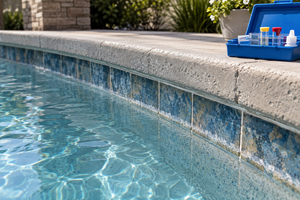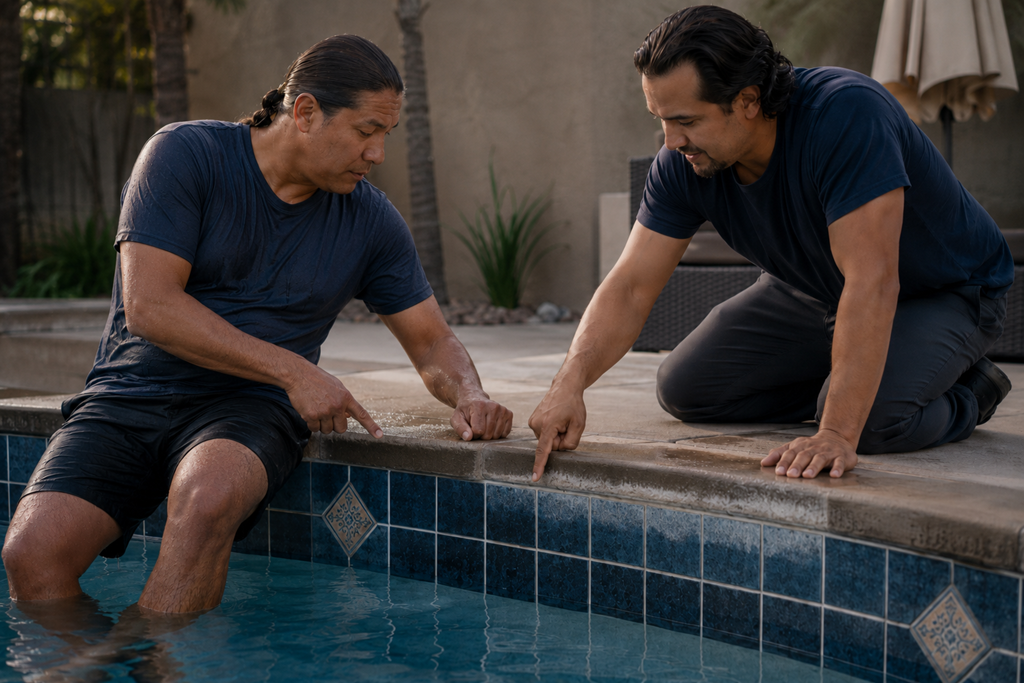
Pool tile can look dirty even when the water looks clear because the tile and the water are showing two different conditions. Clear water means suspended particles are not making the pool look cloudy, while a pale, rough, or discolored band at the waterline can come from minerals, body oils, sunscreen, dust, or residue left behind as water evaporates.
This can be confusing for homeowners. The pool may look inviting from several feet away, yet the tile around the edge appears neglected when viewed up close. That contrast does not automatically mean the pool is poorly maintained. It usually means something has collected on the tile surface even though the water itself remains visually clear.
Clear Water and Clean Tile Are Not the Same Measure
Water clarity mainly describes how easily you can see through the water. Filtration and circulation help remove suspended debris that might otherwise make a pool look cloudy.
Tile cleanliness is a surface condition. Once residue attaches to the tile, it may no longer be floating in the water where the filter can capture it. A pool can therefore have sparkling water and still develop a noticeable band around its perimeter.
Clear-looking water also does not provide a complete picture of water chemistry. Some dissolved materials remain invisible while they are in the water. They become easier to see only after water evaporates and leaves them behind on the tile.
The important distinction is simple:
Clear water describes what is suspended in the pool. Dirty-looking tile describes what has remained attached to a surface.
The Waterline Acts Like a Collection Boundary
The most noticeable buildup commonly appears where the water repeatedly meets the tile.
Pool water moves slightly throughout the day as people swim, water circulates, wind crosses the surface, and evaporation lowers the level. Each wetting-and-drying cycle can leave a small amount of material behind.
Over time, these small deposits may form a continuous band. The line can look white, gray, tan, dull, greasy, or uneven depending on what has collected and the type of tile beneath it.
Sacramento-area heat and dry conditions can make evaporation an important part of this pattern. However, the appearance of the line alone does not confirm its exact cause. A closer evaluation may be needed to distinguish ordinary surface residue from hardened mineral buildup or another tile condition.
Minerals Can Remain After the Water Disappears
Some pool water contains dissolved minerals that are not visible while fully mixed into the water. When water reaches the tile and evaporates, the water disappears but the minerals do not.
Repeated evaporation can gradually produce a pale or chalky deposit. As the layer becomes thicker, it may feel rough rather than merely looking discolored.
This is one reason a pool can appear exceptionally clear while the waterline tile looks dirty. The material affecting the tile may have been dissolved in otherwise transparent water before it was deposited on the surface.
A rough white band is often described broadly as scale, but homeowners should avoid assuming every light-colored mark has the same cause. The tile material, texture, deposit location, and surrounding pool conditions can affect what the buildup is and how it should be addressed.
Oils and Outdoor Debris Can Form a Dull Line
Not every dirty-looking waterline is caused mainly by minerals.
Sunscreen, skin oils, cosmetic products, leaves, pollen, dust, and other outdoor material can gather at the surface. As the water moves against the tile, some of that residue may cling to the edge.
This type of buildup may look dull, yellowed, gray, or slightly greasy rather than bright white and crusty. It may also be more noticeable in certain sections of the pool where floating debris tends to collect.
A homeowner may skim the water, empty the baskets, and see a clear pool afterward, but the residue already attached to the tile can remain. Removing debris from the water does not necessarily remove the film it previously left behind.
The Tile Surface Can Make the Problem More Visible
The same amount of residue may look different on different pool finishes.
Dark blue, black, or glossy tile can make a pale mineral band stand out sharply. Light-colored or textured tile may hide some discoloration while allowing rough deposits to collect within small surface variations.
Grout lines can also hold residue differently from glazed tile. A band may therefore look irregular even when it follows the waterline consistently.
These visual differences matter when discussing cleaning expectations. A provider may need to consider the tile material and finish before recommending a method. An approach appropriate for one surface may be unnecessarily aggressive or ineffective on another.
A Clear Pool Does Not Rule Out a Water-Condition Issue
One common misunderstanding is that clear water proves the water cannot be contributing to the tile buildup.
Water can look transparent while still containing dissolved material capable of forming deposits. Clarity by itself does not reveal whether the water is likely to leave mineral residue when it evaporates.
The reverse can also be true. A dirty-looking line does not automatically mean the entire pool has a serious water problem. The buildup may reflect months of repeated evaporation, ordinary swimmer use, outdoor debris, or a combination of conditions.
This is why it is helpful to separate two questions:
- What is currently attached to the tile?
- What conditions may have allowed it to collect there?
Cleaning addresses the first question. Understanding the second can help set realistic expectations about whether the line may gradually return.
Why More Scrubbing Is Not Always the Best Answer
When a waterline first appears, it is natural to assume that additional brushing or a stronger household cleaner will solve it.
Some light surface film may release with routine care. Hardened deposits, however, may not respond the same way. Increasing pressure or using progressively harsher products can create a different problem if the tile glaze, grout, surrounding finish, or decorative surface is damaged.
It can also be difficult to judge progress while the tile is wet. Water temporarily darkens some residue and makes the surface look cleaner. The remaining band may become visible again after the tile dries.
If a deposit is widespread, rough, persistent, or difficult to identify, a professional evaluation may be more useful than continued trial and error.
What a Pool Tile Cleaning Provider Should Help Clarify
Before scheduling professional cleaning, Sacramento-area homeowners can ask a few focused questions:
- What type of buildup does the provider believe is present?
- Will the provider test a small area before cleaning the full waterline?
- Is the proposed method appropriate for the specific tile and grout?
- What parts of the pool will be protected during the work?
- Does the estimate cover cleaning only, or does it include an evaluation of why the deposit may be returning?
A qualified provider should be able to explain the proposed approach in plain language. Be cautious when every mark is described as the same problem without considering the surface, texture, location, or condition of the tile.
It is also reasonable to ask what improvement is realistic. Cleaning may remove the visible deposit without restoring tile that is already etched, worn, faded, or physically damaged.
When Professional Cleaning May Be Worth Discussing
Professional cleaning may be appropriate when the band remains after ordinary maintenance, feels rough, extends around a large portion of the pool, or repeatedly returns.
An evaluation may also be useful when the pool has glass, decorative, textured, older, or otherwise delicate tile. The goal is not simply to remove the mark. It is to choose a method that fits the surface and avoids creating unnecessary damage.
A provider may also notice that the deposit is heavier near a spillway, raised spa, return, or area with frequent splashing. These patterns can provide useful context about how water is reaching and drying on the tile.
The presence of clear water should not discourage a homeowner from asking about the tile. It simply means the concern is more likely to involve material attached to the waterline than debris clouding the pool.
The Water and the Tile Are Telling Different Parts of the Story
A clear pool can still have dirty-looking tile because water clarity and surface buildup are separate conditions.
The water may be filtering well enough to remain transparent while minerals, oils, sunscreen, dust, and other residue collect where the water repeatedly meets the tile. Evaporation can make those materials increasingly visible even when the pool looks clean from a distance.
Recognizing that difference can help homeowners describe the issue more accurately, ask better questions, and compare cleaning recommendations without assuming that clear water means the tile should also be spotless.