A security door can add a stronger layer at your entry without making the front of your home look heavy, industrial, or out of place. The key is to choose a door whose proportions, finish, pattern, visibility, and hardware work with the style of the house rather than visually competing with it. For Sacramento-area homeowners, the best-looking option is usually the one that feels like part of the entry rather than a separate security feature added afterward.
That distinction can be easy to miss when you are looking at doors in a catalog or showroom. A design that looks attractive by itself may feel completely different once it is placed in front of your existing entry door, trim, siding, stucco, windows, and hardware.
The goal is not necessarily to make the security door disappear. It is to make sure its appearance feels intentional.
Start With Your Existing Entry, Not The Door By Itself
One of the easiest ways to make this decision harder is to judge a security door as an isolated product.
Your front entry already has a visual structure. The shape and color of the main door, width of the opening, surrounding trim, nearby windows, exterior lighting, house color, walkway, and porch all contribute to how another door will look once installed.
A decorative security door with an elaborate pattern might look impressive in a product photo but feel too busy against a detailed entry. A simpler design may work better when the house already has strong architectural features.
The reverse can also be true. A very plain security door may look unfinished or overly utilitarian on an entry where the rest of the exterior has more visual character.
Instead of asking only, “Do I like this door?” ask, “Do I like what this door will do to the appearance of my entry?”
That small change in perspective can make comparisons much easier.
Pay Attention To How Much Of Your Front Door Will Still Show
A security door becomes another visual layer in front of the main entry door.
That means the amount of visibility through the security door can have a large effect on the final appearance.
If you have a front door color, wood finish, decorative glass, or other feature you like, you may prefer a security-door design that allows more of it to remain visible. A dense pattern or visually heavy screen can make the original door less prominent.
For homeowners who want the security door itself to become part of the home's exterior design, a stronger decorative pattern may make more sense.
Neither approach is automatically better. The important question is which door you want people to notice first: the security door, the original entry door, or the two working together as one composition.
A Decorative Pattern Should Fit The Scale Of The House
Security doors can range from simple straight lines to more decorative geometric or ornamental patterns.
It is easy to choose based on whether a pattern looks attractive up close. But the door will usually be viewed from farther away—from the sidewalk, driveway, walkway, or street.
Consider how visually dense the pattern appears from those distances.
Large, simple shapes often read differently than tightly spaced decorative details. A pattern that seems subtle in a small product image may become one of the strongest visual elements on the front of the house once it fills an entire doorway.
This is one reason it can be helpful to look at photographs of full installations rather than relying only on close-up product samples.
Color And Finish Can Either Connect The Door Or Separate It
The security door does not necessarily need to match the main front door.
Sometimes matching another existing exterior element creates a more cohesive result. Window frames, exterior light fixtures, house trim, railings, gates, or other metal features may provide useful visual reference points.
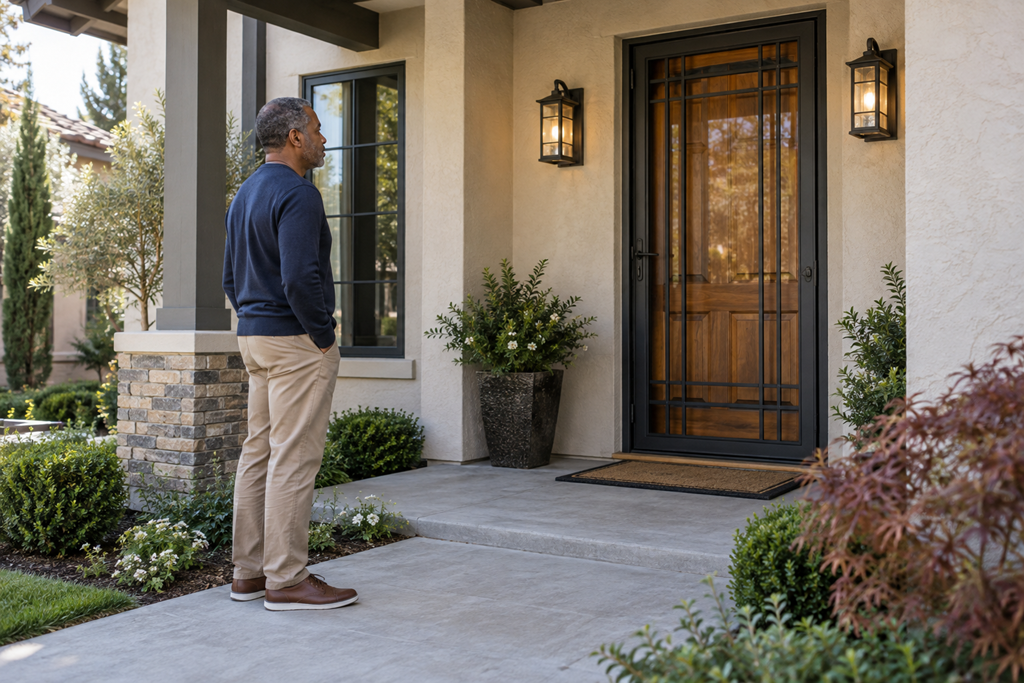
A dark security door against a lighter exterior, for example, can intentionally frame the entry. A finish closer to the surrounding trim can produce a quieter effect.
Sacramento-area homeowners may also want to discuss how different finishes hold up to the amount of sun and exposure their particular entry receives. That is a practical question for a qualified installer or manufacturer rather than something to assume based on appearance alone.
The broader design question is simpler: decide whether you want the security door to contrast with the house or blend into it.
Small Details Can Change The Overall Look
Handles, locksets, hinges, frames, thresholds, and other visible components may seem secondary when you are selecting the main door design.
Once everything is installed, however, those details become part of the entry.
A door with a restrained pattern can still look visually cluttered if several finishes compete with one another. Conversely, consistent hardware and frame choices can help a more noticeable security door feel integrated with the rest of the home.
You do not need every metal component on the property to match. The goal is simply to avoid choosing each element independently without considering how they will appear together.
Do Not Let Appearance Become The Only Comparison
Wanting a security door that looks good does not mean appearance should replace the practical reasons you are considering one.
A visually appealing door still needs to fit the opening, function as intended, and meet the priorities that led you to consider a security door in the first place.
That is where comparing local installers can be useful. Rather than beginning with the assumption that a certain style is right for your house, explain both your functional priorities and what you want the finished entry to look like.
A qualified professional can then explain which available options are appropriate for the actual doorway and installation.
Be cautious when the conversation focuses almost entirely on appearance without clearly addressing the door's construction, operation, installation, or other practical considerations that matter to you.
Ask To See The Door In A Real Entry Context
Product photos can help you narrow your preferences, but context matters.
Before making a final selection, useful questions for a Sacramento-area security-door installer can include:
- Can I see completed installations of this design on homes with a similar entry style?
- How much of my existing front door will remain visible through this model?
- Which frame and hardware finishes are available with this design?
- Are there simpler or less visually dense versions with similar functional features?
- Is there anything about my doorway that could make the finished installation look different from the examples I am seeing?
These questions keep the conversation focused on the finished result rather than just the product sitting in front of you.
Be Careful About Choosing The Most Decorative Option Automatically
More design detail does not always produce a better-looking entry.
When homeowners are presented with several security doors side by side, the most elaborate model may naturally attract attention. Once placed on a house, however, that same design has to coexist with everything else on the front elevation.
The better choice may be the door that supports the architecture instead of becoming the dominant feature.
This does not mean decorative security doors are a poor choice. It simply means decoration works best when it feels connected to the house rather than added for its own sake.
Look At The Entry From More Than One Distance
The appearance of a security door changes depending on where you stand.
Up close, you may notice finish texture, hardware, welds, screen material, and small decorative details. From farther away, the overall pattern, contrast, proportions, and relationship to the house become more important.
Before committing, picture the door from the places where you normally see your home: arriving in the driveway, walking toward the entry, sitting across the street, or approaching from the sidewalk.
That wider view can reveal whether the door complements the house or visually overwhelms the entry.
The Best-Looking Security Door Usually Feels Intentional
Choosing a security door does not have to mean accepting an industrial-looking entrance, and choosing an attractive door does not require turning the entry into a decorative focal point.
The strongest result usually comes from considering the security door as part of the entire front entry.
Compare how much of the original door remains visible, how the pattern relates to the home's architecture, whether the finish connects with other exterior elements, and how the complete doorway will look from normal viewing distances.
When comparing Sacramento-area installers, discussing those details before choosing a model can help you evaluate the finished appearance rather than selecting a door based only on how it looks in isolation.