Choosing window treatments for privacy without making a room feel dark usually comes down to balancing three things: how much daylight you want to keep, how much visibility you want to reduce, and when privacy matters most. The right choice is often not the most opaque option, but the one that manages light and views in a way that fits how you actually use the room.
That balance can be harder to judge than it sounds. A window treatment that looks pleasantly filtered during the day may provide less privacy than expected after dark. A heavier treatment may solve the privacy problem but leave a room feeling unnecessarily closed off. And a treatment that works well in a bedroom may feel completely wrong in a kitchen, home office, or front living area.
For Sacramento-area homeowners and renters, it helps to think about privacy and natural light as two separate needs that can often be managed together rather than choosing one at the expense of the other.
Privacy Does Not Automatically Require a Darker Room
One of the easiest assumptions to make is that greater privacy requires heavier, more opaque window coverings.
Sometimes it does. But not always.
Privacy is largely about limiting a particular line of sight. Light control is about deciding how much daylight enters the room and how that light is softened, redirected, or blocked.
Those goals overlap, but they are not identical.
A light-filtering treatment, for example, may diffuse direct views while still allowing substantial daylight into the room. Adjustable blinds or shutters may let you change sightlines without covering the entire window in the same way throughout the day. Other treatments can cover the portion of a window where privacy matters while leaving another area more open to daylight.
The useful question is therefore not simply, “How much of the window can I cover?”
It is, “What needs to be hidden from view, and how much light do I want to preserve while doing it?”
Think About What Someone Could Actually See
Privacy needs can change dramatically from one window to another.
A street-facing front window may have a direct sightline from the sidewalk into a seating area. A second-story bedroom window may receive plenty of daylight while having very little direct visibility from outside. A bathroom window may need more dependable screening even when the window itself is relatively small.
Before comparing treatments, consider the actual relationship between the window and the surrounding space.
Think about where people normally sit, stand, work, eat, or relax inside the room. Then consider whether neighboring homes, walkways, streets, patios, or other areas outside create meaningful sightlines into those spaces.
This can prevent you from choosing a more restrictive treatment simply because the window feels exposed when only part of it actually creates a privacy concern.
Daytime and Nighttime Privacy Can Be Very Different
A treatment that appears private in daylight does not necessarily provide the same level of privacy after sunset.
During the day, brighter outdoor conditions can make it more difficult to see through certain sheer or light-filtering materials from outside. At night, interior lighting changes that relationship. Depending on the material, people outside may be able to see shapes or activity that were difficult to see earlier.
This is one reason it can be misleading to judge a treatment only by how it looks in a showroom or during the brightest part of the day.
If nighttime privacy matters in the room, ask specifically how the material performs after dark with interior lights on.
That question is especially useful for bedrooms, bathrooms, front-facing rooms, and other spaces where dependable privacy is more important than simply softening the view during daylight hours.
The Room Should Help Determine the Treatment
Using the same window treatment throughout a home can create visual consistency, but it does not mean every room has the same functional needs.
A home office might benefit from filtered daylight that keeps the space bright while reducing direct outside visibility. A bedroom may need greater privacy at night. A kitchen or dining area may benefit from maintaining daylight while controlling views from a nearby walkway or neighboring property.
Even two windows in the same room can have different priorities depending on their orientation and surroundings.
Instead of starting with one product for the entire house, it can be more useful to identify what each room needs the window treatment to accomplish.
That does not mean every window needs a completely different design. It simply means function should be part of the comparison before appearance becomes the deciding factor.
Adjustable Coverage Can Create More Flexibility
Some window treatments give you more control over privacy than treatments that are simply fully open or fully closed.
Depending on the window and the product, adjustable slats, movable panels, top-down or bottom-up shade configurations, and layered treatments can create different combinations of light and privacy.
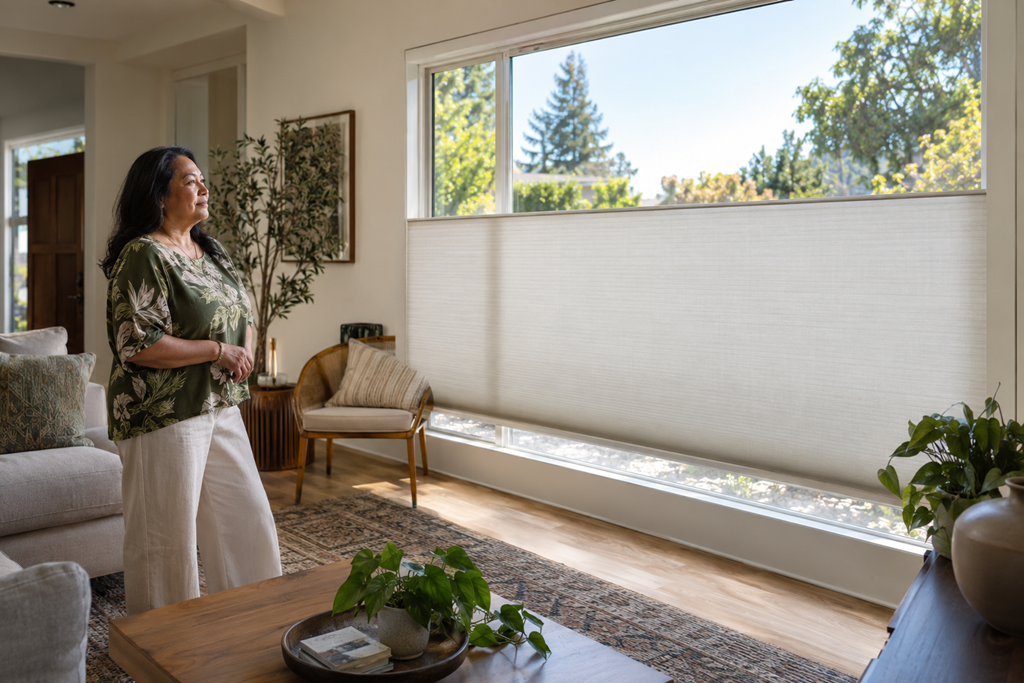
For example, covering the lower portion of a window while allowing daylight through the upper portion may work well when the primary privacy concern is a direct street-level sightline.
Layering can also provide flexibility. A lighter treatment can manage daylight during much of the day, while a more opaque layer can provide additional privacy when needed.
The point is not that one particular configuration is always better. It is that having more than two settings—completely exposed or completely covered—can make it easier to adapt the room throughout the day.
Look at the Material in the Actual Light
Small samples can be useful for comparing colors and textures, but they do not always reveal how a full window treatment will affect a room.
A material can look relatively transparent when held close to a bright window and noticeably more substantial under different lighting conditions. Color can also affect how light feels after passing through the treatment.
Sacramento's bright daylight can make these differences especially noticeable in rooms with significant sun exposure.
When possible, evaluate samples near the actual window being considered. Look at how much daylight remains in the room and how clearly objects, landscaping, buildings, or people can be seen through the material.
If you are working with a local window treatment professional, ask whether larger samples or demonstrations are available before making a final selection.
Avoid Choosing by Opacity Alone
Terms such as sheer, light-filtering, room-darkening, and blackout can be useful starting points, but they do not tell you everything about how a particular treatment will perform in your home.
Two light-filtering materials may provide noticeably different levels of privacy. Two rooms using the same material may also feel different because of window size, exterior conditions, interior lighting, or the distance between the window and nearby activity.
This is why choosing the darkest available option is not automatically the safest decision.
If the treatment blocks substantially more daylight than the room needs, you may solve one problem while creating another.
The better goal is enough privacy for the room's actual use while preserving as much useful daylight as you reasonably want.
A Few Questions Can Make Comparing Options Easier
If you are meeting with a Sacramento-area window treatment professional, a few focused questions can help keep the discussion centered on the privacy-and-light balance:
- How much privacy does this material provide during the day?
- What changes when interior lights are on at night?
- Will this treatment still allow diffused daylight into the room?
- Can part of the window remain uncovered while the main sightline is screened?
- Are there layered or adjustable options that would give me more control?
- Can I see a larger sample in the room before deciding?
These questions can also make it easier to compare recommendations from different providers because you are evaluating the same practical concerns rather than comparing appearance alone.
Common Choices That Can Lead to Regret
One common mistake is choosing a treatment entirely from a small sample without considering the full window.
Another is assuming that a sheer treatment automatically provides dependable privacy because it obscures the view during daylight.
At the opposite extreme, some homeowners select a very opaque covering immediately because privacy is important, only to realize later that the room now requires artificial lighting during parts of the day when natural light had previously been useful.
It is also easy to focus heavily on color, fabric, or decorative style before deciding how the treatment needs to function.
Those design details matter, but they are easier to evaluate once you know the level of coverage, adjustability, and light transmission that works for the room.
Aim for the Right Amount of Control
Choosing window treatments for privacy does not have to mean deciding between being completely exposed and blocking the window entirely.
Start with the actual sightline you want to control, think about how the room is used during both the day and evening, and compare how different materials affect daylight before committing to a treatment.
When discussing options with a local window treatment professional, be specific about when privacy matters and how much natural light you want to preserve. That gives you a clearer basis for comparing recommendations and choosing a treatment that works with the room rather than simply covering the window.