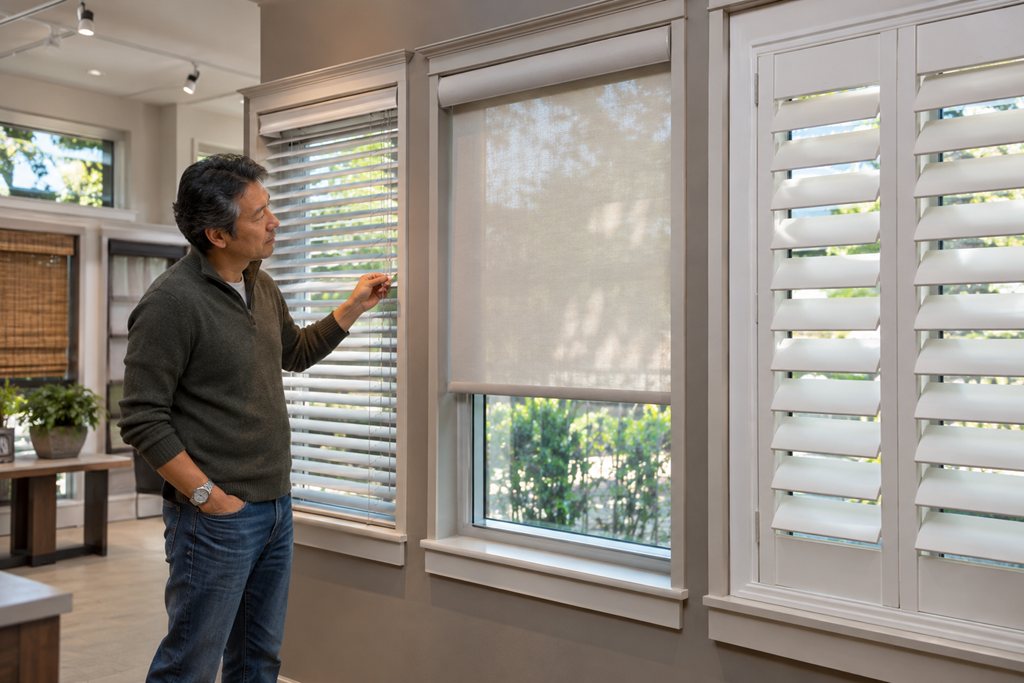
Comparing blinds, shades, shutters, curtains, and other window treatments involves more than choosing a style that looks good. Each option handles sunlight, privacy, views, cleaning, and daily operation differently, and the right fit can change from one window to the next. For Sacramento-area homeowners and renters, the useful starting point is understanding what each room needs before comparing products or installation proposals.
The challenge is that several window treatments can look equally appealing in a showroom while performing very differently at home. A blind may offer convenient control over the direction of incoming light. A fabric shade may create a softer appearance but provide fewer intermediate adjustments. Shutters, drapery, and specialty coverings introduce their own advantages and compromises.
This guide explains how the major options compare, what differences matter during everyday use, and how to evaluate recommendations before selecting products or arranging professional installation.
Start by separating appearance from function
Window treatments are both decorative and functional, but those two purposes do not always point toward the same choice.
A treatment that complements the furniture may still allow unwanted sunlight onto a television screen. A covering that provides substantial privacy may also make a room darker than expected. A product that looks streamlined when closed might occupy more space than anticipated when fully open.
Before comparing styles, identify the main job each window treatment needs to perform.
Decide which problem matters most
Consider these common priorities:
- Light control: Adjusting how much natural light enters a room.
- Privacy: Limiting visibility into the home during the day or evening.
- Glare reduction: Making screens, workspaces, or seating areas more comfortable.
- Room darkening: Reducing incoming light in bedrooms or other spaces.
- Heat management: Helping manage the effects of sunlight entering through windows.
- View preservation: Maintaining a connection to the outdoors when desired.
- Convenience: Making treatments easy to open, close, and adjust.
- Appearance: Coordinating the covering with the room's design.
These goals can overlap, but they are not interchangeable.
For example, reducing glare does not always require making a room substantially darker. Likewise, a treatment that provides daytime screening may not deliver the same privacy after dark.
The first useful comparison is therefore not between brands or materials. It is between what you want the window to accomplish and how different coverings achieve that result.
Understand how the main window treatment categories differ
Blinds, shades, shutters, and curtains all cover windows, but their construction and operation create meaningful differences.
Understanding these distinctions helps narrow the choices before comparing colors, fabrics, or installation prices.
Blinds: Adjustable light control through slats
Blinds typically use horizontal or vertical slats that can be adjusted to change light direction and visibility.
Horizontal blinds are common on conventional residential windows. Vertical blinds are often considered for wider openings and sliding glass doors.
Their main advantage is flexibility. Depending on the design, you can tilt the slats to redirect sunlight without raising or fully opening the entire covering.
However, tilted slats do not necessarily provide complete privacy or darkness. Light can pass through gaps, and visibility may change depending on the viewing angle.
Materials also matter. Some blinds are made from aluminum, vinyl, wood, or composite materials, each with different appearances and maintenance considerations.
Blinds may be worth comparing when:
- You want to adjust light without completely uncovering the window.
- You prefer a relatively structured appearance.
- You need different levels of visibility throughout the day.
- The window is opened or adjusted frequently.
One practical consideration is cleaning. Individual slats can collect dust, and the amount of maintenance may vary with their size, texture, and construction.
Shades: A broad category with different light-filtering behaviors
Shades generally use a continuous material that raises, lowers, folds, or rolls to cover the window.
Unlike conventional blinds, many shades do not provide independent slat adjustment. Their performance depends heavily on the material and operating design.
Several common types deserve separate consideration.
Roller shades use material that rolls around a tube. They often provide a streamlined appearance and are available in different levels of opacity.
Cellular shades have a structured, pocketed design that can provide insulating benefits. Their effectiveness depends on construction, fit, and the window conditions.
Roman shades fold into sections when raised and may appeal to homeowners who prefer a softer fabric appearance.
Woven shades use materials such as natural fibers or textured alternatives, creating a distinctive appearance but potentially allowing varying amounts of light and visibility.
The important distinction is that choosing a shade does not automatically determine how much light or privacy it will provide.
A light-filtering roller shade and a room-darkening roller shade can have substantially different effects even though they operate similarly.
Shades may be appealing when you prefer a continuous covering, want a particular fabric appearance, or need more control over the overall brightness of a room.
Shutters: A more architectural covering
Interior shutters generally consist of framed panels with adjustable louvers.
They can offer a structured appearance and allow some control over light and privacy through louver adjustment.
Unlike many blinds and shades, shutters also have panel-opening requirements. Their frames, hinges, and swing clearance can affect how they interact with nearby furniture, window handles, and surrounding trim.
Material construction may influence durability, moisture suitability, cleaning, and appearance.
Shutters may deserve consideration when you want a more integrated architectural look and are comfortable with their physical presence around the window.
However, they are not automatically the most practical choice for every opening.
Curtains and drapery: Flexible coverage with fabric character
Curtains and drapery panels can provide a softer visual treatment, substantial coverage, or a layered arrangement.
Their performance depends on fabric weight, lining, fullness, mounting position, and how the panels overlap.
Lightweight curtains may diffuse daylight while allowing considerable visibility. Heavier or lined drapery may provide stronger room darkening and privacy.
A major practical consideration is stacking space.
When opened, fabric panels need somewhere to gather. This can reduce the unobstructed view or interfere with nearby furniture if the arrangement is not planned carefully.
Drapery may be particularly useful when appearance, fabric texture, and broad window coverage are major priorities.
Specialty and layered options: Combining different functions
Some windows benefit from a treatment that does more than one job.
Examples include:
- Top-down/bottom-up shades: Selected designs allow coverage to be adjusted from different directions.
- Dual shades: Certain systems combine materials with different filtering or room-darkening properties.
- Sheer treatments: These can soften daylight while offering varying levels of screening.
- Panel-track systems: Sliding fabric panels may suit certain wide windows or patio doors.
- Layered treatments: A shade paired with drapery can separate daytime light control from stronger evening coverage.
Layering can improve flexibility, but it also introduces additional material, operating, mounting, and cost considerations.
More components do not automatically mean a better result. The useful question is whether the added layer solves a problem that a simpler treatment would leave unresolved.
Compare the options by what they actually do
Once you understand the categories, compare their everyday behavior rather than relying on appearance alone.
The following table summarizes broad differences. Actual performance varies by product, material, configuration, and installation.
Window treatment | Main practical strength | Important tradeoff |
|---|---|---|
Horizontal blinds | Adjustable slats for directing light | Dust collection and possible light gaps |
Vertical blinds | Adjustable coverage for wider openings | Slat movement, stacking, and clearance |
Roller shades | Simple operation and streamlined appearance | Light and privacy depend heavily on fabric |
Cellular shades | Light control with potential insulating benefits | Material and construction affect performance |
Roman shades | Soft fabric appearance with folding operation | Fabric stacking and cleaning considerations |
Interior shutters | Adjustable louvers and architectural appearance | Frame depth, clearance, and panel operation |
Curtains and drapery | Fabric flexibility and broad coverage | Stacking space and mounting requirements |
Layered treatments | Separate functions for light and privacy | Added components, complexity, and expense |
This comparison provides a starting point, not a final product recommendation.
Two roller shades made from different fabrics may behave less alike than a roller shade and another type of covering chosen for the same purpose.
The details of the actual product can matter as much as the category name.
Match the treatment to how each room is used
A whole-home window treatment project becomes easier to evaluate when you stop assuming every room needs the same solution.
Consistency in appearance can be desirable, but functional needs may differ considerably.
Bedrooms: Privacy and unwanted light
Bedrooms often require stronger privacy and light control than common living spaces.
A light-filtering shade may create a pleasant appearance during the day but allow more morning light than someone wants while sleeping.
Room-darkening or blackout-style products may provide better coverage, although the treatment material alone does not determine the finished result.
Light can enter around the sides, top, or bottom of some installations. Ask how the proposed product and mounting arrangement will affect those gaps.
Nighttime privacy also deserves attention, particularly if the room faces neighboring windows or outdoor walkways.
Living rooms: Balance daylight and visibility
Living areas may benefit from flexible adjustments that preserve daylight without leaving occupants exposed or creating uncomfortable glare.
Blinds with adjustable slats, certain shades, and layered arrangements can offer different ways of balancing these needs.
Consider whether the covering will remain partially open for much of the day.
A product that performs well only when completely closed may be inconvenient if you regularly want natural light and an outdoor view.
Home offices: Glare without unnecessary darkness
A home office can present a specific challenge: sunlight may make a computer screen difficult to see even when the room otherwise feels comfortable.
The objective is often to control the direction or intensity of light without making the workspace unnecessarily dark.
Adjustable blinds or appropriately selected filtering shades may deserve consideration.
The position of the desk and the angle of sunlight can be just as important as the covering itself.
Kitchens and bathrooms: Cleaning and moisture exposure
Rooms with moisture, splashes, cooking residue, or frequent cleaning needs require additional material consideration.
Some fabrics and natural materials may be less convenient in these environments than products designed for easier cleaning or greater moisture resistance.
Material suitability should be confirmed for the actual conditions rather than assumed from the product category.
Privacy and ventilation also matter, especially where occupants want coverage without unnecessarily limiting natural light.
Sliding doors and frequently used openings
A sliding glass door presents a different operating challenge from a conventional window.
A treatment may need to accommodate regular passage, a large glass area, nearby furniture, and door hardware.
Vertical blinds, panel-track systems, drapery, and certain specialty shades may offer different solutions.
The important question is how the treatment behaves when the door is being used, not just how it looks when closed.
Look closely at privacy, sunlight, and room comfort
Some of the most important differences between window treatments are difficult to judge from a small sample.
A material can appear opaque when viewed against a solid surface but become noticeably translucent when illuminated from behind.
Daytime privacy is not the same as nighttime privacy
During the day, outdoor brightness may make it difficult for someone outside to see through certain screening materials into a darker room.
After sunset, interior lighting changes that relationship.
Sheer fabrics, open-weave materials, and some light-filtering shades may reveal more interior activity than expected.
Before choosing a treatment, ask what visibility is likely to be like under both lighting conditions.
A demonstration with light behind the material can be more informative than examining an unlit sample.
Understanding how to evaluate privacy before choosing window treatments can help you identify which rooms need stronger coverage at different times of day.
Glare reduction is different from room darkening
A room can be bright without feeling uncomfortable, while a narrow area of direct sunlight can create substantial glare.
Blocking nearly all incoming light may solve the glare problem but create a different inconvenience.
For some rooms, an adjustable covering or a carefully selected filtering material may provide a better balance.
The decision depends on where sunlight lands, when the room is occupied, and how much daylight you want to preserve.
Heat control deserves separate attention
Sacramento-area homeowners may place particular importance on windows receiving strong sun exposure during warmer periods.
However, visible light reduction and heat-management performance are not identical.
A darker-looking product is not necessarily the most effective option for every heat-related concern.
Different materials, constructions, colors, and installation arrangements can produce different results.
If heat management is a major goal, ask the provider to explain the relevant product characteristics and any supporting performance information rather than assuming that appearance predicts effectiveness.
Window treatments may contribute to comfort, but they should not be treated as a guaranteed solution to broader insulation or cooling problems.
Learning more about how sun exposure affects window covering choices can help you assess which windows need more attention before comparing materials.
Pay attention to how the treatment opens and closes
A window treatment is something you may operate repeatedly for years.
Convenience can matter more in everyday life than it does during a brief showroom visit.
Consider reach and frequency of use
Think about whether the treatment will be adjusted several times a day or left in one position for long periods.
A manually operated product may be practical on an easily reached window but inconvenient on a tall opening or behind furniture.
Operation should feel manageable for the people who regularly use the room.
Ask to try the actual operating mechanism, or a representative demonstration, before deciding.
Compare cordless and motorized operation
Cordless designs can reduce the hazards associated with accessible operating cords. Window covering safety is especially important in homes where young children may be present.
Ask providers about current child-safety features and appropriate products for the household.
Motorized treatments can be useful for high windows, difficult-to-reach locations, or situations where convenient adjustments are a priority.
However, motorization may introduce additional components, power requirements, setup considerations, and future maintenance needs.
Some systems use batteries, while others depend on different power arrangements.
A provider should explain how the specific system operates, how it will be powered, and what happens if service is needed.
Examine the covering when fully open
An often-overlooked comparison is how much of the glass remains visible when the treatment is raised, folded, or stacked.
A roller shade may leave a compact roll above the opening. A Roman shade may create a more visible folded stack. Drapery requires lateral gathering space, while shutters need room for panel movement.
The details depend on the selected product and installation design.
Consider whether the result affects your view, window access, or nearby objects.
A treatment that appears unobtrusive when closed may create a different physical presence when open.
Understand how materials affect maintenance and longevity
Two window treatments with similar appearances can require very different care.
Material selection influences how readily surfaces collect dust, how they respond to moisture, and whether cleaning is straightforward.
Blinds with numerous slats may require regular attention to individual surfaces. Some smooth materials may be easier to wipe clean than textured fabrics.
Fabric shades and drapery may need more specialized cleaning, depending on the material and manufacturer's instructions.
Wood and natural-fiber products may have different moisture and environmental limitations from synthetic alternatives.
Before choosing, consider:
- How often will the treatment need cleaning?
- Can the material be maintained using methods you are comfortable with?
- Is it suitable for the room's moisture and sunlight conditions?
- Are components or replacement parts available if something wears out?
- What does the product warranty cover, and what is excluded?
Durability should not be judged solely from material labels.
Construction quality, hardware, operating frequency, installation conditions, and maintenance can all influence how a treatment performs over time.
A more expensive material is not automatically more durable or appropriate for your particular use.
Compare the entire installation, not just the covering
Even after selecting a preferred treatment type, the installation arrangement can change the finished appearance and function.
This is especially important when ordering custom products.
Inside mounting versus outside mounting
An inside-mounted treatment generally sits within the window opening, while an outside-mounted treatment is positioned beyond the opening.
The choice may influence how much trim remains visible, the amount of coverage, light gaps, and the treatment's physical relationship to the window.
Not every product will fit every opening in the same way.
Window depth, handles, uneven surfaces, surrounding trim, and other details may affect what is practical.
A qualified installer can evaluate these conditions and explain the available arrangements.
Special window shapes and connected openings
Unusually shaped windows, very wide openings, and multiple adjacent windows may require more planning than ordinary rectangular windows.
The selected treatment may need to account for separate operating sections, consistent alignment, or limitations in available product dimensions.
A treatment that works well on one standard window may not transfer directly to a larger or more complicated opening.
This does not necessarily mean the project requires the most elaborate product.
It means the recommendation should reflect the actual window configuration.
Consider the finished appearance from inside and outside
Color, texture, material thickness, and hardware can influence how a treatment looks in different lighting.
Some products also have different appearances on the room-facing and window-facing sides.
If the windows are prominent from the street or backyard, consider what the coverings will look like from outside.
For a group of visible windows, consistency may matter even when individual rooms use different products.
The goal is to find a workable relationship between appearance and function rather than forcing identical coverings into every space.
Compare value by understanding what is included
Cost comparisons can become misleading when two proposals include different products, materials, operating systems, or installation services.
One estimate may cover basic manually operated blinds for standard openings.
Another may involve custom shades, specialized materials, motorization, removal of existing coverings, or installation around challenging window conditions.
Those proposals should not be judged as though they describe identical work.
Factors that may affect the total cost include:
- Number, size, and shape of windows.
- Standard versus custom product dimensions.
- Material and construction quality.
- Manual versus motorized operation.
- Mounting hardware and installation complexity.
- Access to tall or difficult-to-reach openings.
- Removal or disposal of existing treatments.
- Warranty coverage and any included follow-up service.
Ask whether the quoted amount covers measurement, ordering, delivery, installation, adjustments, and applicable optional features.
For custom orders, also clarify when selections and measurements become final, whether changes are possible, and what could affect the installation schedule.
The lowest estimate may not include everything you expect. Conversely, a higher estimate does not automatically indicate a better product or installation.
A useful comparison identifies what you are receiving and whether those features address your actual priorities.
Use demonstrations to test the tradeoffs before committing
Product samples are valuable, but they are most useful when you evaluate them with specific questions in mind.
Rather than trying to compare every available design, narrow the selection to a few serious options.
Compare materials under realistic lighting
Ask whether samples can be examined near an actual window.
Notice the appearance when daylight passes through the material, not only when the sample is held against a wall.
If privacy matters, consider how the treatment might behave with interior lights turned on after dark.
A showroom cannot always reproduce your home's exact conditions, but a thoughtful demonstration can reveal differences that product photographs overlook.
Test the movement and controls
Operate the sample if possible.
Notice how smoothly it raises, lowers, tilts, slides, or folds.
Pay attention to the space required when open and whether adjustment is likely to be convenient at home.
For motorized products, ask to see how the control system works and what routine upkeep may involve.
Ask what the sample does not show
A small demonstration may not reveal the complete installed appearance.
For instance, a sample might not show the final mounting hardware, edge gaps, fabric stacking, or exact relationship to the window trim.
Ask whether photographs or full-size demonstrations of comparable installations are available.
The purpose is not to predict every detail perfectly. It is to understand which expectations have been demonstrated and which still depend on the final measurements and installation design.
Questions that help narrow the final choice
After reviewing the products and your window conditions, a short conversation with a window treatment professional can help resolve remaining uncertainties.
Consider asking:
- Which two or three treatment types fit my main priorities, and why?
- What would I give up by choosing one option instead of another?
- How will the proposed material perform for daytime and nighttime privacy?
- What should I expect regarding glare, incoming light, and room darkening?
- How much of the window will remain covered when the treatment is fully open?
- Will the proposed mounting method affect the window's appearance or operation?
- What maintenance, power requirements, or replacement components should I anticipate?
- What is included in the estimate, and what could change before installation?
The answers should relate to your actual rooms and openings.
A provider who recommends the same product for every window without discussing different needs may be overlooking useful distinctions.
Similarly, be cautious when explanations focus almost entirely on appearance, promotional offers, or upgrades while leaving practical questions unanswered.
You should be able to understand why a product is being recommended, what limitations it has, and what installation involves before approving an order.
Once you've narrowed your product choices, understanding how to evaluate a window treatment company before hiring can help you compare the providers responsible for measuring, ordering, and installing them.
Make the decision window by window
The most practical way to compare window treatments is to begin with the problem each opening needs to solve, identify the products capable of addressing it, and then evaluate their tradeoffs.
For one room, adjustable blinds may provide the flexibility you need. Another may benefit from a fabric shade that softens sunlight. A bedroom may require stronger coverage, while a sliding door may call for a treatment designed around frequent movement.
There is no requirement that every window use the same category.
Before committing, confirm how your preferred options will manage light and privacy, how they will operate, what maintenance they require, and what the finished installation will include.
A thoughtful selection is one that makes sense not only when the treatment is new, but also during the ordinary routines of daily life.