Choosing flooring involves more than finding a color or style that looks right in your home. Different flooring materials respond differently to daily foot traffic, moisture exposure, spills, cleaning routines, and long-term wear. For Sacramento-area homeowners planning a flooring installation or replacement, understanding these differences can make it easier to compare options, discuss practical needs with flooring professionals, and choose a material that fits how each space will actually be used.
A floor that performs well in a quiet bedroom may not be the most practical choice for a busy kitchen, entryway, or household with pets. Similarly, a material that handles occasional spills may not be suitable for a room with persistent moisture problems.
The goal is not necessarily to find one flooring material that works everywhere. It is to understand how traffic, moisture, and maintenance affect each option so you can make a more informed decision before requesting estimates or committing to an installation.
Start with how each room will be used
The most useful flooring comparison begins with the conditions the material will experience after installation.
Two rooms in the same house can have very different flooring requirements, even when the homeowner wants a consistent appearance throughout the property.
Consider three practical questions:
- How much daily traffic will the floor receive?
- What types of moisture or spills could reach the flooring?
- How much cleaning and ongoing maintenance are you willing to manage?
These questions help narrow the choices before appearance, product pricing, or installation estimates become the main focus.
Traffic involves more than the number of people
A room's traffic level depends on how people use the space, not simply how often they enter it.
For example:
- Entryways may experience tracked-in dirt, outdoor moisture, and abrasive debris from shoes.
- Hallways often receive repeated foot traffic along the same walking paths.
- Kitchens may experience standing activity, dropped objects, food spills, and frequent cleaning.
- Living rooms can experience furniture movement, pets, children, and concentrated traffic around seating areas.
- Bedrooms generally receive different traffic patterns and may place greater emphasis on comfort and sound.
- Laundry rooms may experience occasional water exposure and the weight or movement of appliances.
Even within a single room, certain areas can receive substantially more wear than others.
When comparing flooring, explain these conditions to the installer rather than describing a room only as busy or lightly used.
Think about the household, not just the room
Flooring needs can change depending on the people and activities involved.
A household with large dogs may place greater emphasis on scratch resistance, surface texture, and cleaning convenience. A family with young children might prioritize spill cleanup and resistance to everyday wear. Someone who prefers walking barefoot may care more about surface comfort.
Furniture type, rolling office chairs, mobility needs, and cleaning preferences can also influence material suitability.
The better you understand your actual use patterns, the easier it becomes to distinguish a visually appealing product from one that is practical for your household.
How common flooring materials compare
Several flooring categories appear frequently in residential installation and replacement projects. Each offers different advantages, limitations, and maintenance expectations.
The following comparison provides a starting point rather than a universal ranking.
Flooring material | Daily traffic considerations | Moisture considerations | Typical maintenance needs |
|---|---|---|---|
Luxury vinyl plank or tile | Performance depends on product construction, protective wear layer, and installation | Many products resist surface water, but moisture can still affect seams, edges, or the subfloor | Regular sweeping and manufacturer-approved damp cleaning |
Laminate | Often resists everyday surface wear, depending on product quality | Water exposure at joints and edges can be a concern; some products offer enhanced water resistance | Dry cleaning and limited moisture according to product instructions |
Porcelain or ceramic tile | Durable surface for many active areas; impact can chip or crack individual tiles | Tile surfaces generally tolerate water well, but grout, underlying materials, and installation details matter | Routine cleaning, grout care, and maintenance of appropriate sealants where required |
Engineered hardwood | Wear performance depends on wood species, finish, and top-layer construction | Usually better suited to controlled interior conditions than repeated standing water | Sweeping, approved cleaning products, and finish-conscious care |
Solid hardwood | Can provide long service when properly selected and maintained, but scratching and denting vary by species and finish | Sensitive to moisture and humidity changes | Regular cleaning, moisture control, and possible future refinishing |
Carpet | Wear resistance depends on fiber, construction, density, and padding | Spills, stains, and trapped moisture require attention | Vacuuming, periodic deeper cleaning, and prompt spill treatment |
The actual performance of any flooring product depends on its specifications, installation requirements, room conditions, and maintenance.
A material category alone does not tell you how a particular product will perform.
Luxury vinyl flooring: practical, but not automatically problem-free
Luxury vinyl plank (LVP) and luxury vinyl tile (LVT) are often considered for active households because many products combine relatively straightforward surface cleaning with resistance to everyday spills.
However, the word waterproof requires careful interpretation.
Some vinyl products are described as waterproof because the flooring components themselves resist damage from water. That does not mean water cannot enter through joints, reach the subfloor, or create problems beneath the installed flooring.
Product construction, joint design, installation method, and subfloor moisture conditions still matter.
When comparing vinyl products, ask about the protective wear layer, expected use conditions, cleaning restrictions, and the manufacturer's installation requirements.
Laminate: surface durability with important moisture distinctions
Laminate flooring can offer strong resistance to certain types of everyday surface wear, depending on its construction and protective finish.
Its main tradeoff often involves moisture.
Traditional laminate products may be vulnerable to swelling or damage when water reaches susceptible joints or core materials. Some newer products are designed for improved spill resistance, but performance claims differ.
A product described as water-resistant should not automatically be treated as suitable for prolonged standing water.
For Sacramento homeowners considering laminate in kitchens, entryways, or other spill-prone spaces, it is worth reviewing the specific manufacturer's moisture limitations rather than relying only on broad category descriptions.
Tile: strong surface durability with different comfort and maintenance needs
Porcelain and ceramic tile can work well in areas where surface moisture resistance and wear durability are priorities.
However, tile brings its own considerations.
Hard surfaces may feel less comfortable underfoot during extended standing, and grout lines can require additional cleaning. Dropped objects may break, and individual tiles can chip or crack under certain conditions.
Tile performance also depends on proper substrate preparation, installation, and suitability for the intended location.
For areas that frequently become wet, slip resistance deserves particular attention. Not every tile finish is appropriate for every wet or dry setting.
Hardwood: appearance, repairability, and environmental sensitivity
Solid and engineered hardwood can provide a natural appearance that many homeowners value.
However, the two categories are not interchangeable.
Solid hardwood is made from a single piece of wood, while engineered hardwood typically has a real wood surface bonded to multiple supporting layers.
Some engineered products offer improved dimensional stability under certain environmental conditions, but both types require attention to moisture, installation suitability, and maintenance.
The ability to refinish a floor also varies.
Solid hardwood can often be refinished multiple times when sufficient material remains. Engineered hardwood refinishing depends on the thickness and construction of its real wood top layer.
Neither category should be assumed appropriate for repeated standing water.
Carpet: comfort and sound with different cleaning demands
Carpet remains an option where softness, warmth underfoot, and sound absorption matter.
Bedrooms and certain living areas may benefit from these characteristics.
However, carpet fibers can retain dust, debris, and moisture, and different products vary considerably in stain resistance and cleanability.
Fiber type, pile construction, density, and the carpet cushion can all influence performance.
A household with pets, frequent spills, or high traffic should compare the specific carpet system rather than assuming that all carpet wears or cleans the same way.
Match the flooring to the kind of wear it will experience
Flooring descriptions frequently use terms such as durable, scratch-resistant, and heavy-duty.
These terms can be useful, but they do not all describe the same type of performance.
Scratch resistance is not the same as dent resistance
A flooring product may resist visible scratches while remaining vulnerable to dents or damage from concentrated impacts.
For example, the finish on a hardwood floor might resist minor surface abrasion, but the wood beneath can still dent from furniture or dropped objects.
Similarly, a hard tile surface may resist many scratches while remaining susceptible to chipping under impact.
Consider which kinds of damage are most likely in your home.
Repeated traffic can wear certain areas faster
Walkways between the kitchen, dining room, and entryway may experience significantly more use than the edges of those same rooms.
Depending on the flooring, long-term wear may appear as surface abrasion, loss of finish, flattened fibers, or changes in texture.
Ask flooring professionals which product characteristics address repeated traffic, and whether a particular product has usage limitations or an applicable residential wear classification.
Avoid assuming that a thicker product automatically has better wear performance. Overall thickness, protective surface construction, and durability are different characteristics.
Pets and furniture create different demands
Pets can introduce repeated claw contact, tracked-in dirt, and occasional moisture.
Furniture legs may concentrate weight in small areas. Rolling chairs and frequently moved furniture can create additional wear.
Flooring professionals may recommend suitable protective pads, furniture supports, or mats, but these accessories do not eliminate the need to select an appropriate flooring surface.
The objective is to match the material's actual characteristics to predictable household use.
Understand the difference between spills and ongoing moisture
Moisture is one of the most important factors to evaluate before choosing flooring.
However, not all moisture exposure is alike.
A small spill that is cleaned promptly is different from repeated water exposure, an appliance leak, moisture beneath the floor, or an ongoing humidity problem.
Those differences can change which products are appropriate.
Surface moisture
Surface moisture includes tracked-in rainwater, spilled drinks, kitchen splashes, and other water that reaches the exposed flooring surface.
Some products are designed to tolerate these conditions better than others.
Yet even moisture-resistant floors have limits, particularly around seams, transitions, edges, and penetrations.
A manufacturer may specify how quickly standing water should be removed or which cleaning methods are acceptable.
Moisture beneath the flooring
Moisture originating from a concrete slab, crawlspace conditions, plumbing problem, or another underlying source requires a different evaluation.
A flooring surface that tolerates spills may still be unsuitable for installation over a substrate with excessive moisture.
This distinction matters for Sacramento-area homes with different foundations, room additions, or older flooring installations.
The relevant issue is the actual condition of the property, not an assumption that a certain type of home always has a particular moisture problem.
Before selecting flooring, ask whether the installer will evaluate substrate moisture where appropriate and explain what conditions must be met for the selected flooring system.
Humidity and seasonal conditions
Some flooring materials expand or contract as indoor conditions change.
Wood-based flooring is particularly sensitive to changes in moisture content.
Manufacturers may specify environmental conditions that need to be maintained before, during, and after installation.
For Sacramento-area homeowners, indoor cooling, heating, ventilation, and seasonal changes may all affect interior conditions.
The practical question is whether the proposed flooring is compatible with the environment the household can reasonably maintain.
Moisture resistance is not a substitute for correcting a problem
If an existing floor shows unexplained discoloration, swelling, recurring dampness, or other evidence of moisture-related damage, selecting a more water-resistant covering may not address the underlying cause.
A qualified flooring professional may need to assess the flooring and substrate, and another appropriate specialist may be needed if the moisture source falls outside the installer's scope.
It is better to understand the condition before choosing a replacement product than to rely on the flooring itself to solve it.
Compare what maintenance will actually involve
Two flooring materials can appear equally convenient in a showroom but require noticeably different care at home.
Maintenance is not just about how often a floor needs cleaning. It also involves which products can be used, how quickly spills must be addressed, and what happens when the surface becomes worn.
Everyday cleaning
Before choosing a material, consider whether the recommended cleaning routine matches your habits.
Some flooring systems allow routine damp cleaning with approved products. Others require greater moisture control or specific cleaning solutions.
Steam cleaning, aggressive scrubbing, excessive water, and certain chemical cleaners may be unsuitable for particular flooring systems.
Do not assume a cleaning method is acceptable simply because it works on another floor in the house.
Long-term surface care
Maintenance also includes how a floor responds to aging and damage.
For example:
- Some hardwood floors can be sanded and refinished, depending on their construction and condition.
- Certain vinyl or laminate products may require replacement of damaged planks rather than refinishing.
- Tile installations may need grout maintenance or individual tile repairs.
- Carpet may need periodic professional cleaning or replacement when wear becomes significant.
These differences matter because the initial installation cost is only one part of the flooring decision.
A material that fits your cleaning preferences and repair expectations may offer better practical value than a product chosen mainly for appearance.
Consider your willingness to maintain the finish
Some homeowners are comfortable following specialized cleaning instructions and addressing minor finish wear.
Others prefer a floor that requires fewer material-specific decisions.
Neither preference is inherently better.
What matters is knowing the maintenance commitment before installation, especially if you plan to use the same flooring across several rooms.
Decide whether one flooring material should serve the entire home
Consistent flooring can create a connected appearance between rooms.
However, using one material throughout a house can involve compromises.
A flooring product suitable for a bedroom may not offer the moisture resistance preferred in a laundry room. A hard surface appropriate for an entryway may not provide the comfort or acoustics desired elsewhere.
There are three broad approaches worth comparing.
Use one material across most rooms
This approach can simplify the appearance of connected areas and reduce the number of flooring transitions.
It may make sense when the selected product fits the expected conditions in each room.
The important limitation is that convenience and visual consistency should not override the material's installation or moisture restrictions.
Choose different materials for different conditions
Some households prefer a combination of surfaces.
For example, tile might be considered in a moisture-prone area while another flooring material is chosen for bedrooms.
This allows each room's practical requirements to influence the selection.
The tradeoff is that different flooring heights, transitions, cleaning methods, and visual finishes may need to be coordinated.
Combine materials selectively
Another option is to maintain a consistent material through the main living areas while using a different surface in spaces with unusual wear or moisture needs.
A flooring professional can explain whether the proposed transitions are practical and how adjacent floor heights, door clearances, and installation methods affect the plan.
The most suitable approach depends on the property layout and the specific products being considered.
How installation conditions can change the material decision
Flooring is not installed in isolation.
The existing floor, underlying substrate, room layout, and selected installation system can influence both product suitability and project scope.
These considerations deserve attention before a homeowner compares final estimates.
Existing flooring and subfloor condition
A new floor may require a suitable surface beneath it.
Unevenness, existing damage, moisture, unsuitable underlayment, or previous installation methods can affect what preparation is necessary.
Different flooring systems have different requirements for flatness, moisture, and substrate condition.
A product that appears attractive in a showroom may become a less practical choice if the property requires extensive preparation to meet its installation specifications.
This does not automatically mean the material should be rejected. It means the required work needs to be understood.
Floating, glued, and mechanically fastened systems
Flooring materials may be installed using different methods, depending on the product and site conditions.
Some systems float over an approved underlayment, while others are attached to the substrate using adhesives or mechanical fasteners.
These methods can affect preparation requirements, sound, transitions, and suitability for particular rooms or substrates.
Homeowners do not need to master the technical installation process.
However, they should understand why a professional recommends a particular method and whether it is consistent with the manufacturer's requirements.
Transitions, doors, and existing fixtures
The finished flooring height can affect how adjoining rooms connect.
Potential considerations include:
- Door clearance
- Flooring transitions between rooms
- Baseboards and trim
- Appliance clearance
- Existing cabinets and fixtures
- Stair and landing details where applicable
These details may not be visible when comparing product samples.
A flooring professional should evaluate relevant site conditions and explain whether the selected flooring creates additional installation requirements.
Compare material value, not just the purchase price
Flooring projects involve more than the price of the visible surface material.
The full project may include removal of existing flooring, preparation, underlayment, installation labor, transitions, trim work, disposal, and other necessary tasks.
A lower-priced material is not always the lowest-cost completed installation.
Similarly, a more expensive flooring product does not automatically provide greater value for every household.
Compare the complete installed scope
When reviewing estimates, confirm whether each proposal includes the same work.
For example, one estimate may include removal and disposal of the existing flooring, while another assumes the room will already be prepared.
One provider may identify substrate preparation as a separate potential cost, while another may include a defined allowance.
These differences can make estimates difficult to compare unless the scope is explained.
Consider realistic service life and repair options
A product's expected usefulness depends on the household environment, installation, cleaning practices, and product characteristics.
Longer warranty language does not necessarily mean the flooring will remain free of visible wear for that entire period.
Ask what the product warranty actually covers, what is excluded, and whether particular conditions or maintenance practices can affect coverage.
Also consider how damage would be addressed.
A floor that permits individual plank replacement may have different repair implications from one that requires refinishing or larger-area replacement.
Avoid treating one specification as the entire value story
A particular wear-layer thickness, product thickness, hardness rating, or warranty length may be useful, but it does not tell the whole story.
Product specifications should be interpreted within the appropriate flooring category.
A meaningful comparison considers the material's intended use, relevant performance characteristics, installation compatibility, maintenance requirements, and total project scope.
What to bring to a flooring showroom or estimate appointment
You can make material recommendations more useful by preparing a basic description of the rooms before meeting with a flooring professional.
You do not need detailed construction measurements or technical drawings to start the conversation.
Useful information includes:
- Rooms involved: Which spaces need new flooring, and whether the project includes connected areas.
- Traffic patterns: Where people, children, or pets spend the most time.
- Moisture exposure: Whether the spaces experience frequent spills, tracked-in water, or known moisture concerns.
- Cleaning preferences: Whether you prefer simple daily cleaning or are comfortable with specialized care.
- Existing conditions: Visible unevenness, prior water damage, loose flooring, or unusual transitions.
- Appearance goals: Whether consistent flooring between rooms matters to you.
- Project boundaries: Whether you are replacing one room's flooring or coordinating several spaces.
Photographs of the current rooms can help communicate the layout and visible conditions, although they do not replace an on-site assessment when one is needed.
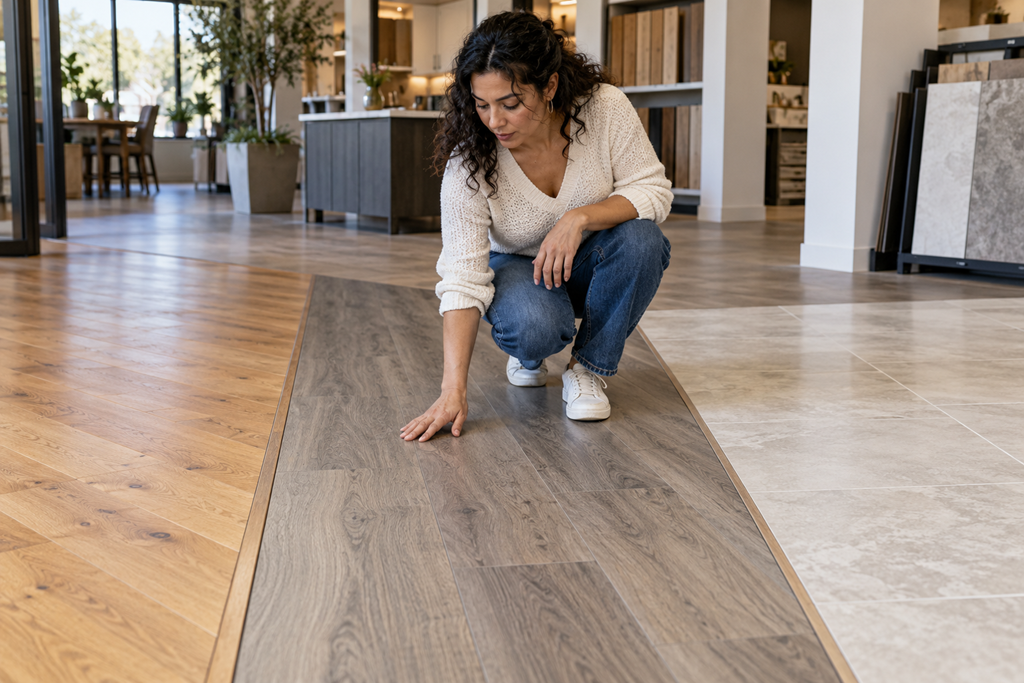
If possible, ask to see larger installed displays rather than relying entirely on small handheld samples.
The appearance of seams, surface texture, sheen, and transitions can be easier to understand when viewed across a larger area.
Questions that help distinguish flooring recommendations
The most productive flooring conversations connect product recommendations directly to your household conditions.
Instead of asking which flooring material is the best, ask why a particular product fits the way you plan to use the space.
Consider these questions:
1. Which of these materials is most suitable for the traffic and wear conditions in my rooms? Ask for an explanation tied to the specific products being recommended.
2. How does each option handle spills, standing water, and moisture beneath the floor? These are separate concerns and may involve different limitations.
3. What cleaning methods and products does the manufacturer recommend or prohibit? This helps you evaluate the real maintenance commitment.
4. How would scratches, dents, stains, or other damage typically be addressed? Compare repair possibilities before assuming that every surface can be restored.
5. What existing-floor or subfloor conditions could change the recommendation? Ask whether further evaluation or preparation may be necessary.
6. What installation work is included in the estimate, and what could become an additional charge? Clarify removal, preparation, transitions, trim, and disposal as applicable.
7. What product and workmanship warranty information will I receive? Understand the coverage, exclusions, and responsibilities involved.
A flooring professional should be able to explain the reasoning behind the recommendation in language you can understand.
If a recommendation depends mainly on a broad claim such as "completely maintenance-free," "impossible to scratch," or "waterproof in every situation," ask for the specific product limitations.
Likewise, be cautious about a recommendation that ignores a known moisture concern or does not account for relevant installation conditions.
Such concerns do not automatically mean a provider is unsuitable, but they are reasons to seek clarification or another professional opinion.
Make the final comparison using the conditions that matter most
Once you have narrowed the options, compare the actual products rather than returning to general material categories.
A simple comparison can help organize the decision:
Decision factor | What to look for |
|---|---|
Traffic and wear | Product suitability for repeated use, abrasion, furniture, and pets |
Moisture | Surface-water limitations, seam performance, and substrate requirements |
Maintenance | Approved cleaning methods, routine care, and restrictions |
Comfort | Surface feel, hardness, and sound characteristics |
Appearance | Finish, texture, seams, and how the material works across connected rooms |
Installation | Subfloor preparation, installation method, and transitions |
Long-term value | Installed scope, repair options, warranty terms, and expected upkeep |
You may find that one option performs particularly well in an area you care about but requires a compromise elsewhere.
For example, a highly moisture-resistant surface may feel harder underfoot. A natural wood floor may offer refinishing possibilities but require more attention to moisture. A soft carpet may provide comfort but demand more intensive cleaning.
These are useful distinctions rather than reasons to eliminate an entire category.
If two products appear equally suitable, the final choice may come down to the details of their maintenance, installation requirements, appearance, and total installed cost.
Choosing flooring that fits everyday life
The most useful flooring decision is not necessarily the one that produces the most impressive showroom appearance.
It is the one that balances how the rooms are used, the moisture conditions they experience, and the care you are realistically prepared to provide.
For Sacramento-area homeowners, comparing flooring materials becomes more manageable when the decision is based on actual household needs rather than broad claims about durability or popularity.
Before committing, make sure the material recommendation, installation scope, product limitations, and maintenance expectations all make sense together.
A flooring choice that fits your daily routines and property conditions is a stronger starting point for a successful installation than appearance or purchase price alone.