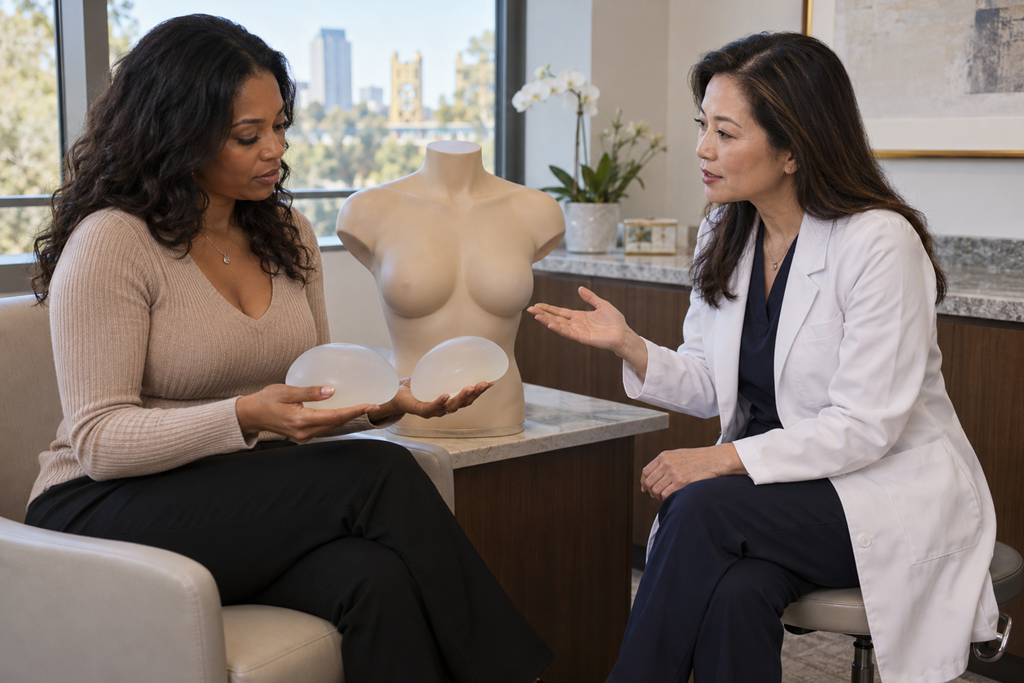
Discussing breast implant surgery with a surgeon involves more than explaining the appearance you hope to achieve. A useful consultation should help you understand which goals may be realistic for your individual anatomy, what compromises different surgical options may involve, and which risks or future responsibilities deserve consideration. For Sacramento-area patients exploring breast augmentation, the conversation is an opportunity to examine expectations, understand professional recommendations, and decide whether moving forward makes sense for their circumstances.
The challenge is that personal goals and surgical possibilities do not always match perfectly. A patient may have a particular breast size, shape, or overall appearance in mind, while a surgeon may identify anatomical limitations, health considerations, or tradeoffs that affect the available options.
A productive consultation makes room for both perspectives. You should be able to describe what matters to you while receiving an individualized explanation of what surgery may and may not accomplish.
This guide focuses on how to have that conversation, understand the answers, and recognize when additional information or another professional opinion would be worthwhile.
Start by describing the change you actually want
One of the most useful things you can do before a breast implant consultation is separate your desired appearance from the particular procedure or implant specifications you may have researched.
For example, a patient might enter the consultation believing that a certain implant size will create the appearance they want. However, implant volume alone does not determine the final result.
Existing breast tissue, chest dimensions, skin characteristics, breast position, implant characteristics, and surgical technique can all affect the outcome.
Instead of beginning with a specific implant size, consider describing the appearance or proportion you hope to discuss.
Your priorities might include:
- Creating more fullness relative to your current breast appearance.
- Exploring changes in breast shape or overall proportions.
- Understanding whether a particular degree of fullness is achievable.
- Discussing visible asymmetry between the breasts.
- Considering how changes might appear in everyday clothing.
- Understanding how the result may change with aging, pregnancy, or weight fluctuations.
These are starting points for a discussion, not guarantees that surgery can accomplish every goal.
Explain what you like about your current appearance, too
A consultation does not need to focus exclusively on what you want to change.
You might appreciate certain aspects of your existing breast shape or proportions and want to understand whether those characteristics could be preserved.
For example, someone interested in additional fullness may also care about maintaining a particular overall silhouette.
Explaining both preferences gives the surgeon more information about what you consider an acceptable result.
It also creates an opportunity to identify competing goals before decisions are made.
Distinguish your priorities from your preferences
Not every desired characteristic carries equal importance.
You might consider one goal essential while viewing another as negotiable.
A useful way to organize your thoughts is to identify:
- Primary goal: The change you most want to discuss.
- Secondary preferences: Characteristics you would appreciate but might reconsider.
- Unacceptable possibilities: Outcomes or compromises that would substantially affect your decision.
- Unanswered concerns: Questions that could change whether you want surgery at all.
This distinction can make the consultation more productive because the surgeon can explain which goals may be compatible and which might involve competing considerations.
Understand why the surgeon's assessment may change the conversation
Breast augmentation is not simply a matter of selecting a preferred appearance and having it reproduced surgically.
A qualified surgeon must evaluate the individual patient's anatomy, health history, goals, and other relevant factors before discussing suitable options.
That evaluation may include breast and chest measurements, skin characteristics, existing breast tissue, symmetry, and medical considerations.
The surgeon may also review relevant medical history, medications, previous procedures, and other health information that could influence surgical planning.
The important distinction is between what you would like to achieve and what the surgeon considers medically appropriate and reasonably achievable.
Your goals are personal; the clinical assessment is individualized
You are the person who determines which appearance changes matter to you.
The surgeon is responsible for explaining the medical and anatomical considerations associated with possible approaches.
These responsibilities should complement one another.
A surgeon should not dismiss your preferences without explaining why they may be difficult to achieve. At the same time, a patient's preferred appearance should not override legitimate concerns about procedural risks or suitability.
For example, you might ask about a particular degree of fullness.
Rather than simply approving or rejecting the idea, the surgeon should be able to discuss the relevant anatomical considerations, limitations, alternatives, and potential compromises.
An explanation does not need to guarantee a particular result to be useful.
Ask what could change the recommendation
Recommendations may depend on information that is not obvious before a clinical examination.
Questions worth considering include:
- Which aspects of my anatomy are most relevant to the goals I described?
- Are there limitations that could affect the appearance I hope to achieve?
- What concerns would make you recommend a different approach?
- Are there circumstances in which you would advise against surgery?
- What additional information would you need before making a recommendation?
A thoughtful response should help distinguish personal preference from clinical judgment.
If the surgeon determines that a requested outcome is not appropriate or realistic, understanding the reasoning may be more valuable than finding someone who immediately agrees with the original request.
Discuss the tradeoffs behind different implant and placement options
Breast implant surgery involves decisions that can affect appearance, surgical planning, recovery, and future considerations.
These may include implant filling, shape, dimensions, surface characteristics, placement, incision location, and other features.
Not every option is appropriate for every patient.
The consultation should help you understand the relevant choices without requiring you to become an expert in surgical techniques.
Implant characteristics involve more than appearance
Patients may encounter discussions about saline-filled and silicone gel-filled implants.
They may also hear about differences in implant shape, profile, dimensions, and surface characteristics.
These characteristics can influence surgical planning and may involve different benefits, limitations, and risks.
For example, the filling material can affect how implant rupture may be recognized. Certain implant surface characteristics are also relevant to discussions of rare implant-associated cancers.
The goal is not to decide which implant sounds most appealing based on a product description.
Instead, ask why a particular option is being discussed for your circumstances.
Useful questions include:
- What makes this implant option relevant to my stated goals?
- What are its important limitations?
- How does it compare with other reasonable options?
- What risks differ between the alternatives?
- What would make another option more appropriate?
The surgeon should explain these distinctions in understandable language.
Placement choices may involve competing considerations
Implants can be positioned using different surgical approaches, including placement relative to the chest muscle.
The suitability of an approach depends on individual anatomy, the selected implant, medical history, and the surgeon's assessment.
Different approaches may involve tradeoffs relating to appearance, tissue coverage, recovery, movement-related changes, and other considerations.
Rather than asking which placement is universally better, ask:
"Why would you recommend this placement for my anatomy, and what would I be giving up compared with another reasonable option?"
This encourages a discussion of the actual decision instead of a broad claim that one technique is preferable for everyone.
Ask whether your goals involve more than augmentation
Some appearance goals may involve breast position, skin characteristics, or existing asymmetry rather than volume alone.
A surgeon may discuss whether augmentation by itself could address the concern or whether another approach, such as a breast lift, warrants consideration.
That does not mean an additional procedure is automatically necessary.
It means the patient should understand the distinction between increasing volume and changing other breast characteristics.
If another procedure is introduced, ask what specific concern it would address, what additional risks or recovery considerations it introduces, and what the alternatives are, including choosing no surgery.
Separate realistic improvement from an exact visual promise
A consultation can help establish a reasonable range of expectations, but it cannot provide certainty about a final cosmetic result.
Two patients who choose similar implants may experience different results because of differences in anatomy, healing, and other factors.
Even for one patient, the final appearance may not precisely match a photograph, simulation, or imagined result.
Understanding this uncertainty is an important part of informed decision-making.
Use reference photographs as conversation tools
Photographs can help you communicate preferences that are difficult to describe.
For example, you might bring images that illustrate differences in overall fullness, shape, or proportion.
However, a photograph of another person's result does not establish what is achievable for you.
Instead of asking a surgeon to reproduce an image exactly, consider asking:
- Which characteristics of this image might be realistic for my anatomy?
- Which characteristics could be difficult to reproduce?
- What differences should I expect between this example and my potential result?
- Does this photograph suggest a goal that involves tradeoffs I have not considered?
This turns a visual reference into a discussion rather than a promised result.
Understand the limits of sizing demonstrations and simulations
Some consultations include implant samples, sizing garments, or computer-generated visualizations.
These tools may help patients explore preferences and communicate desired proportions.
They should not be interpreted as precise predictions of postoperative appearance.
A useful question is:
"What can this demonstration help me understand, and what can it not reliably predict?"
A surgeon who clearly explains the limitations of visualization tools is helping you evaluate their usefulness.
Discuss symmetry without expecting perfection
Natural breasts commonly differ in size, position, or shape.
Surgery may address certain differences, but complete symmetry cannot be guaranteed.
If symmetry matters to you, describe which differences you notice and ask how the surgeon evaluates them.
Also ask which differences may remain visible after surgery and whether attempts to address them involve additional procedures or compromises.
This is especially important when your expectations depend on a very specific visual result.
Make the discussion of risks as specific as the discussion of benefits
It can be easier to discuss desired appearance than possible complications.
However, an informed consultation should address both.
Breast implants carry surgical and implant-related risks, including infection, bleeding, changes in sensation, scarring, implant rupture, capsular contracture, and the possibility of additional operations.
Capsular contracture occurs when scar tissue around an implant tightens and may affect the breast's appearance or cause discomfort.
There are also important discussions involving breast implant-associated anaplastic large cell lymphoma (BIA-ALCL), other reported cancers involving tissue around implants, and systemic symptoms sometimes discussed as breast implant illness.
These subjects deserve individualized explanation rather than dismissal or exaggerated claims.
Ask about risk in the context of your own circumstances
A general list of possible complications is useful, but it does not explain your individual situation.
You can ask the surgeon:
- Which risks are particularly relevant to my health history and proposed procedure?
- How could the recommended implant characteristics or technique affect those risks?
- What complications would require additional evaluation or treatment?
- How would your practice respond if a complication developed?
- Which concerns remain uncertain or cannot be predicted for me?
The surgeon should be able to distinguish known risks from issues that are still being studied.
Where evidence is limited, a clear explanation of that uncertainty is preferable to either reassurance without support or unnecessary alarm.
Discuss the patient decision checklist
Breast implant consultations should include appropriate information about the devices under consideration, including their risks, warnings, and limitations.
Ask to review the manufacturer's patient decision checklist and relevant patient labeling for the proposed implant.
Take time to understand the information rather than treating it as paperwork to complete.
If anything is unclear, request an explanation before making a decision.
Recognize that choosing not to proceed is an option
A consultation does not have to end with a surgery date.
Depending on the patient's goals and clinical circumstances, the available choices may include reconsidering the requested approach, exploring alternatives, postponing a decision, or declining surgery.
Understanding these options is part of informed consent.
A useful consultation should leave room for a decision not to undergo the procedure.
Talk about recovery in terms of your actual responsibilities
Recovery expectations become more meaningful when they are connected to the patient's everyday life.
A general recovery description may not answer practical questions about work, caregiving, driving, exercise, or assistance at home.
For Sacramento-area patients, planning transportation to and from appointments and arranging help during early recovery may be relevant.
The surgeon should provide individualized guidance based on the planned procedure, health considerations, and expected recovery needs.
Explain the activities that matter in your routine
Instead of asking only how long recovery takes, describe what your normal days involve.
For example:
- Does your job involve lifting, repetitive arm movements, or physically demanding work?
- Do you have young children or relatives who depend on you for physical assistance?
- Do you normally exercise or participate in activities involving the upper body?
- Will someone be available to assist you after surgery?
- Do you have transportation and scheduling limitations?
These details can help the surgeon explain potential restrictions and planning needs.
Ask about milestones rather than a single recovery date
Recovery is not one event.
A patient may be able to resume certain activities before others, and the timing can vary.
Ask what the surgeon expects regarding everyday movement, work responsibilities, driving, exercise, follow-up visits, and activities that place physical demands on the chest or upper body.
Also ask what symptoms or changes would require contacting the surgical team promptly and how postoperative concerns are handled outside normal office hours.
Avoid treating a general recovery estimate as a promise of when you will feel comfortable or return to every activity.
Consider what breast implants may mean years after surgery
A discussion focused only on the immediate cosmetic result leaves out an important part of the decision.
Breast implants are not lifetime devices. Their lifespan cannot be predicted for an individual patient, and future surgery may become necessary because of complications, changes in preferences, or other circumstances.
Some patients may eventually consider replacement, removal, or another operation.
The original consultation should therefore address more than the first procedure.
Ask what future monitoring could involve
Different implant types and circumstances may require different follow-up considerations.
For example, silicone gel implant rupture may not always produce obvious symptoms, making imaging recommendations an important topic.
Ask which examinations, imaging, and follow-up visits are recommended for the implant being considered, and how those recommendations should be reviewed over time.
Also discuss how implants may affect breast imaging and how to inform imaging professionals about their presence.
A patient should understand the likely responsibilities associated with ongoing implant care, not just the immediate postoperative visits.
Discuss potential changes in appearance over time
Breast appearance may change with aging, pregnancy, breastfeeding, weight fluctuations, and changes in natural breast tissue.
Implants do not prevent those changes.
Consider asking:
- Which aspects of my appearance could change over time?
- How might pregnancy or weight changes affect the result?
- What cosmetic changes might lead someone to consider another operation?
- What might the breasts look like if implants are eventually removed without replacement?
- Which future changes are difficult to predict?
These discussions help distinguish the desired initial appearance from longer-term expectations.
Understand what revision surgery could involve
Revision surgery is not necessarily a repeat of the original procedure.
Its purpose, complexity, risks, costs, and recovery may differ depending on the reason it is being considered.
A future operation might involve replacing implants, addressing a complication, changing implant characteristics, or removing implants without replacement.
Ask what situations commonly lead to revision discussions and what limitations may exist if another procedure becomes necessary.
No surgeon can accurately promise the number of operations a particular patient will need over a lifetime.
Discuss the full financial commitment, not just the initial surgery
Cost is relevant to realistic expectations because breast implant surgery can involve expenses beyond the initial procedure.
A quoted amount may include some combination of surgical fees, anesthesia, facility charges, implants, and postoperative care.
What is included varies by practice and treatment plan.
Rather than assuming all consultations or estimates use the same structure, ask for a clear written explanation.
Important topics include:
- Which services and fees are included in the quoted amount?
- Are preoperative evaluations or tests billed separately?
- Which postoperative visits are included?
- What costs could arise if a complication requires additional treatment?
- How are revision procedures handled financially?
- What ongoing imaging or follow-up expenses might apply?
- What are the cancellation, rescheduling, and payment terms?
These questions are especially relevant when comparing recommendations from more than one surgeon.
A lower initial quote does not necessarily mean lower total expenses, and a higher quote does not establish that the outcome will be better.
Understand the limits of warranties and financial policies
Implant manufacturers may offer warranty programs with specific coverage terms and exclusions.
Such programs should not be confused with guarantees of implant longevity, surgical outcomes, or complete coverage of future medical expenses.
Ask what applies to the proposed implant and what financial responsibilities could remain with you.
Also ask how the practice handles concerns about appearance, complications, or dissatisfaction after surgery.
Clear policies are valuable even when a patient never needs to use them.
Notice how the surgeon handles uncertainty and disagreement
The surgeon's communication style is part of the consultation experience.
You may feel more comfortable with a surgeon who can explain a recommendation while also discussing its limitations.
That does not mean the surgeon must agree with every preference.
Professional disagreement can be useful when it is supported by a clear explanation.
A thoughtful answer may include limitations
Consider the difference between these two responses to a patient's request for a particular appearance:
Response A: A confident promise that the chosen implant will produce the exact desired appearance.
Response B: An explanation of the patient's goals, the factors that may affect the result, the relevant risks, and the limitations that cannot be eliminated.
The second response may be more useful because it gives the patient information needed to judge the recommendation.
Good communication should make complicated subjects understandable without pretending that uncertainty does not exist.
Recognize when more discussion is needed
Certain consultation experiences warrant additional questions or consideration.
Examples include:
- Specific cosmetic results being guaranteed.
- Important risks being dismissed without explanation.
- An unwillingness to discuss reasonable alternatives.
- Pressure to select a procedure or schedule surgery before concerns are addressed.
- Confusing explanations about implant characteristics or placement.
- Unclear information about professional qualifications or surgical facilities.
- No meaningful discussion of future monitoring or possible additional surgery.
- Financial terms that remain difficult to understand.
These experiences do not automatically establish that a provider is unqualified.
They are reasons to request clarification, verify information, or consider another consultation.
Verify qualifications without relying on presentation alone
An attractive office, polished photographs, or confident explanation does not establish a surgeon's qualifications.
Ask about board certification in plastic surgery, including certification by the American Board of Plastic Surgery, as well as relevant experience, surgical privileges, facility accreditation, and complication-management arrangements.
The American Society of Plastic Surgeons provides consultation questions covering these subjects.
You can also ask about the surgeon's experience with patients whose goals or anatomical considerations resemble yours.
The objective is not to identify the most persuasive presentation. It is to understand whether the professional's qualifications, judgment, communication, and proposed approach support an informed decision.
Prepare a consultation that reflects your actual priorities
You do not need an extensive research binder to participate meaningfully in a breast implant consultation.
A short, organized summary can help you explain your goals without forgetting important concerns.
Before the appointment, consider preparing the following information.
Your goals
Write down what you hope to change and what you would prefer to preserve.
Describe appearance goals in ordinary language rather than relying only on implant sizes or technical terminology.
If useful, identify which goals matter most.
Your questions and concerns
Choose several questions that could genuinely influence your decision.
These might involve anatomical limitations, possible complications, expected appearance, recovery restrictions, long-term monitoring, or future expenses.
You do not have to ask every possible question in one appointment.
Focus on the issues that affect your willingness to proceed.
Relevant personal and medical information
Be prepared to discuss your medical history accurately, including previous procedures, medications, supplements, allergies, relevant breast health history, and other information the surgeon requests.
The surgeon may also need to know about pregnancy plans, breastfeeding concerns, tobacco or nicotine use, and prior imaging or breast evaluations.
Do not independently stop medications or change treatment based on general online information. Discuss any necessary changes with the appropriate clinician.
Visual references, when helpful
If photographs illustrate your preferences, bring a small selection showing specific characteristics you want to discuss.
Be ready to explain what each image represents rather than assuming the surgeon will interpret it the same way you do.
A way to remember the answers
Consider bringing written questions and taking notes during the conversation.
You can also ask whether a trusted support person may attend the consultation.
When a medical explanation is difficult to remember, request a written summary or appropriate patient-education materials.
The goal is to leave with information you can review afterward, not to make a decision while trying to remember every detail.
Use a few focused questions to bring the discussion together
Near the end of the consultation, it can be helpful to move from individual details to the larger decision.
The following questions connect goals, tradeoffs, and expectations without turning the appointment into an interrogation.
1. Based on my goals and your assessment, what outcomes seem realistic, and what limitations should I understand?
2. What options would you consider appropriate for me, and what are the main tradeoffs among them?
3. Which risks or complications are most relevant to the approach you are recommending?
4. What parts of the final appearance or recovery cannot be predicted reliably?
5. What should I understand about future monitoring, possible revisions, and long-term expenses?
6. If I decide not to proceed with the recommended approach, what reasonable alternatives could I consider?
7. What information should I review or clarify before making a final decision?
You may not need to ask these questions word for word.
Their purpose is to help you determine whether the conversation has addressed the matters most important to you.
Give yourself room to evaluate the consultation afterward
A productive consultation provides information, but the decision does not need to be completed before you leave.
Take time to review what the surgeon recommended and compare that explanation with your original priorities.
Ask yourself whether you now understand:
- What the surgeon believes is reasonably achievable.
- Which desired characteristics may involve compromises.
- Why the proposed approach was recommended.
- What the important risks and uncertainties are.
- What recovery and long-term responsibilities may involve.
- Which expenses could extend beyond the initial procedure.
- Whether you felt able to ask questions and discuss concerns.
If important issues remain unresolved, request clarification.
A second opinion from another appropriately qualified plastic surgeon may also help when recommendations differ significantly, a proposed approach is difficult to understand, or you want an independent perspective.
Different surgeons may exercise different professional judgments. The useful comparison is not simply whether their recommendations match, but how clearly each explains the reasoning, risks, and limitations.
Make the decision based on understanding, not an idealized promise
The value of a breast implant consultation is not measured by how closely the surgeon's initial response matches the appearance you imagined.
It comes from understanding which goals may be realistic, what different approaches involve, which compromises matter to you, and what uncertainties remain.
For Sacramento-area patients considering breast augmentation, a careful discussion can help separate personal preferences from clinical considerations and make future responsibilities part of the decision.
You do not need to eliminate every uncertainty before deciding. You do need enough understandable, individualized information to evaluate whether the potential benefits, risks, limitations, and commitments are acceptable to you.
And if the discussion reveals that your goals, the available options, or the associated tradeoffs do not align, choosing to reconsider or decline surgery remains a valid outcome.