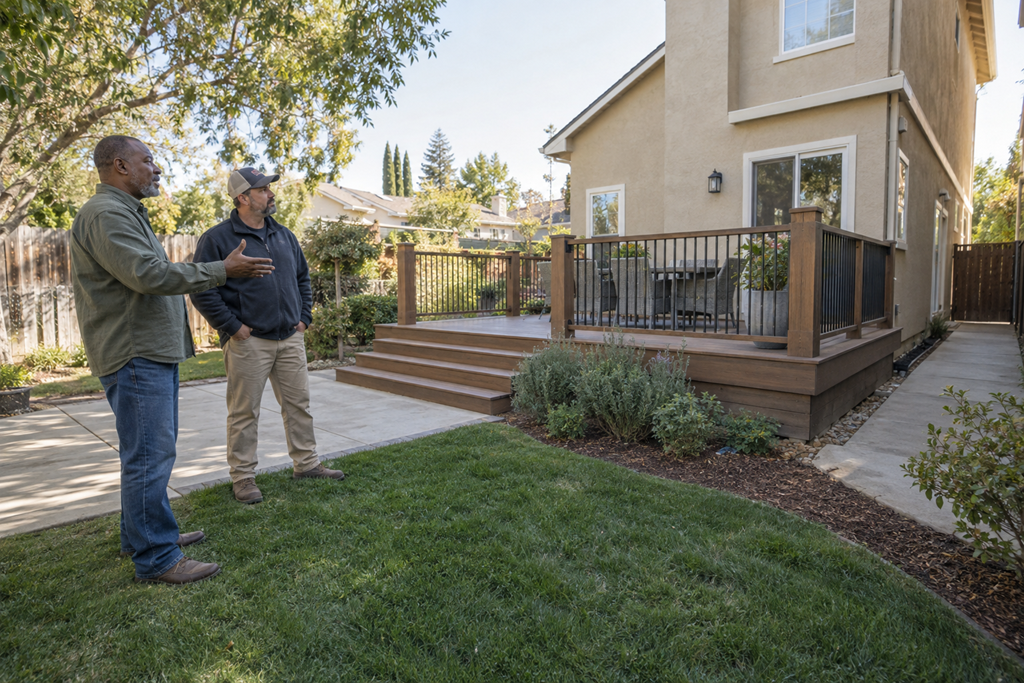
Evaluating a deck builder is less about finding the most polished sales pitch and more about seeing how clearly the builder understands your property, explains the proposed scope, answers questions, and sets expectations before you commit. For Sacramento-area homeowners, a good early conversation should make the project easier to understand—not leave basic details feeling vague, rushed, or assumed.
A deck project can look straightforward from the outside. You may already know roughly where you want the deck, what you want it to look like, or whether you are repairing an existing structure or planning something new. But choosing the builder introduces another layer of decisions: what exactly is being proposed, what assumptions are being made, what could change, and how well the person you are considering hiring communicates those details.
You do not need to become a deck-building expert to evaluate a builder. You do need enough information to understand what the builder is proposing and whether the working relationship feels organized, specific, and transparent.
The Estimate Should Reveal How the Builder Thinks
An estimate is more useful when it reflects an actual understanding of the property rather than simply presenting a number.
Notice what happens before the price is discussed. Does the builder take time to understand the area being considered? Do they ask about how you expect to use the deck? Do they pay attention to the relationship between the deck, the house, stairs, surrounding yard, access areas, and other parts of the property that could affect the project?
For an existing deck, the conversation may also involve what appears to be staying, what may need further evaluation, and whether the homeowner's idea of a repair matches what the builder believes should be considered.
The point is not to judge the builder by how long an estimate takes. It is to notice whether the proposed work appears connected to the actual property in front of them.
A quick price can feel convenient. A clearly understood scope is usually more useful.
Make Sure You Understand What the Price Actually Covers
Two deck estimates can have different totals because they are describing different projects.
That distinction is easy to miss.
One builder may be discussing only the main deck surface while another proposal may account for additional elements such as stairs, railings, removal of existing materials, site access, finishing details, or other parts of the agreed scope.
Material choices can also affect what is being proposed.
Before focusing on which number is lower, try to understand what each number represents.
A useful proposal should give you enough information to recognize the basic boundaries of the job. You should be able to tell what the builder expects to provide, what decisions still need to be made, and what is not currently included.
If an important part of the project exists only as a verbal assumption, it is reasonable to ask for clarification before hiring.
Specific Answers Matter More Than Perfect Answers
A builder does not need to have an immediate answer to every possible question.
In fact, some details may depend on further evaluation, material selections, site conditions, scheduling, or decisions that have not been made yet.
What matters is how uncertainty is handled.
There is an important difference between saying that something needs to be confirmed and giving a vague answer that leaves you unsure what happens next.
A builder who communicates well should generally be able to explain the proposed process in understandable language. If something could affect the scope, timing, or cost, you should have a reasonable sense of how that issue would be addressed if it comes up.
Be cautious about treating absolute certainty as a sign of quality. Home projects can involve variables. Clear communication about those variables can be more useful than promises that everything will go exactly as expected.
Pay Attention to What Happens When You Ask Questions
The way a builder responds to ordinary homeowner questions can tell you something about the working relationship.
You should be able to ask why a particular approach is being proposed, what a term in the estimate means, when certain decisions need to be made, or how changes would be handled.
The response does not need to become a lengthy technical lesson.
It should help you understand the decision.
If basic questions repeatedly lead to vague answers, dismissive responses, pressure to commit, or statements that important details will simply be figured out later, you may still have important information to gather.
Deck projects can involve many decisions after the initial estimate. Communication that already feels difficult before hiring may be worth paying attention to.
Ask About How the Project Will Be Managed
Homeowners sometimes focus heavily on the finished deck and less on what the project experience may be like while the work is happening.
Those expectations are worth discussing before the project begins.
Useful questions include:
- Who will be the main point of contact once the project starts?
- What major parts of the work are included in the proposed scope?
- Which material or design decisions need to be finalized before work begins?
- What could reasonably cause the scope, cost, or schedule to change?
- How are changes discussed and approved?
- What should I expect regarding access to the work area and surrounding property?
- What documentation, credentials, insurance information, references, or other verification can I review before hiring?
- What happens if something unexpected is discovered after the project begins?
You are not trying to eliminate every unknown.
You are trying to understand how unknowns are handled.
A Builder Should Be Able to Explain Choices Without Forcing Them
Deck projects can involve choices involving materials, layout, appearance, maintenance expectations, and budget.
A builder may have strong preferences based on experience, and those recommendations can be useful. But you should still understand why a recommendation is being made and how it relates to your priorities.
For example, a Sacramento-area homeowner thinking about long periods of sun exposure may want to discuss how different material choices fit the intended location and expected use. Another homeowner may care more about upkeep, appearance, or how the deck connects with an existing outdoor area.
Those are conversations to have with a qualified professional rather than reasons to make technical assumptions on your own.
A helpful builder should make the tradeoffs easier to understand without making you feel that there is only one acceptable choice simply because it is the option being recommended.
References Are More Useful When You Know What You Want to Learn
Seeing previous work can help, but attractive project photos only answer part of the question.
When reviewing a builder's past work or speaking with previous customers, think about the parts of the experience that matter to you.
You may want to learn whether communication remained consistent after the project started, whether changes were clearly discussed, whether expectations were realistic, and whether the completed project generally matched what had been agreed upon.
The purpose is not to find evidence that every past project was perfect.
It is to get a better sense of how the builder manages real projects and real homeowner expectations.
Watch for Pressure That Makes the Decision Harder
You may occasionally encounter reasons to sign quickly, make an immediate deposit, or decide before you feel ready.
There can be legitimate scheduling or material considerations behind certain timelines, but you should still understand what you are agreeing to.
A hiring decision becomes harder when urgency replaces explanation.
If you are still unclear about the scope, responsibilities, project communication, or major assumptions, asking for clarification is reasonable.
A professional estimate should help you decide whether to hire the builder. It should not make you feel that you have to hire first and understand the project later.
Comparing Builders Means Comparing More Than the Final Number
Price matters, but it is only one part of the comparison.
A lower estimate may represent the same project at a lower cost. It may also represent a different scope, different material assumptions, fewer included items, or details that have not yet been addressed.
The same principle applies to a higher estimate. A higher number does not automatically mean the proposal is better or more complete.
Try to compare what each builder is actually proposing.
Look at how clearly the scope is described, how questions are answered, how potential changes are discussed, and whether you understand what the project is expected to include.
When those pieces are clear, the price becomes easier to evaluate in context.
The Best Time to Resolve Confusion Is Before You Hire
You do not need every detail of a future deck project finalized during the first conversation.
You should, however, feel that you understand the general project being proposed and how the builder plans to move from estimate to completed work.
If something important still feels unclear, that does not automatically mean the builder is the wrong choice. It may simply mean another question needs to be answered before you decide.
For Sacramento-area homeowners, evaluating a deck builder is ultimately about reducing avoidable assumptions before work begins. When the scope, communication, expectations, and decision process are understandable, you are in a much better position to compare builders and choose the professional relationship that fits your project.