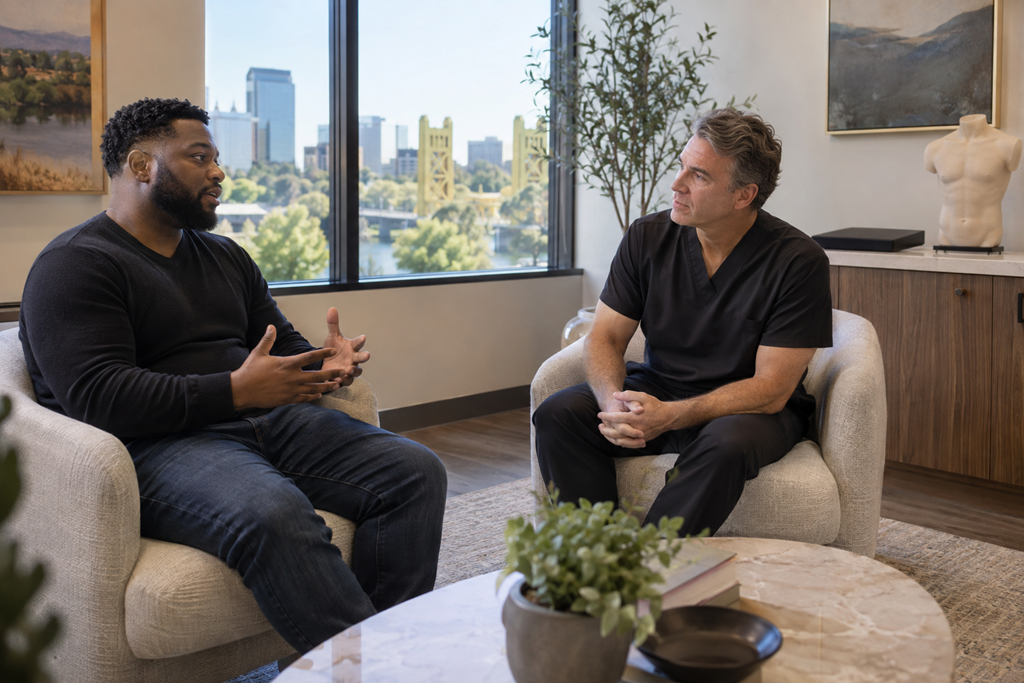
Evaluating a liposuction provider is less about finding the person with the most dramatic photos or the fastest path to scheduling and more about how carefully the provider evaluates you, explains what the procedure can and cannot reasonably address, discusses risks and recovery, and gives you room to make an unpressured decision. For Sacramento-area patients, a useful consultation should help you understand the provider’s qualifications, approach, facility, follow-up process, and expectations before you decide whether moving forward makes sense.
It can be easy to focus on the most visible parts of a cosmetic consultation: photographs, pricing, treatment areas, or the possibility of a particular appearance. Those details may matter, but they do not tell you everything you need to know about the provider.
The more useful question is whether the provider gives you enough information to understand the decision you are considering.
The Consultation Should Feel Like an Evaluation, Not a Sales Presentation
A thoughtful liposuction consultation should involve more than a quick look at the area you are concerned about followed by a recommendation.
The provider should take time to understand what you are hoping to change, what expectations you have, and whether liposuction is appropriate to discuss for your individual situation. Personal health considerations, previous procedures, medications, anatomy, skin characteristics, and other factors may affect what a qualified provider recommends.
You do not need to determine any of those medical issues yourself.
What matters when evaluating the provider is whether those issues appear to be taken seriously rather than treated as obstacles to getting you scheduled.
If the conversation quickly moves from your concern to available dates, financing, or paperwork without much individualized discussion, that can leave important questions unanswered.
Qualifications Matter, but So Does How They Apply Their Experience
A provider may present credentials, training, certifications, professional memberships, or experience with cosmetic procedures.
Those details are worth understanding and, when possible, independently verifying. You can also ask specifically about the provider's training and experience with liposuction rather than cosmetic services generally.
But credentials alone do not tell you what your experience with the provider will be like.
Pay attention to whether the provider can explain their approach in understandable language. A qualified professional should be able to discuss why a particular approach may or may not be appropriate without making you feel as though you are expected to understand medical terminology.
A provider's experience becomes more meaningful when you can see how that experience informs an individualized discussion about your situation.
Look for a Discussion of Limits, Not Just Possibilities
Cosmetic consultations naturally involve talking about what someone hopes to change.
A useful consultation should also address limitations.
That means discussing what liposuction may reasonably address, what it may not address, what uncertainties exist, and why individual results vary. The discussion should not make a particular appearance seem guaranteed.
This is especially important when photographs are part of the consultation.
Before-and-after images can help illustrate a provider's work, but someone else's result is not a prediction of yours. Differences in anatomy, treatment areas, health, healing, procedure details, and personal goals can all make direct comparisons misleading.
A good provider should help keep those photographs in context rather than using them as proof of what will happen for you.
Risk and Recovery Should Not Feel Like Side Notes
It is reasonable for patients to be interested in the potential result of a cosmetic procedure.
It is equally important to understand how a provider discusses the less appealing parts of the decision.
Listen for a clear conversation about possible risks, limitations, recovery expectations, follow-up, and what would happen if you had a concern afterward. The purpose is not to leave the consultation frightened. It is to make sure the decision is being presented realistically.
You should also be able to ask questions about issues that are specific to your health or circumstances.
Only a qualified medical professional who evaluates you personally can advise you about candidacy, risks, recovery, treatment options, or likely outcomes.
Understand Where the Procedure Fits Into the Provider's Overall Process
Evaluating the provider also means understanding more than the consultation itself.
Ask where the procedure would take place, who would be involved in your care, what type of facility would be used, what credentials or standards apply to that setting, and how monitoring and emergency planning are handled.
You can also ask who provides anesthesia or sedation when applicable and what role each professional has.
You do not need to become an expert in medical facility standards to ask these questions.
The goal is simply to understand the environment in which care would occur and whether the provider is willing to explain it clearly.
A polished consultation room or attractive website does not answer those questions for you.
Pay Attention to What Happens After the Procedure, Too
People comparing cosmetic providers sometimes spend most of their attention on the procedure itself.
Follow-up deserves attention as well.
Ask what communication normally looks like after the procedure, how follow-up visits are handled, whom you contact if you have questions, and how unexpected concerns are addressed.
You are not trying to predict whether a problem will occur.
You are evaluating whether there appears to be a clear process if you need help.
A provider who explains the procedure thoroughly but is vague about what happens afterward may leave an important part of the patient experience unclear.
Before-and-After Photos Are Context, Not a Substitute for Evaluation
Photos are often memorable because they make cosmetic changes easy to visualize.
That can also make them disproportionately influential.
When looking at a provider's photographs, consider what information they actually give you. They may show examples of previous work, but they cannot establish your candidacy or tell you what result you should expect.
It may be more revealing to notice how the provider uses the photographs.
Are they presented as examples while the provider continues discussing individual differences? Or does the conversation make it feel as though selecting a photograph is similar to selecting an outcome?
The second approach can oversimplify a decision that requires individualized medical evaluation.
A Few Questions Can Reveal a Lot About the Provider's Approach
You do not need to arrive with a long interrogation checklist. A handful of direct questions can help you understand how the provider thinks and communicates.
Consider asking:
- What experience do you have performing liposuction?
- How do you determine whether someone may be an appropriate candidate?
- What limitations would you want me to understand?
- What risks should I discuss with you based on my individual situation?
- Where would the procedure take place, and who would be involved?
- What does follow-up normally look like?
- What happens if I have a concern during recovery?
- Is there anything about my expectations that you think we should discuss further?
The usefulness of these questions is not limited to the answers themselves.
Notice whether you receive direct explanations, whether questions are welcomed, and whether the provider acknowledges areas where certainty is not possible.
Pressure Is Information
A consultation can be informative even when you decide not to move forward.
You should generally have room to think about what you heard, review information, ask additional questions, or seek another qualified opinion if you want one.
Be cautious about allowing limited-time pricing, immediate scheduling opportunities, financing discussions, or enthusiasm about a possible result to substitute for your evaluation of the provider.
That does not automatically mean those subjects are inappropriate.
The issue is whether they begin driving the decision before you feel you understand the medical and practical considerations.
A provider who is comfortable with an informed patient should be able to give you space to consider the decision.
The Best Comparison Is Often About Process, Not Personality
When meeting more than one Sacramento-area provider, it can be tempting to compare who seemed friendliest, whose office looked nicest, or whose photographs were most impressive.
Those impressions may be part of your experience, but they are not the only useful comparison.
Consider how thoroughly each provider evaluated your situation.
Think about who explained limitations as clearly as possibilities, who addressed your questions without rushing, who described the facility and follow-up process clearly, and who allowed you to make the decision without pressure.
That comparison can tell you more about the care process than personality alone.
You Should Leave With More Understanding, Not Just More Excitement
A liposuction consultation does not need to end with a decision.
It can simply leave you better informed about what the procedure involves, what questions apply to your situation, and whether you feel comfortable continuing the conversation with that provider.
For Sacramento-area patients considering liposuction, evaluating the provider means looking beyond photographs, promises, and scheduling convenience. Pay attention to how carefully the provider evaluates you, how realistically the procedure is discussed, how clearly risks and follow-up are explained, and whether you have room to make your own decision.
Questions about your personal candidacy, risks, recovery, or expected results should always be discussed with a qualified medical professional who can evaluate your individual circumstances.