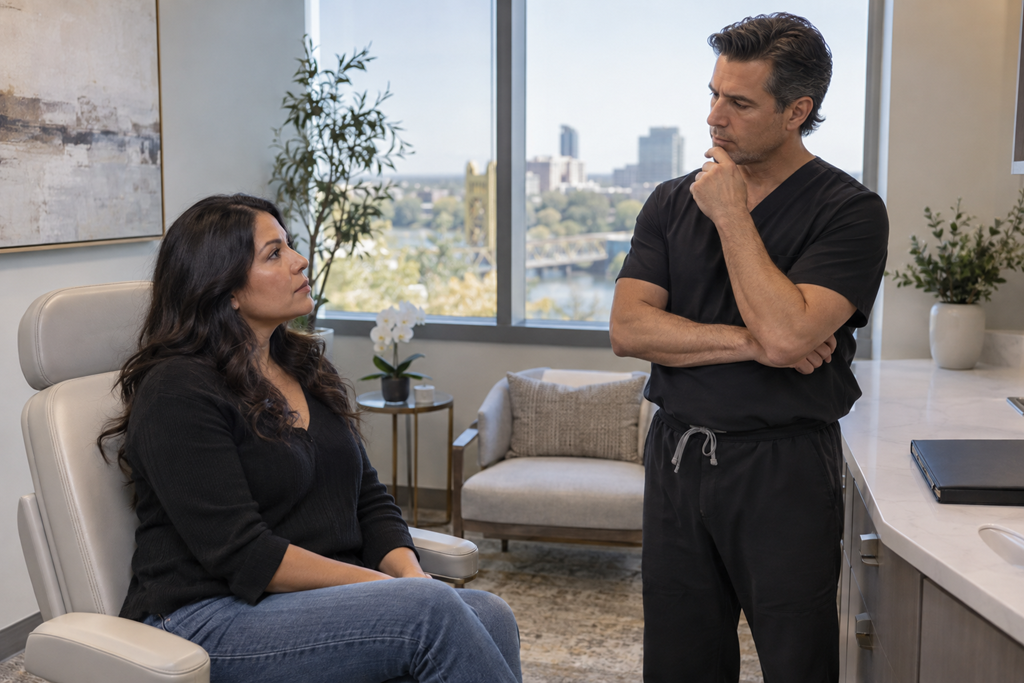
Evaluating a rhinoplasty provider is less about finding someone who promises a particular look and more about understanding how carefully they assess your goals, explain what may or may not be realistic, discuss risks and recovery, and respond to questions before you decide. A strong consultation should help you understand the provider’s approach, communication style, qualifications, and follow-up expectations without making you feel rushed into surgery.
That distinction can be easy to miss. Rhinoplasty is highly personal, and people often arrive at a consultation after spending considerable time thinking about one feature of their appearance. It is natural to focus on photographs, possible results, or whether you immediately like the provider.
Those things may matter, but they do not tell you everything you need to know about the person you may be trusting with your care.
For Sacramento-area patients comparing rhinoplasty providers, it can be useful to pay attention to the quality of the evaluation itself.
Look At How Carefully The Provider Evaluates You
A rhinoplasty consultation should be more than a quick conversation about what you would like your nose to look like.
Notice how the provider approaches the discussion.
Do they take time to understand what you hope to change? Do they ask questions rather than immediately offering a solution? Do they explain that individual anatomy, health considerations, expectations, and other factors may affect what can reasonably be discussed?
You do not need to know the technical details yourself to notice whether the provider seems methodical.
A provider who carefully evaluates the individual situation may leave you with a more nuanced discussion than someone who moves quickly toward describing a desired result.
That is an important distinction when comparing providers.
A Good Conversation Is Not The Same As A Guarantee
It is understandable to want a clear picture of what rhinoplasty might accomplish. But cosmetic surgery does not offer the certainty of selecting a product from a catalog.
Be cautious about interpreting confident communication as certainty about an outcome.
A useful consultation can include discussion of goals and possible changes while also acknowledging limitations, tradeoffs, uncertainties, risks, healing, and differences between patients.
A provider should be able to talk about what they believe may be achievable without making the conversation sound like a guaranteed transformation.
For personal questions about candidacy, risks, surgical options, recovery, or expected results, those discussions belong with a qualified medical professional who can evaluate your individual situation.
Pay Attention To How Your Goals Are Handled
One of the most useful things you can observe is what happens when you describe what you want.
A provider should not simply replace your preferences with their own idea of what would look good.
At the same time, thoughtful evaluation does not necessarily mean agreeing with every request.
A provider may explain that a requested change would need to be considered in relation to facial proportions, anatomy, function, healing, or other individual factors. Hearing limitations or alternatives can be valuable information rather than a sign that the consultation went poorly.
In fact, one of the clearest ways to evaluate communication is to notice whether the provider can disagree, set boundaries, or explain uncertainty without dismissing you.
You should leave understanding more about the reasoning behind the discussion, even if the answer was not exactly what you expected.
Before-And-After Photos Are Only One Part Of The Evaluation
Before-and-after photographs are commonly associated with cosmetic surgery consultations, and they can help you understand the kinds of patients or results a provider chooses to show.
They should not have to carry the entire decision.
Photos cannot tell you everything about how a provider communicates, approaches individual differences, handles complications, explains recovery, or supports patients after a procedure.
They also represent other patients, not a prediction of what will happen in your situation.
If you review photographs, the useful question is not simply, “Do I like these results?”
You can also consider whether the provider explains what the photographs can and cannot demonstrate and whether the discussion remains focused on your individual evaluation rather than encouraging you to expect someone else’s outcome.
Qualifications Should Be Understandable, Not Merely Impressive-Sounding
Provider qualifications can become confusing because websites and consultations may include numerous titles, memberships, credentials, training descriptions, and professional affiliations.
You do not need to become an expert in medical credentialing before scheduling a consultation.
You should, however, feel comfortable asking about the qualifications of the clinician who would actually perform the surgery, including relevant training, experience, credentials, and how those credentials can be independently verified.
If something is unclear, ask what it means.
A straightforward explanation is more useful than a long collection of impressive-sounding terms you cannot easily interpret.
You can also ask about the provider's experience with rhinoplasty and with patients whose concerns are similar to the ones you want evaluated, while remembering that another patient's experience cannot guarantee your outcome.
Notice Whether Risks And Recovery Get Real Attention
A consultation centered almost entirely on appearance can leave important parts of the decision underexplored.
Rhinoplasty involves surgery, so discussions about potential risks, recovery, follow-up, limitations, and what happens if concerns develop afterward are relevant parts of evaluating a provider.
You do not need to judge the medical details on your own.
Instead, notice whether those topics receive meaningful attention and whether you have opportunities to ask questions.
If difficult subjects are brushed aside while the possible cosmetic benefits receive most of the attention, you may not yet have enough information to make a comfortable decision.
A balanced conversation should make room for both what someone hopes to achieve and what they need to understand before choosing surgery.
Find Out Who Will Actually Be Involved In Your Care
The person you first meet may not be the only person involved in the process.
That makes it useful to understand who handles different parts of the patient experience.
Who performs the procedure? Who answers medical questions before surgery? Who provides follow-up? If you have a concern during recovery, who would you contact? How are postoperative appointments handled?
The goal is not to map every operational detail of the practice.
It is simply to make sure you understand who is responsible for your care and how communication works before you commit.
A polished initial consultation matters less if the rest of the process remains vague.
Pressure Can Make A Personal Decision Harder To Evaluate
Rhinoplasty is an elective and highly personal decision for many patients. You should have enough space to consider what you learned.
That can become harder when the conversation shifts toward pressure to schedule, make a deposit, secure a date, or decide before you feel ready.
Administrative discussions about scheduling and payment are normal parts of working with a medical practice. Pressure is different.
Pay attention to whether you feel free to leave the consultation, think about the information, ask additional questions, or compare another Sacramento-area provider before deciding.
Taking time to evaluate a major personal decision is not the same as being indecisive.
Sometimes the most useful outcome of a consultation is simply realizing that you need more information.
A Few Questions Can Reveal A Lot About The Provider
You do not need an enormous checklist. A handful of direct questions can help you understand how the provider thinks and communicates:
- How do you determine whether someone's goals are realistic?
- What factors would you consider when evaluating my individual situation?
- What qualifications and experience are most relevant to the procedure I am considering?
- What should I understand about risks, recovery, and limitations?
- Who would handle my follow-up care and questions afterward?
- What happens if my expectations and your recommendation do not match?
The value is not simply in collecting answers.
Listen to how the answers are given. Clear explanations, willingness to discuss limitations, and openness to questions can tell you more than rehearsed assurances.
It Is Easy To Mistake Comfort For Complete Confidence
Feeling comfortable with a provider matters. You are discussing something personal, and communication is important.
But a warm personality by itself does not answer every question about whether a provider is the right fit.
The reverse is also true. A consultation does not necessarily need to feel like an instant personal connection to be useful.
Try separating several things that can easily blur together: whether you like the provider, whether you understand their approach, whether your questions were answered, whether their qualifications are clear, and whether you feel adequately informed about the decision.
That separation can make comparison easier.
You are not simply asking, “Did I like this consultation?”
You are asking, “Did this consultation give me enough useful information to decide whether I want to continue with this provider?”
Moving Forward Should Feel Like An Informed Decision
Evaluating a rhinoplasty provider is ultimately about understanding how they approach you as an individual, not finding someone who makes the strongest promise.
Look beyond attractive photographs, polished offices, reassuring language, or an appealing proposed result. Pay attention to how thoroughly the provider evaluates your concerns, how clearly they communicate limits and risks, whether their qualifications make sense to you, and whether you have room to make the decision without pressure.
For Sacramento-area patients, comparing providers can be less about finding immediate certainty and more about noticing which consultation leaves important questions answered rather than avoided.
You do not need to predict your outcome or make medical judgments yourself. Personal questions about candidacy, risks, recovery, and treatment should be discussed with a qualified medical professional who can evaluate your circumstances.
Your role before moving forward is simpler: make sure you understand who you are considering, how they approach the decision, and whether you have enough information to choose your next step thoughtfully.