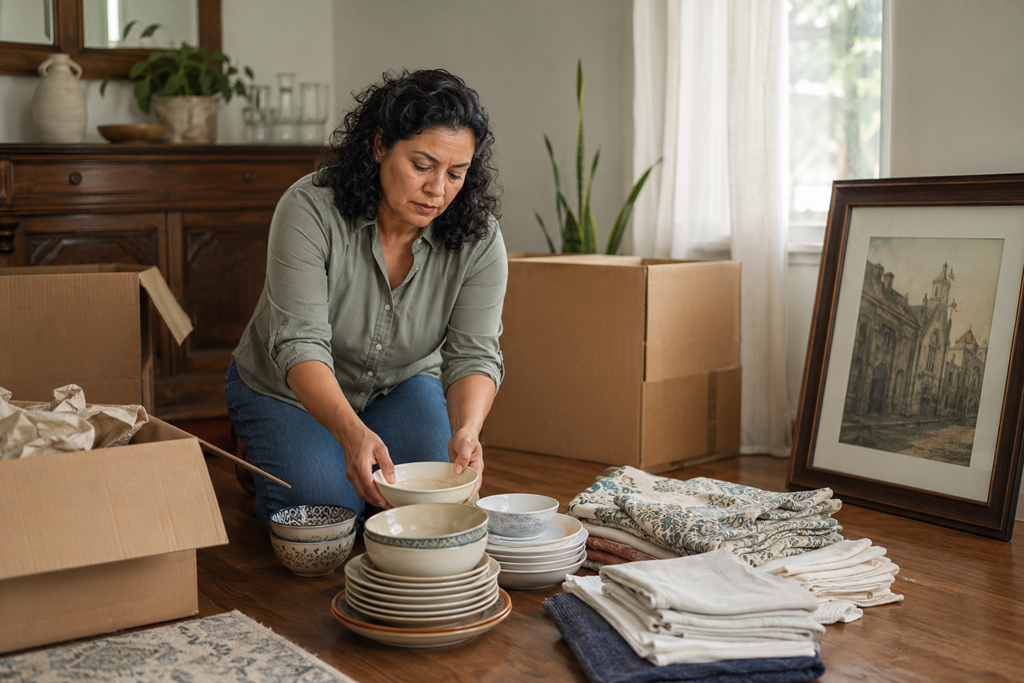
Packing methods work best when they match the belongings being packed, not just the room they came from. A box of books, a framed print, a lamp, folded linens, and a set of dishes may all leave the same room, but they do not need the same kind of packing. The useful question is what each item needs to stay protected, contained, and easy to handle during the move.
That distinction can make packing feel more manageable. Instead of treating every room as one large packing job, you can look at the characteristics of the belongings inside it. Weight, fragility, shape, surface sensitivity, loose parts, and importance can all affect how an item should be prepared.
For Sacramento-area residents preparing for a local move, this also gives you a clearer way to discuss belongings with a moving company. You can identify which items are straightforward, which deserve more attention, and which may require instructions from the mover before moving day.
Start with the item, not the room
Room-by-room packing is useful for keeping belongings organized, but the room itself does not determine how everything inside it should be packed.
A home office illustrates the problem. Books are dense and heavy. A monitor has a vulnerable screen. Framed photographs can have breakable surfaces and exposed corners. Cables and small accessories are easy to separate from the equipment they belong with. A desk lamp may have an awkward shape even though it is relatively light.
Packing all of those belongings the same way simply because they came from one room overlooks the differences that matter during handling and transportation.
A more useful approach is to notice what each group of belongings has in common physically. Items with similar handling needs can then be prepared in similar ways even when they came from different parts of the home.
Weight changes how belongings should be grouped
One of the easiest packing mismatches happens when too many dense belongings are grouped together.
Books, canned pantry items, small appliances, files, and some decorative objects may not appear difficult to pack individually, but their combined weight can add up quickly. Lightweight belongings such as pillows, blankets, lampshades, and some clothing create a different problem: they can take up considerable space without adding much weight.
The packing method should reflect that difference.
The goal is not simply to fill every available container. It is to create manageable groups of belongings without putting unnecessary strain on containers or making packed items unnecessarily difficult to handle.
This is also a good reason to avoid judging a packed container only by how much empty space remains. A partially filled group of dense belongings can already be substantial, while a much larger volume of lightweight belongings may still be easy to manage.
If professional movers will be handling the move, follow their requirements for unusually heavy or awkward belongings rather than assuming every item should be packed the same way.
Fragile belongings need protection from movement as well as impact
People often think of fragile packing mainly as preventing something from being hit. Movement inside the packed container matters too.
Dishes, glassware, ceramics, framed pieces, delicate decorations, and similar belongings can be vulnerable when they shift against one another. The useful distinction is not simply whether something is labeled fragile. It is whether the item has breakable surfaces, exposed edges, hollow sections, delicate attachments, or other characteristics that make uncontrolled movement a concern.
That means two fragile items may still need different approaches.
A flat framed piece has different vulnerable areas than a drinking glass. A lamp base has a different shape than a ceramic serving bowl. A decorative object with projecting pieces may require more attention to its shape than another object made from similar material.
Thinking about how an item could be damaged gives you more useful information than placing everything breakable into one general category.
Soft belongings can serve a different packing purpose
Clothing, towels, bedding, and other soft household belongings generally do not need the same kind of protection as rigid or breakable items. Their main packing concerns are usually keeping them contained, organized, and reasonably clean.
That makes them different from fragile belongings, but it does not make them unimportant to the overall packing plan.
Soft items often occupy substantial volume, and mixing them randomly with dense or delicate belongings can make unpacking less organized. Keeping similar soft belongings together can make it easier to identify what will be needed soon after arriving at the new home.
Some soft belongings may also be useful for filling harmless empty space around appropriate nonfragile items, but they should not automatically be treated as substitutes for protection whenever a delicate object requires more deliberate preparation.
The broader principle is to give each group a purpose rather than using whatever happens to be nearby.
Shape can matter as much as fragility
Not every difficult-to-pack item is fragile.
Floor lamps, long decorative pieces, removable furniture components, irregular kitchen equipment, artwork, and other unusually shaped belongings may simply resist the standard approach used for smaller household items.
Trying to force an awkward item into the same packing method as everything around it can create unnecessary pressure points, protruding parts, or unstable packages.
Before packing an unusual object, notice whether it has:
- removable or loose components
- narrow sections that could bend
- projecting pieces
- exposed corners or edges
- a shape that prevents it from sitting securely
- parts that could become separated during the move
This does not mean you need a specialized solution for every unusual object. It means shape should be considered before deciding how the object will be contained or protected.
For items that are particularly large, heavy, valuable, or difficult to prepare safely, ask the moving company how it wants the item handled before you pack it yourself.
Surface sensitivity is easy to overlook
Some belongings are sturdy enough that they are unlikely to break, yet their surfaces can still be damaged.
Finished wood, polished metal, coated furniture parts, mirrors, artwork, electronics, and certain decorative pieces can be vulnerable to scratching, rubbing, pressure, or contact with other objects.
That creates an important distinction between structural strength and surface protection.
A sturdy item does not necessarily need to be surrounded by the same type of protection as delicate glassware, but it may still benefit from being kept away from rough surfaces, sharp edges, hardware, or other objects that could leave marks.
Recognizing this difference helps prevent the common assumption that anything unbreakable can simply be packed together.
Small parts need a connection to the item they belong with
Packing becomes frustrating when the main object arrives but its small parts do not.
Hardware, cables, remotes, stands, removable shelves, mounting pieces, and similar components are easy to separate during a move because they may be removed before the larger item is packed.
The important packing method here is organizational rather than protective.
Keep related pieces associated with the larger object in a way that makes sense when you unpack. That might mean grouping components together and identifying what they belong with rather than placing miscellaneous small parts from several rooms into one catch-all container.
This becomes especially useful when furniture or equipment has been partially disassembled before moving.
If movers will disassemble or reassemble particular items, clarify their process first so your own organization does not interfere with theirs.
Everyday-access items deserve their own logic
Not everything should be packed according to how well it fits with similar belongings.
Some items matter because of when you will need them.
Basic toiletries, medications, important documents, device chargers, a change of clothes, children’s necessities, pet supplies, and other immediately useful belongings may need to remain accessible rather than disappearing into the main shipment.
This is a different kind of matching. The method is based on access rather than weight, shape, or fragility.
Separating immediate-use belongings from ordinary packed household items can prevent the first evening in a new home from turning into a search through multiple containers.
Important documents, medications, valuables, and similar personal items may also require handling outside the normal moving process. Ask your mover what it does and does not transport, and keep anything requiring personal control with you when appropriate.
Avoid the “one packing method per room” trap
A common source of confusion is trying to develop one packing rule for the kitchen, another for the bedroom, another for the garage, and so on.
Rooms are useful for labeling where belongings belong after the move. They are less useful for determining physical protection.
A kitchen alone can contain breakable dishes, sharp utensils, soft linens, heavy cookware, small appliances, food items, and important household documents. A bedroom can contain lightweight clothing alongside electronics, mirrors, framed artwork, and heavy books.
The more varied the room, the less useful a single packing method becomes.
Instead, room location and packing method can work together: keep track of where the item belongs while choosing its preparation based on what the item actually needs.
A quick assessment before packing can prevent unnecessary improvising
You do not need to create a detailed inventory of every object in the house. A brief visual review of each room can reveal the belongings that deserve a different approach.
Look for clusters such as dense items, breakable pieces, soft goods, awkward shapes, surface-sensitive objects, belongings with removable parts, and things you will need immediately after the move.
This gives you a practical picture of the packing job before everything is already spread across the floor.
It can also help when communicating with a Sacramento-area moving company. Instead of asking only how many boxes you might need, you can point out unusual, fragile, large, or personally important belongings and ask how the mover expects those items to be prepared.
That conversation may also reveal what the moving company handles itself and what it expects you to have ready beforehand.
The goal is appropriate preparation, not perfect packing
Matching packing methods to belongings does not require creating a unique system for every possession.
The useful shift is simpler: stop assuming that items should be packed alike merely because they came from the same room or fit into the same container. Pay attention to what could make an item difficult to carry, vulnerable to damage, easy to lose, or inconvenient to find later.
Once you can separate those needs, packing decisions become easier to make. Heavy belongings can be treated differently from lightweight ones, fragile belongings differently from sturdy ones, awkward shapes differently from regular shapes, and immediate-use items differently from things that can remain packed.
That gives you a clearer basis for preparing your home, discussing special belongings with a mover, and deciding which packing approaches actually fit the move.
Related resource: If you are ready to compare the types of boxes, tape, labels, and protection supplies that may fit those packing needs, see How to Choose Moving Boxes, Tape, Labels, And Protection Supplies.