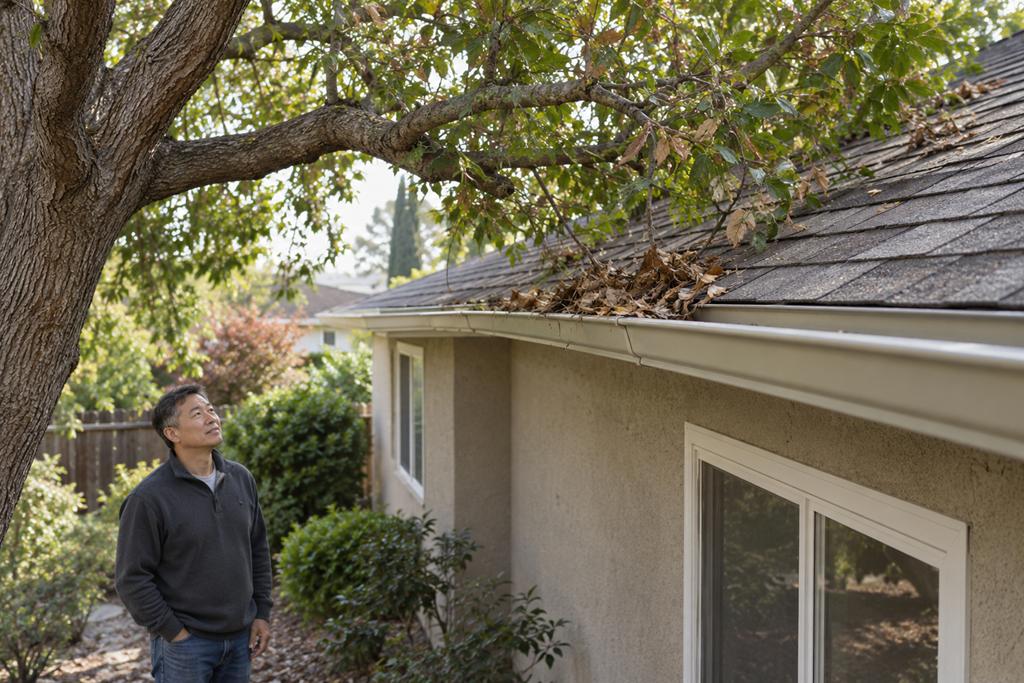
A tree may be contributing to roof or gutter problems when branches repeatedly touch or hang directly over the roofline, debris keeps collecting in the same gutter sections, or one side of the house develops recurring buildup beneath the canopy. Those signs do not prove the tree is the only cause, but they can help you decide whether a tree-service evaluation—and possibly a separate roofing or gutter inspection—is worth discussing.
The confusing part is that trees, roofs, and gutters naturally occupy the same outdoor space. A branch extending over a house does not automatically mean something is wrong. Leaves in a gutter do not necessarily mean the tree needs major pruning. The more useful question is whether there is a consistent relationship between the tree and the problem you keep noticing.
Look For A Pattern Between The Canopy And The Problem
One of the clearest things a homeowner can notice is whether the problem appears primarily beneath a particular section of the tree.
For example, you might see that one gutter section repeatedly collects leaves, needles, seeds, small twigs, or other tree debris while gutters farther from the canopy stay relatively clear. You might notice branches resting against the roof edge or moving close enough to make contact when the wind picks up.
The location matters.
If recurring buildup consistently appears directly beneath an overhanging canopy, the tree may be contributing to the maintenance problem even if there is nothing obviously wrong with the tree itself.
That distinction is important. A healthy tree can still create clearance or debris concerns simply because of how its canopy relates to the house.
For Sacramento-area property owners, these relationships may become more noticeable as dry debris accumulates and seasonal rain begins moving water through the gutters again. The goal is not to diagnose the tree from the ground, but to recognize a repeatable pattern worth discussing with a qualified professional.
A Branch Near The Roof Is Not The Same As A Branch Touching It
It is easy to look up, see a large branch over the house, and assume the roof is automatically at risk.
Proximity alone does not tell you enough.
A branch that remains above the roof without contacting it presents a different situation from one that rests on the roof edge, rubs against a surface, presses into a gutter, or repeatedly reaches the structure as it moves.
That is one reason photographs taken safely from the ground can be useful when requesting an estimate. They can help show where the branch, roofline, and gutter sit in relation to one another without requiring you to climb onto the roof or into the tree.
Avoid trying to measure clearance from a ladder or testing branches yourself. A tree-service professional can evaluate the actual pruning objective and explain what part of the canopy, if any, should be addressed.
The important consumer question is not simply, “Is that branch close?”
It is, “What specific problem would the proposed tree work be intended to solve?”
Recurring Gutter Buildup Can Be More Informative Than A Single Clog
Almost any gutter can collect leaves or debris occasionally.
A recurring pattern is more useful.
Suppose the same gutter corner repeatedly fills beneath one side of a tree while other sections of the roofline stay comparatively clear. That relationship gives you something specific to show a tree-service provider.
It may also help you have a more focused conversation about pruning goals.
Instead of requesting vague work such as “cut the tree back,” you can explain that you are trying to understand whether a particular part of the canopy is contributing to repeated gutter buildup.
That helps keep the proposal connected to the actual reason you called.
It also reduces the chance of treating general pruning and roof-or-gutter clearance as though they were automatically the same project.
Roof And Gutter Problems May Have More Than One Cause
One of the easiest mistakes is assuming that because a tree is near the problem, the tree must be responsible for all of it.
That is not necessarily the case.
A gutter can have its own maintenance or drainage issues. Roofing materials can have concerns unrelated to nearby branches. Water appearing where you did not expect it can also require evaluation beyond the scope of a tree-service company.
A tree-service provider can address the tree-related part of the situation. That might include evaluating branch position, pruning goals, dead or hanging limbs, canopy relationships, access, and the proposed cleanup scope.
That does not automatically make the provider the right professional to determine the condition of roofing materials or gutter components.
If you are already seeing a damaged gutter, an apparent roof-surface problem, or signs of water entering the home, it may make sense to ask whether a separate roofing or gutter professional should evaluate that part of the property.
You do not need to decide in advance which provider is “right.” Sometimes the first useful step is simply separating the tree question from the roof or gutter question.
Removing The Tree Is Not Automatically The Answer
Seeing branches above a roof can make removal feel like the most complete solution.
But the presence of roof or gutter concerns does not by itself tell you whether removal is appropriate.
The useful discussion is more specific: What part of the tree is contributing to the concern, what pruning goal is being proposed, and why does the provider believe that scope fits the situation?
Depending on the tree, its condition, its structure, and its relationship to the house, a provider may discuss different options. Those conclusions should come from evaluating the actual property rather than from assuming that every overhanging tree requires the same response.
This is also why a tree-service proposal should describe the intended work clearly enough that you can connect it back to your original concern.
If you called because of one gutter corner, for example, you should be able to understand how the proposed tree work relates to that area.
Prepare For An Estimate By Documenting What You Can See Safely
You do not need to inspect the tree yourself before contacting a provider.
A few simple observations from normal ground-level areas can make the conversation more productive.
Notice where the recurring problem appears. Look at which part of the canopy is above that area. Think about whether you have seen actual branch contact or simply overhang. If the problem has happened more than once, note whether it keeps occurring in the same location.
Ground-level photographs can also help you remember what you observed, particularly if the issue is more obvious after wind, leaf drop, or rain.
There is no need to climb onto the roof, lean into gutters, enter the tree, cut branches, or investigate around overhead electrical lines.
The goal is preparation, not diagnosis.
Ask What The Proposed Tree Work Is Supposed To Accomplish
When reviewing an estimate, a few targeted questions can help keep the scope tied to the roof or gutter concern:
- Which part of the tree is the proposed work addressing?
- Is the goal branch contact, roof clearance, recurring debris, dead or hanging limbs, or something else?
- What will actually be pruned or removed under the quoted scope?
- How will cut material and other tree debris be cleaned up?
- Are there access conditions that affect how the work would be performed?
- If utility lines are involved, how does that affect who should perform the work?
- Is the proposal limited to tree work, or should I have the roof or gutter evaluated separately?
The answers should help you understand what you are buying rather than simply giving you a larger list of tree work.
If two providers recommend noticeably different scopes, ask each one to explain how its recommendation connects to the roof or gutter issue you originally described.
That can be more revealing than comparing the proposals only by price.
Do Not Let A Visible Tree Hide A Separate Roof Or Gutter Issue
Trees are easy to see, which makes them easy to blame.
A branch hanging over the roof creates an obvious visual explanation for leaves in the gutter or a concern near the roofline. But the visible tree and the actual source of a property problem are not always the same thing.
That is why it helps to keep the service boundaries clear.
A tree-service evaluation can help determine what tree work is reasonable to discuss. A roofing or gutter professional can address questions about those systems themselves.
If both appear relevant, treating them as separate parts of the same property concern can make the decision easier to understand.
The Most Useful Clue Is Consistency
You usually do not need to determine from the ground whether a tree is definitively “causing” a roof or gutter problem.
What you can look for is consistency.
Branches contacting the same roof area, debris repeatedly accumulating beneath the same section of canopy, or a recurring gutter issue that closely follows the tree's position are useful observations to bring to a professional evaluation.
From there, focus on whether the proposed tree work clearly addresses the problem you described, whether the scope and cleanup are understandable, and whether another professional should evaluate the roof or gutter itself.
That approach helps you move from simply noticing “a tree near the house” to asking a much more useful question: What, specifically, is the tree contributing to, and what service actually addresses that part of the problem?