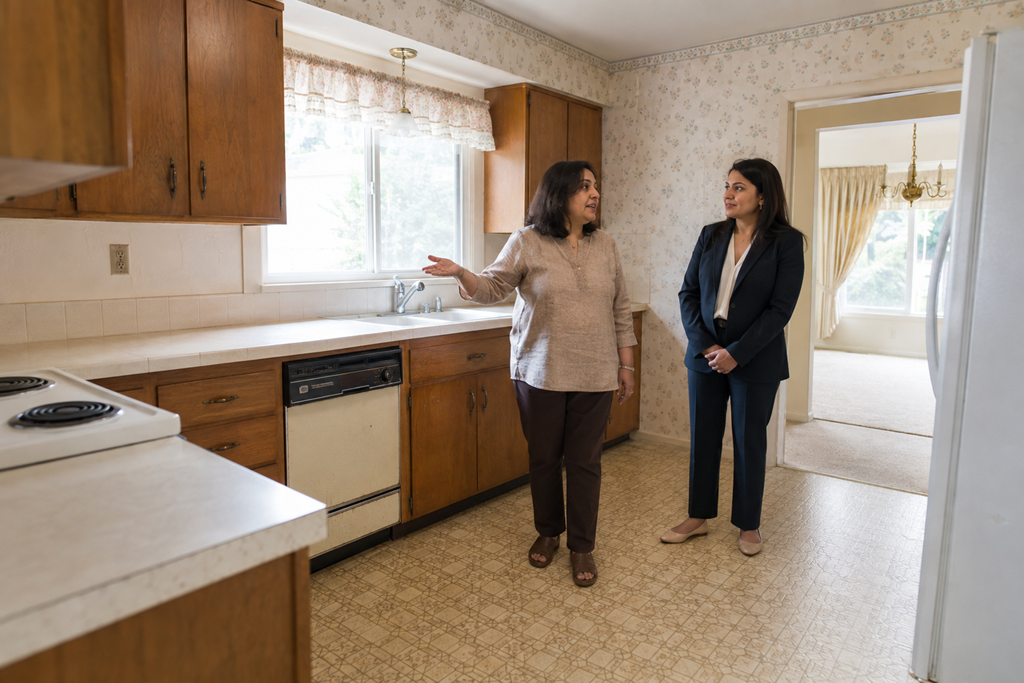
Buying a home that needs updates can make sense when the property still fits your goals, but the decision is easier when you separate cosmetic changes from work that could affect your budget, timing, comfort, or ability to move in smoothly. The key is not whether the home looks dated. It is whether you understand what you may be taking on before you commit.
A house with older cabinets, flooring, fixtures, paint colors, or finishes can create an immediate impression that a long list of projects is waiting. That first reaction can make it difficult to tell the difference between things you simply want to change and things you need more information about.
For Sacramento-area buyers, the useful question is not simply, “How much updating does this house need?” It is, “Does the amount and type of updating fit the way I want to buy, move, budget, and live?”
A Dated Home And A Problem Home Are Not The Same Thing
One of the easiest mistakes to make is treating every older-looking feature as evidence that something is wrong.
A kitchen may look dated because of cabinet style, countertop color, flooring, or lighting choices that no longer match your preferences. A bathroom may have finishes you would eventually replace even though your immediate concern is mostly appearance.
At the same time, a freshly updated room does not automatically tell you everything about the condition behind what you can see.
That is why appearance should be treated as one part of the decision rather than the entire decision.
When something raises a condition question that you cannot answer by looking at it, that is a reason to gather more information from an appropriate qualified professional rather than guessing based on how old or new the room appears.
Separate The Updates Into Different Kinds Of Decisions
It can help to stop thinking of the property as simply “updated” or “not updated.”
Instead, consider three broad types of concerns.
Cosmetic preferences are things you may want to change because of style, color, finish, or personal taste. These can still affect your budget, but they may not determine whether you can comfortably use the home as it is.
Functional limitations are features that may technically work for the current owner but do not fit the way you expect to use the property. Storage, room configuration, lighting, surfaces, or other everyday features may fall into this category depending on your priorities.
Uncertain conditions are observations that leave you wondering whether additional evaluation would be useful before you become comfortable with the property.
This distinction matters because the three categories should not automatically receive the same weight.
You may be perfectly comfortable postponing cosmetic changes for several years while feeling very differently about an item you do not yet understand.
The Real Question Is How Much Unfinished Decision-Making You Are Buying
A home that needs updates can involve more than the eventual cost of new finishes.
It can also mean choosing materials, comparing service providers, scheduling projects, living around work, making decisions with other household members, and determining which improvements should happen first.
For some buyers, that process is appealing. They would rather purchase a home that is not finished to someone else's taste and make changes gradually.
For others, the same property can become frustrating because they wanted to move in and focus on daily life rather than begin making another series of property decisions.
Neither preference is inherently better.
What matters is recognizing your own tolerance before mentally converting every dated feature into a simple future project.
Look Beyond The First Room That Gets Your Attention
A kitchen often dominates the conversation because it contains many visible finishes in one place. But concentrating on one dramatic room can make the overall scope difficult to see.
Try to notice how many separate areas of the property are contributing to your impression that the home needs updating.
If the kitchen, bathrooms, flooring, interior finishes, lighting, storage areas, and exterior features all make you think, “We would probably change that,” the cumulative scope may feel different from one outdated room in an otherwise suitable property.
The opposite can also happen.
A visually dated kitchen can make the entire house feel like a major project even when most of the property already works well for the buyer's needs.
The goal is not to create an exhaustive renovation list during a showing. It is to avoid letting one highly visible feature define the whole property before you have considered the rest of it.
Think About What You Could Live With For A While
A useful question is not only what you would eventually change, but what you would be comfortable leaving alone.
That distinction can reduce pressure to imagine every update happening immediately after purchase.
A room can be unattractive to you without preventing you from using it. An older finish can be something you plan to revisit later rather than a project that has to compete immediately with moving expenses, furniture, work schedules, family responsibilities, or other priorities.
This is where personal preference becomes important.
Another buyer's idea of a “simple update” may involve far more disruption, planning, or spending than you want to take on. Conversely, something another buyer considers a major drawback may barely matter to you.
Your own expectations are more useful than a generic label such as fixer-upper, move-in ready, or needs TLC.
Consider How One Update May Affect Another
Individual projects do not always exist in isolation.
Changing flooring may affect how you think about adjoining rooms. Updating a kitchen may make nearby finishes feel more dated. Replacing one visible element can change what you want to do with surrounding surfaces, colors, or fixtures.
This does not mean that every project will grow into a larger renovation.
It means you should be cautious about mentally assigning a single, simple solution to a room before you understand how much of that space you actually want to change.
When an update is important to your buying decision, getting appropriate information before relying on assumptions can help you compare the property with your realistic plans rather than an imagined best-case version of the project.
Your Real Estate Professional Should Help You Clarify The Decision
When considering a home that needs updates, the quality of the conversation with your real estate professional matters.
An agent does not need to decide whether you should renovate a kitchen, determine the condition of building systems, or predict what future work will cost.
What can be useful is a professional who listens carefully to your priorities, helps you keep the property in context, communicates clearly when you have questions, and recognizes when a concern may be better addressed by an inspector or another qualified specialist.
If you feel that every concern is being minimized as “just cosmetic,” or every dated feature is being treated as a major problem without enough information, the conversation may not be helping you evaluate the property on your own terms.
You should be able to distinguish what is known, what is simply your preference, and what still needs clarification.
Questions Worth Asking Before You Get More Committed
A few focused questions can make the conversation more useful without turning the property into a long project-planning exercise:
- Which of my concerns are primarily about appearance, and which ones should I investigate further?
- What property information is available for me to review before I make assumptions about the condition?
- Are there areas where an appropriate specialist's evaluation may help me understand what I am seeing?
- Which updates do I actually consider important before moving in?
- Which changes could I comfortably postpone?
- Does this property still fit my larger goals if I decide not to complete every update I currently imagine?
These questions keep the focus where it belongs: whether the home works for you as a purchase, not whether every room could eventually be redesigned.
Be Careful With “We Can Just Update It Later”
That phrase can be perfectly reasonable, but it can also hide a lot of unanswered questions.
“Later” may mean after you have lived in the home long enough to know what really bothers you. That can be useful.
But it can also become shorthand for several projects that have not yet been considered in relation to one another.
Before relying on the idea that an update will be easy to handle later, ask yourself whether the proposed change is something you genuinely understand or simply something you are assuming will be straightforward.
You do not need a complete remodeling plan before buying a home. You do need enough perspective to know whether the amount of uncertainty feels acceptable to you.
A Home Can Need Updates And Still Be The Right Fit
Buying a home that needs updating is not automatically a compromise, and buying a freshly finished home is not automatically the easier choice.
A property may still work very well when its location, layout, usable space, and other important characteristics align with your goals and the updates feel manageable on your terms.
The most useful approach is to separate appearance from condition, distinguish optional improvements from unanswered questions, and think realistically about how much project planning you want to take on.
When you understand those differences, “needs updates” becomes less of a vague warning and more of a specific factor you can evaluate alongside the rest of your home-buying priorities.