A tree problem may deserve faster professional attention when something has changed suddenly, appears unstable, or could affect people, vehicles, a home, or another occupied area. Concerns that develop slowly and are not creating an obvious near-term risk can often be evaluated and planned instead. The key is not simply how large or old the tree looks, but what changed, where it is, and what could be affected if the condition worsens.
That distinction can be difficult for a homeowner to make from the ground. A large tree can look intimidating even when the concern is routine, while a less dramatic change may deserve closer attention because of where it is located.
For Sacramento-area homeowners, the goal is not to diagnose the tree yourself. It is to recognize when a concern may justify faster professional evaluation and when you can probably approach the situation as a planned tree-service decision.
Sudden Change Usually Matters More Than Appearance Alone
One of the most useful questions is simple: What changed?
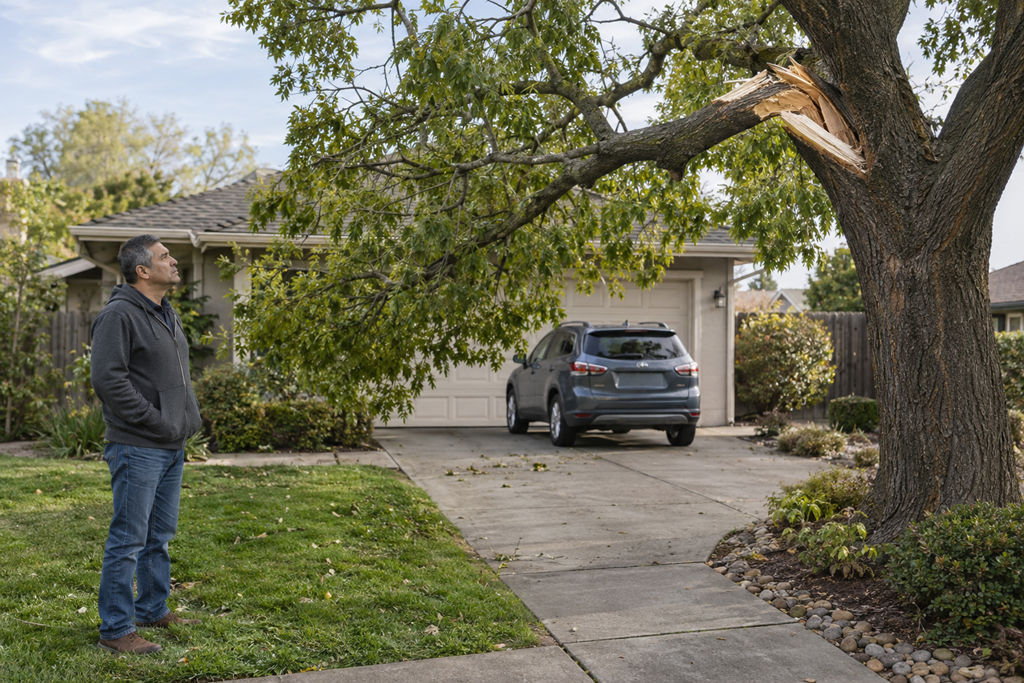
A tree that has looked essentially the same for years presents a different decision from one that suddenly has a broken limb, visible split, noticeably different position, or other new condition.
That does not mean every new change is dangerous. It means the change gives a tree professional useful context when deciding how quickly the property should be evaluated.
The same idea applies after seasonal wind or rain. Finding a few small twigs or leaves on the ground is different from discovering that a major limb has broken or that a substantial part of the tree looks different than it did before.
Rather than trying to determine exactly what the tree needs, focus first on whether the condition appears new, significant, or quickly changing.
Some Conditions Are Better Treated As Time-Sensitive Questions
Certain situations make it reasonable to contact a qualified tree professional sooner rather than simply adding the issue to a future maintenance list.
Examples can include a large broken or hanging limb, a newly visible split in a major part of the tree, a substantial section that has shifted unexpectedly, or a tree condition that changed noticeably after wind or rain.
Location matters too.
A questionable limb over an open part of a yard creates a different situation from a similar limb positioned above a driveway, walkway, roof, patio, parking area, or another place people regularly use.
Conditions involving electrical lines or an immediate threat to people or property should not be treated like ordinary tree-maintenance scheduling. Appropriate utility or emergency resources may be needed depending on the situation.
You do not need to determine the technical cause before making the call. Describing what changed and what is nearby is often more useful than trying to name the problem yourself.
Other Tree Concerns Can Often Be Planned More Deliberately
Many tree-service decisions develop gradually.
You may notice that branches are getting closer to the house, the canopy has become denser than you prefer, a tree is creating more debris than expected, or routine pruning has simply been postponed.
You might also notice a small dead branch, uneven growth, or another condition that has been present for some time without an obvious sudden change.
Those concerns may still be worth discussing with a professional. The difference is that they can often be approached as planning questions rather than assumed emergencies.
That gives you more room to ask what work is actually recommended, whether it needs to happen soon, what the proposed scope includes, and how the provider reached that conclusion.
This distinction can also make it easier to compare local tree services without feeling pressured to approve work simply because the tree looks large or unfamiliar.
A Dramatic-Looking Tree Is Not Automatically An Emergency
Trees naturally have characteristics that can look concerning to someone who does not work with them regularly.
A tree may lean, have an uneven canopy, shed branches, contain areas without leaves, or grow close to structures. Those observations can be worth evaluating, but appearance alone does not tell you how time-sensitive the situation is.
That is one reason photos and descriptions can only go so far.
A qualified professional may need to see the tree, its surroundings, and the specific condition before explaining whether the concern calls for prompt action, routine service, continued observation, or another approach.
The useful question for the homeowner is not, “Does this tree look scary?”
It is, “Has something meaningfully changed, and what could be affected if the condition becomes worse?”
That framing keeps the decision focused on the actual situation rather than the size or appearance of the tree.
Where The Tree Stands Can Change The Decision
Two similar-looking tree concerns can deserve different levels of attention because of what surrounds them.
Consider a branch over an unused planting area versus one positioned above a front walkway. The branch itself may look similar, but the consequences of a failure would not be the same.
This is why the surrounding area matters when you contact a tree service.
Mention nearby roofs, vehicles, fences, walkways, patios, neighboring property, play areas, or other regularly occupied spaces when they are relevant. You are not deciding whether the tree is hazardous. You are giving the professional a clearer picture of the situation.
Sacramento-area properties can also place mature trees relatively close to homes, driveways, outdoor living areas, and neighboring lots. Looking at the tree together with the space around it can make the service conversation much more useful.
Waiting For Obvious Damage Can Make The Decision Harder
Another common pattern is assuming that a tree concern only matters after something falls.
There is a middle ground between treating every unusual-looking branch as an emergency and ignoring a concern until damage occurs.
If something appears to be changing, you can ask a tree professional to evaluate it without assuming that major work will be necessary.
That can be especially useful when you are unsure whether a condition is routine maintenance, something that should be watched, or something that deserves quicker attention.
Professional evaluation and immediate tree removal are not the same decision.
A good service conversation should help separate the question of how soon the tree should be evaluated from the separate question of what work, if any, should ultimately be performed.
Give The Tree Service Useful Context When You Call
You do not need a technical description of the tree to begin the conversation.
A few practical details can help a provider understand why you are calling:
- What did you notice?
- Did it appear suddenly or gradually?
- Has the condition changed recently?
- Did you first notice it after wind or rain?
- Is a broken or questionable area above something people regularly use?
- Are nearby structures, vehicles, or neighboring property involved?
- Does the provider recommend a prompt evaluation or a routine appointment, and why?
If you speak with more than one provider, pay attention to whether each one explains the level of concern and proposed next step clearly.
A recommendation is easier to evaluate when you understand both what the provider sees and why the timing matters.
Urgency And Scope Are Two Different Questions
A tree can deserve prompt evaluation without necessarily requiring a large project.
Likewise, a planned tree project can involve substantial work even though the situation is not an emergency.
Keeping those two questions separate can make the decision much easier:
How quickly should someone qualified evaluate the situation?
and
What work actually makes sense after it has been evaluated?
That distinction can help Sacramento homeowners avoid both extremes: dismissing a meaningful change because nothing has fallen yet, or assuming that every tree concern requires an immediate major expense.
The most useful next step is usually to describe what changed, consider what is nearby, and ask a qualified tree professional to explain the recommended timing and scope. You do not need to diagnose the tree yourself to make a more informed service decision.