Garage storage works best when tools, sports gear, and household items are not treated as one large group of things that simply need to disappear behind cabinet doors. Each category has different needs for weight support, shelf height, ventilation, visibility, and everyday access, so the right cabinet plan starts with how the items are actually used.
This distinction is easy to overlook. A wall of matching cabinets may look organized in a drawing or showroom, but the finished system can become frustrating when heavy tool cases are placed too high, basketballs roll behind household supplies, or tall equipment cannot fit between fixed shelves.
For Sacramento-area homeowners considering garage cabinet installation, the useful question is not simply, “How many cabinets can fit?” It is, “What should each part of the storage system be expected to hold?”
Different Belongings Create Different Storage Demands
Tools, sports equipment, and household supplies often share the same garage, but they do not behave the same way in storage.
Tools may be heavy, sharp, dirty, small, or frequently used. Some are easier to manage in shallow drawers where individual items remain visible. Larger power tools and molded carrying cases may require reinforced lower shelves or drawers that can support their weight.
Sports gear is often bulky and irregularly shaped. Balls, helmets, racquets, pads, folding chairs, golf bags, and portable nets do not always fit neatly on standard shelves. Some equipment may also need time to dry before being placed inside an enclosed cabinet.
Household items can range from paper goods and seasonal decorations to cleaning supplies and bulk purchases. These belongings may be lighter than tools, but they can still become difficult to find when deep cabinets allow smaller items to disappear behind larger containers.
The categories may be stored near one another, but they usually benefit from different shelf spacing, cabinet depths, drawer styles, and access points.
Begin With Use Rather Than Available Wall Space
An empty garage wall can make cabinet planning appear straightforward. It is tempting to fill the entire area with the largest arrangement that fits.
That approach can overlook how the garage works when a vehicle is parked, a passenger door is open, someone is carrying groceries, or children are trying to retrieve sports equipment. Cabinet doors and drawers need usable clearance, not merely enough room to appear on a layout.
It is also helpful to consider how often each item is used.
Frequently used belongings usually need to be reachable without moving several other things first. Seasonal decorations and occasional household supplies may work well in higher or less prominent storage areas. Heavy equipment generally makes more sense closer to the floor, where it does not have to be lifted overhead.
Thinking about these movements before choosing the cabinet arrangement can reveal that different sections of the garage need different storage solutions.
Tool Storage Depends On More Than Cabinet Size
A cabinet can be large enough for a collection of tools without being well suited to holding them.
Deep shelves may accommodate bulky cases but make small supplies hard to see. Wide shelves may look useful but require adequate support when loaded with heavy equipment. A tall cabinet may provide plenty of volume while offering few practical places for frequently used hand tools.
A garage cabinet professional should be able to explain how the proposed drawers and shelves are intended to be used. This includes discussing shelf adjustability, drawer construction, weight ratings, lockable sections when appropriate, and whether the cabinet interior can accommodate existing tool cases without stacking them awkwardly.
The goal is not to create a cabinet for every individual tool. It is to make sure the storage method matches the weight, size, and frequency of use of the tools that matter most.
Sports Gear Often Needs Flexible Space
Sports equipment can expose the limitations of a cabinet plan because it rarely comes in consistent shapes.
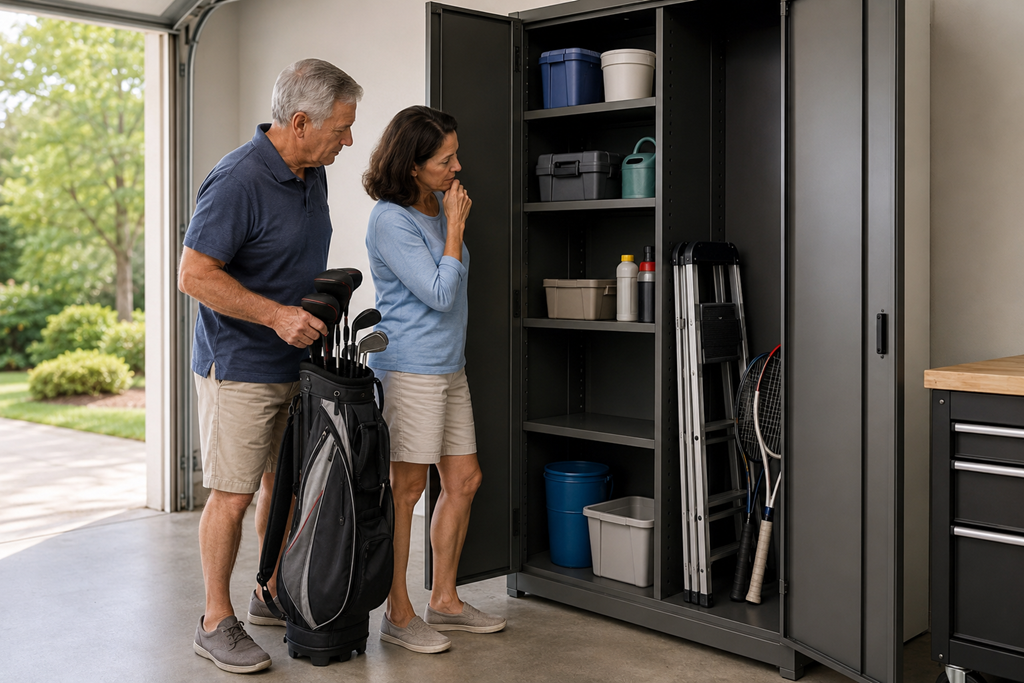
A soccer ball, baseball glove, bicycle helmet, portable net, set of golf clubs, and folding stadium chair may all belong to the same general category, but they do not fit the same shelf configuration. A row of evenly spaced shelves can divide a tall cabinet into compartments that are too short for much of the equipment.
Adjustable shelving, open lower compartments, removable dividers, and nearby wall storage may sometimes work together better than forcing everything into enclosed cabinets.
Access also matters. Equipment used several times a week should not be stored behind holiday decorations or heavy household containers. Family members are more likely to return belongings to their proper place when the location is easy to understand and reach.
Items that return to the garage damp or dusty may need to dry or be cleaned before they are enclosed. That everyday habit should be considered when deciding which sports items belong inside cabinets and which need a temporary open storage area.
Household Items Benefit From Clear Separation
Household overflow often enters the garage gradually. A few paper products, cleaning supplies, reusable bags, seasonal decorations, and unopened purchases can eventually occupy several unrelated shelves.
Cabinets can make this area look cleaner, but closed doors do not automatically create useful organization. Without intentional separation, small household items can become buried behind large storage bins or mixed with automotive products, gardening supplies, and sharp tools.
Grouping similar household items within defined cabinet sections makes it easier to see what is available before buying more. Clear containers may help with visibility, but the cabinet dimensions should still match the containers rather than requiring an assortment of bins to be stacked unpredictably.
Some products also have storage instructions related to temperature, moisture, or ventilation. Sacramento garages can become warm during extended periods of heat, so it is worth checking whether temperature-sensitive belongings are appropriate for garage storage before designing cabinet space around them.
A well-planned cabinet system does not have to hold everything currently in the garage. Part of the planning process may be recognizing that certain belongings should be stored elsewhere.
Identical Cabinets Do Not Always Produce Better Organization
Uniform cabinets can create a clean appearance, but making every section identical may reduce the usefulness of the system.
A long row of cabinets with the same depth and fixed shelf spacing assumes that the belongings are also similar. In most garages, they are not. The result can be wasted vertical space, overloaded shelves, inaccessible corners, or large equipment left on the floor because it does not fit anywhere.
Variation does not have to make the installation look mismatched. Cabinets can maintain a coordinated exterior while using different interior configurations. One section might contain shallow drawers for tools, another might offer adjustable household storage, and a taller compartment might accommodate sports equipment or folding items.
The important comparison is not between matching and nonmatching cabinets. It is between a system designed around real belongings and one designed primarily around visual symmetry.
Questions To Discuss During A Cabinet Estimate
Before comparing garage cabinet proposals, it can help to show the provider the actual belongings rather than describing them only as “tools,” “sports gear,” or “household storage.”
Useful questions include:
- Which sections are designed to support the heaviest tool cases?
- How easily can the shelf heights be changed later?
- Where will tall or irregular sports equipment fit?
- Can doors and drawers open comfortably when vehicles are parked?
- Which belongings would be better stored on racks or in open areas?
- Can the interior arrangement change as the household’s storage needs change?
Clear answers should connect the cabinet design to the objects that will occupy it. A provider who discusses measurements, access, weight, and future flexibility is giving you more useful information than one who focuses only on the total number of cabinets.
A Useful Storage Plan Leaves Room For Real Life
Garage storage does not have to place every possession behind a door. It should make frequently used belongings easier to reach, heavy items safer to handle, irregular equipment easier to return, and household supplies easier to recognize.
Before choosing a garage cabinet installation plan, look beyond the amount of available wall space. Consider what each cabinet section will hold, who will use it, how often it will be opened, and whether the interior can adapt when your belongings change.
That perspective can help Sacramento-area homeowners compare cabinet proposals based on everyday usefulness rather than appearance alone.