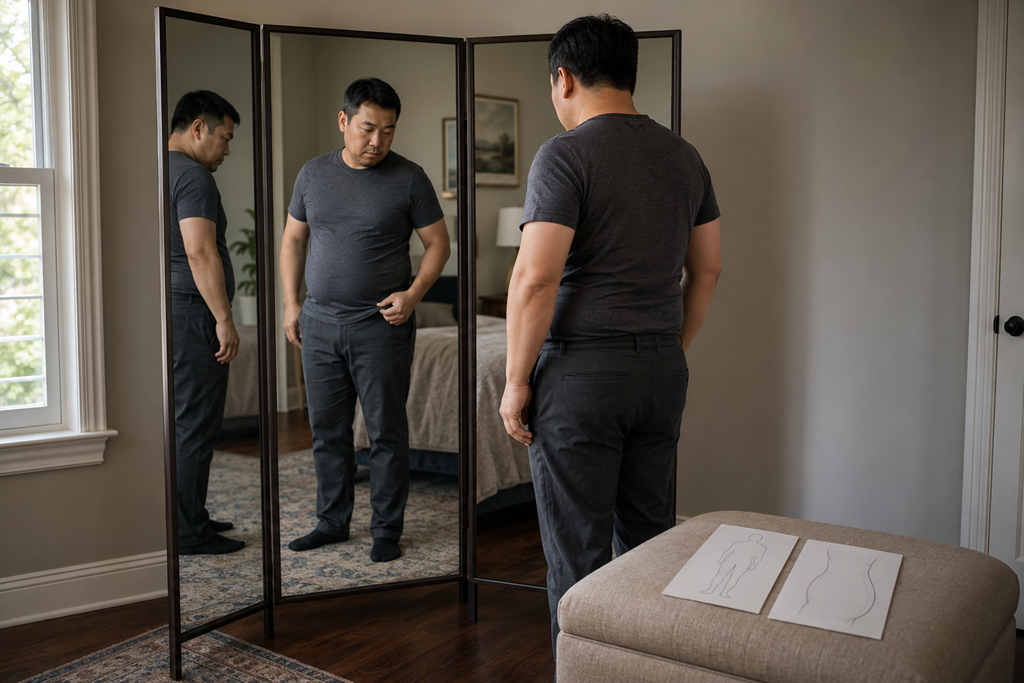
Thinking about liposuction goals realistically means focusing on a change in body contour rather than expecting a completely different body, major weight loss, perfectly smooth skin, or a guaranteed result. The most useful goal is usually specific and personal: improving the shape of one area while understanding that skin quality, anatomy, healing, and the limits of surgery all affect what is possible.
That distinction can be difficult to make when dramatic transformations dominate cosmetic procedure advertising and social media. A person may begin by wanting one area to look more proportionate, then gradually start expecting liposuction to change their overall size, tighten loose skin, remove every irregularity, or create the exact appearance shown in someone else’s photograph.
Realistic goals do not mean settling for a result that does not matter. They mean defining the improvement clearly enough that a qualified provider can explain whether liposuction is suited to it.
Liposuction Is Mainly About Contour, Not Overall Weight Loss
Liposuction is a surgical procedure that removes fat from specific areas and reshapes their contours. It is not considered an overall weight-loss method or a substitute for weight-management approaches.
A goal such as “I want the area around my waist to look more proportionate to the rest of my body” is generally more useful than “I want to become much smaller.” The first goal identifies a location and a visible concern. The second may depend on changes that liposuction alone is not designed to provide.
The number on a scale may not describe what is bothering someone. A Sacramento-area resident might be comfortable with their general size but notice that a localized area affects how certain clothing fits or how balanced their proportions appear. That is a different concern from wanting broad weight loss.
During a consultation, the provider should help separate these two goals rather than treating them as interchangeable.
Improvement Is More Realistic Than Perfection
A realistic goal allows for meaningful improvement without requiring the treated area to become perfectly flat, smooth, symmetrical, or identical to a reference photograph.
Human bodies naturally have differences between sides, changes in skin texture, curves, folds, muscle structure, and variations in how fat is distributed. Surgery does not erase every feature that existed before it.
Liposuction may also have limitations when the main concern involves loose skin, stretch marks, cellulite, muscle separation, or another issue that is not caused only by localized fat. Skin elasticity and existing tissue characteristics can influence how an area looks after fat is removed, and contour irregularities are among the potential risks that should be discussed.
This is why “What is causing the appearance I dislike?” may be more useful than immediately asking, “How much fat can be removed?”
The answer can help determine whether liposuction matches the concern or whether the provider believes another approach—or no procedure—is more appropriate.
Your Natural Anatomy Still Shapes the Result
Liposuction works with the body a person already has. It does not replace their underlying frame, muscle structure, skin characteristics, or natural proportions.
Two people who treat the same general area may not develop the same contour. Their starting anatomy, treatment plan, healing response, weight stability, skin quality, and other individual factors may differ.
This makes goals based on another person’s body difficult to evaluate. Reference photographs can help communicate preferences, but they should be treated as conversation aids rather than templates or promises.
A qualified provider should be able to explain which parts of a reference image relate to removable fat and which parts may reflect genetics, posture, muscle definition, lighting, posing, image editing, or a different procedure.
A Specific Goal Is Easier to Discuss
Broad goals such as “fix my body” or “make me look better” place too much meaning on one procedure. They also make it difficult to determine whether a proposed treatment plan actually addresses the concern.
A clearer goal might focus on:
- Improving how one localized area relates to nearby areas
- Reducing a particular bulge that remains noticeable at a stable size
- Creating a smoother transition between two body regions
- Improving the fit of certain types of clothing
- Making a modest contour change without expecting a different body type
These examples are not guarantees that someone is a candidate. They simply give the consultation a more defined starting point.
It can also help to describe what would count as a worthwhile improvement and what would still feel disappointing. That gives the provider an opportunity to identify a mismatch before a decision is made.
The First Visible Change Is Not Always the Final Result
Expectations should include the recovery period, not only the hoped-for endpoint. Swelling and other temporary changes may make an area look different while it heals, and the full result may take time to become clear.
Someone expecting to judge the final contour immediately may become concerned by normal early changes or feel pressured to evaluate the result too soon. A provider should explain what may be temporary, when progress is usually assessed, and which symptoms should prompt a call to the medical team.
The exact recovery experience varies. Personal medical history, the areas treated, the extent of surgery, the technique used, and the provider’s instructions can all affect what an individual should expect.
Notice How a Provider Responds to Limitations
A useful consultation should include more than statements about what liposuction can accomplish. It should also explain what it may not change.
Be cautious when communication centers on dramatic promises, an exact copied result, complete correction, effortless recovery, or pressure to commit before your questions are answered. Cosmetic surgery involves risks, and a provider should discuss relevant benefits, limitations, alternatives, recovery expectations, and potential complications in understandable language.
Clear communication does not require a provider to sound negative. It means they are willing to explain uncertainty and individual variation instead of presenting one idealized outcome as predictable for everyone.
A thoughtful provider may also adjust the proposed treatment area, recommend a different procedure, suggest waiting, or explain that the expected change may be too limited to justify surgery for that person.
Questions That Can Clarify Your Goal
Before consulting a Sacramento-area liposuction provider, consider asking:
- Which part of my goal appears achievable with liposuction?
- Which concerns are unlikely to change with fat removal alone?
- How might my skin and anatomy affect the contour?
- What degree of improvement would be reasonable in my situation?
- What imperfections or asymmetries could remain?
- How will we evaluate the result after swelling improves?
- What alternatives should I understand before deciding?
- What risks are most relevant to the treatment being proposed?
The value of these questions is not simply getting reassuring answers. It is learning whether the provider explains the procedure in a way that respects your individual starting point.
A Realistic Goal Should Still Feel Personally Meaningful
People sometimes hear “realistic expectations” as a warning not to care too much about the result. That is not the point.
A modest contour change can still be important to someone. The key is knowing what type of change is being considered, what tradeoffs accompany it, and whether the likely improvement feels worthwhile compared with the cost, recovery, uncertainty, and surgical risk.
The decision should also come from the individual rather than pressure from a partner, a trend, a photograph, or the belief that changing one body area will automatically resolve unrelated concerns about confidence, relationships, or overall well-being.
The Most Useful Goal Is One You Can Discuss Clearly
Thinking realistically about liposuction does not require predicting the exact outcome yourself. It means arriving at the consultation with a specific concern and being willing to hear what the procedure can and cannot reasonably address.
A qualified provider should evaluate candidacy, explain personal risks and limitations, and help translate a general wish into a medically appropriate discussion. Sacramento residents can then compare providers based not only on appealing images, but also on how clearly each provider explains anatomy, alternatives, recovery, uncertainty, and reasonable expectations.
The goal is not to lower your standards. It is to make sure the result you are hoping for is connected to what the procedure is actually designed to do.