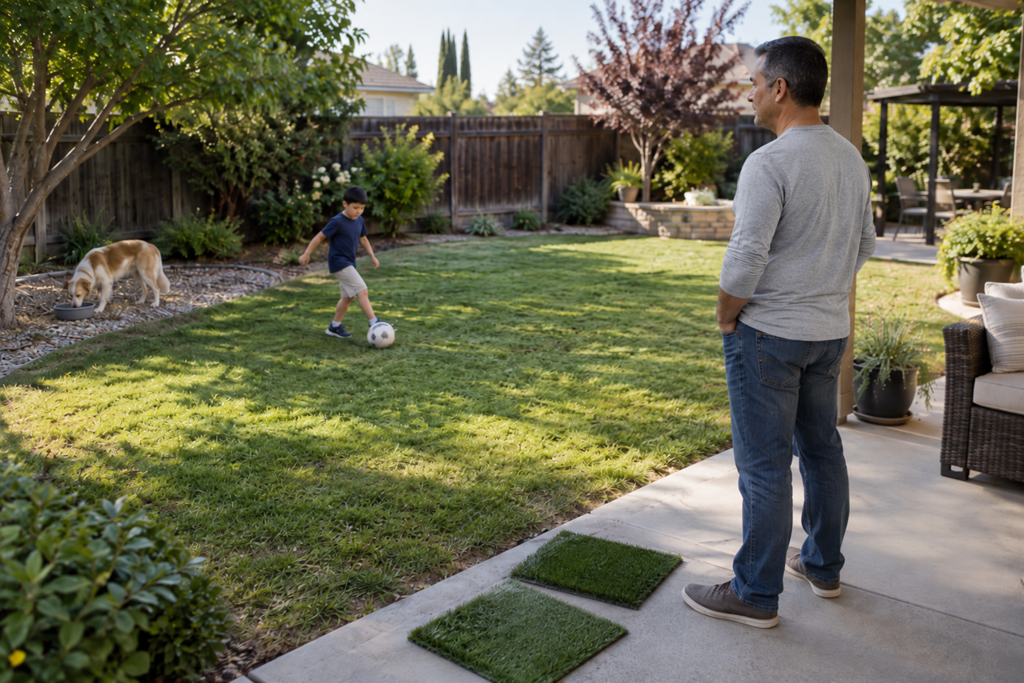
Artificial turf can be a practical choice for a yard used by pets and kids, but the decision is not just about whether the lawn looks neat or needs less mowing. The better question is how the surface will handle the way your household actually uses the yard—running, playing, resting, pet bathroom habits, cleanup, sun exposure, and everyday wear.
For Sacramento-area families, that can mean looking beyond a small turf sample or a general description such as “pet-friendly” or “family-friendly.” A surface that seems appealing in isolation still needs to make sense in the specific parts of the yard where children play, pets spend time, and the household moves through the space every day.
Start With How The Yard Is Really Used
Artificial turf is often evaluated as a landscaping material, but families experience it as an everyday surface.
Think about what regularly happens in the areas being considered for turf. One section may be an open play area. Another may be where a dog typically spends time. A side yard may get frequent foot traffic, while a quieter corner is mostly visual landscaping.
Those differences matter because the same household may expect one surface to serve several purposes.
A yard used mostly for appearance creates a different decision than one where children play regularly, a dog uses the lawn throughout the day, toys remain outside, and family members frequently move between the patio, house, and yard.
Before comparing turf products, it helps to define those real uses first.
Pets And Kids Put Different Demands On The Same Surface
A phrase such as “good for families” can sound reassuring without explaining very much.
For households with pets, questions may center on drainage, cleanup, recurring bathroom areas, odor management, wear patterns, and how easily the surface can be maintained.
For children, the considerations may be different. Families may care about how the surface feels underfoot, how comfortable it is for sitting or playing, how it responds to repeated activity, and whether the surrounding yard layout still works well for normal play.
Neither set of concerns automatically matters more than the other.
The useful question is whether the proposed turf system makes sense for both.
That is one reason a household with a dog and young children may need a more specific conversation with an artificial turf installer than a homeowner primarily trying to replace a decorative lawn.
Sun Exposure Can Change How The Yard Feels
Sacramento-area yards can include a combination of strong sun, partial shade, covered patios, mature trees, fences, and structures that create very different conditions within the same property.
That makes surface comfort worth discussing before choosing turf.
A sample viewed indoors or briefly handled during an estimate does not necessarily tell you how the material will feel in the sunniest part of the yard during the times your family normally uses it.
Instead of treating the entire yard as one uniform space, notice where pets tend to rest, where children tend to play, and which sections receive the most direct sun.
Then ask the installer how those conditions affect the options being proposed.
The goal is not to predict every possible condition. It is to make sure the recommendation reflects the actual yard instead of only the appearance of the turf.
“Pet-Friendly” Should Lead To More Questions
A pet-related product description is a starting point, not a complete explanation.
If a dog will regularly use the turf, ask what the installer expects everyday cleanup and maintenance to involve. Discuss the parts of the yard the pet uses most frequently and whether those areas affect the recommended materials or project design.
It is also worth talking about drainage and recurring pet-use areas before installation rather than assuming every turf system handles them in the same way.
This is especially important when the household expects artificial turf to simplify yard care.
Lower-maintenance landscaping does not necessarily mean no maintenance. Understanding what routine care may still be needed gives you a more realistic picture of what living with the finished yard will be like.
Think About Play, Not Just Appearance
Artificial turf samples are easy to compare by color, blade shape, density, or how they feel in your hand.
Those details can matter, but they do not show the whole experience of using the finished yard.
If children regularly play outside, think about the kinds of activity that actually happen there. Is the lawn mostly used for casual play? Do toys, small goals, play equipment, or outdoor furniture frequently occupy the space? Is the turf area part of the main route between the house and other parts of the yard?
This changes the conversation from “Which turf looks best?” to “Which option fits what happens here?”
That shift can make provider discussions much more useful.
The Entire Yard Does Not Have To Be Treated As One Problem
Another easy assumption is that choosing artificial turf means finding one surface and using it everywhere lawn currently exists.
That may be appropriate for some properties, but it does not have to be the starting assumption.
Different parts of a yard can serve different purposes. A family may have an active play area, a dedicated pet area, planting beds, shaded seating, pathways, or portions of the property that do not need turf at all.
Looking at the yard by function can help you have a more useful conversation about project scope.
It may also help prevent a decision based mainly on replacing every square foot of existing grass rather than considering how the finished space should work.
A Good Estimate Should Reflect Your Household
When comparing local artificial turf providers, pay attention to whether the conversation becomes specific to your property and your family.
A useful discussion should move beyond square footage and product appearance.
Questions worth asking may include:
- How does this option fit a yard regularly used by both pets and children?
- What should we understand about surface comfort in the sunniest areas?
- How would recurring pet-use areas affect maintenance expectations?
- What routine cleaning or care would this installation require?
- Are different parts of the yard worth treating differently?
- What differences between the proposed turf options would we actually notice in everyday use?
You do not need to become an artificial turf expert to ask these questions.
You are trying to understand whether the provider has connected the recommendation to the way your household will actually use the finished space.
Be Cautious With One-Size-Fits-All Answers
Artificial turf decisions can become confusing when broad labels replace specific explanations.
Statements such as “this is our pet turf,” “this is our family option,” or “everyone uses this one” may not tell you enough by themselves.
A stronger explanation connects the recommendation to your yard: where the sun falls, where pets spend time, where children play, how the area will be maintained, and what you should realistically expect from the finished surface.
Similarly, choosing solely because one sample feels softer or looks more natural can leave other practical questions unanswered.
The best-looking sample is not automatically the best fit for the way a particular household uses its yard.
Choose For Everyday Life, Not Just Installation Day
Thinking through artificial turf for pets and kids is ultimately about imagining the yard after the project is finished.
Picture an ordinary week rather than a freshly installed lawn: children using the space, the dog going outside, cleanup happening, toys or furniture moving around, sunny portions of the yard heating up, and heavily used areas seeing repeated traffic.
Those everyday moments reveal the questions that matter most.
Before comparing quotes or committing to an artificial turf installation, make sure the conversation covers how the surface will function for the people and pets who will actually use it. A recommendation that fits your household's routines can be more meaningful than choosing turf based on appearance or a broad product label alone.