A whole house fan is easiest to use comfortably when you treat it as a ventilation tool, not as a replacement for air conditioning. The basic goal is to bring in outdoor air when conditions outside are more comfortable than conditions inside, while giving that incoming air a clear path through the rooms you actually want to cool.
That distinction can explain why a whole house fan sometimes feels refreshing and useful, yet at other times creates drafts, uneven room temperatures, extra noise, or very little improvement at all. The fan itself may not have changed. The outdoor conditions, open windows, interior doors, and airflow path may have changed instead.
For Sacramento-area homeowners, learning to recognize those differences can make it easier to use an existing system comfortably and to have a more productive conversation with a whole house fan professional when something does not seem right.
Comfort Depends More on Timing Than Simply Running the Fan Longer
A whole house fan brings outdoor air into the home while moving indoor air toward the attic and exhaust area. That means the quality and comfort of the outdoor air matter.
If the air outside feels more comfortable than the air trapped inside the house, ventilation may help the home feel better. If outdoor conditions are still uncomfortable, simply running the fan longer does not necessarily improve the experience.
This is especially useful to remember during periods of Sacramento heat. A house may remain warm after the outdoor temperature has begun to feel more comfortable. That can create a useful opportunity for ventilation. At another time of day, pulling hot outdoor air inside may work against the homeowner's comfort goal.
Outdoor air quality, odors, dust, pollen, and other conditions can matter as well. A whole house fan does not condition incoming outdoor air the way an air-conditioning system does. If bringing the outside air indoors is undesirable at that moment, ventilation may not be the right approach.
The important question is therefore not simply, "Is the house warm?"
A better question is, "Would bringing the outdoor air inside make the house more comfortable right now?"
The Openings Around the House Shape Where the Air Goes
A whole house fan needs incoming air from outside. Where that air enters can strongly affect how individual rooms feel.
An open window near the fan may receive noticeable airflow while a more distant room receives much less. A bedroom with a useful airflow path may feel comfortable, while another room remains warmer. A window that is opened much more than the others may become the dominant source of incoming air.
This is why whole house fan comfort is partly an airflow-distribution issue rather than simply an on-or-off decision.
Homeowners do not need to turn that into a complicated airflow calculation. The manufacturer's operating guidance and information from the installer should establish how the particular system is intended to be used, including the amount of available opening it needs.
If you are unsure whether your windows, room arrangement, or interior doors are creating the intended airflow path, that is a reasonable question to bring to a qualified whole house fan professional rather than relying on trial and error.
A Strong Draft in One Room Can Be a Clue
One of the easiest comfort problems to notice is a room that suddenly feels much draftier than expected.
That does not always mean the entire system needs to move less air. It may mean a large share of the incoming air is entering through that particular room.
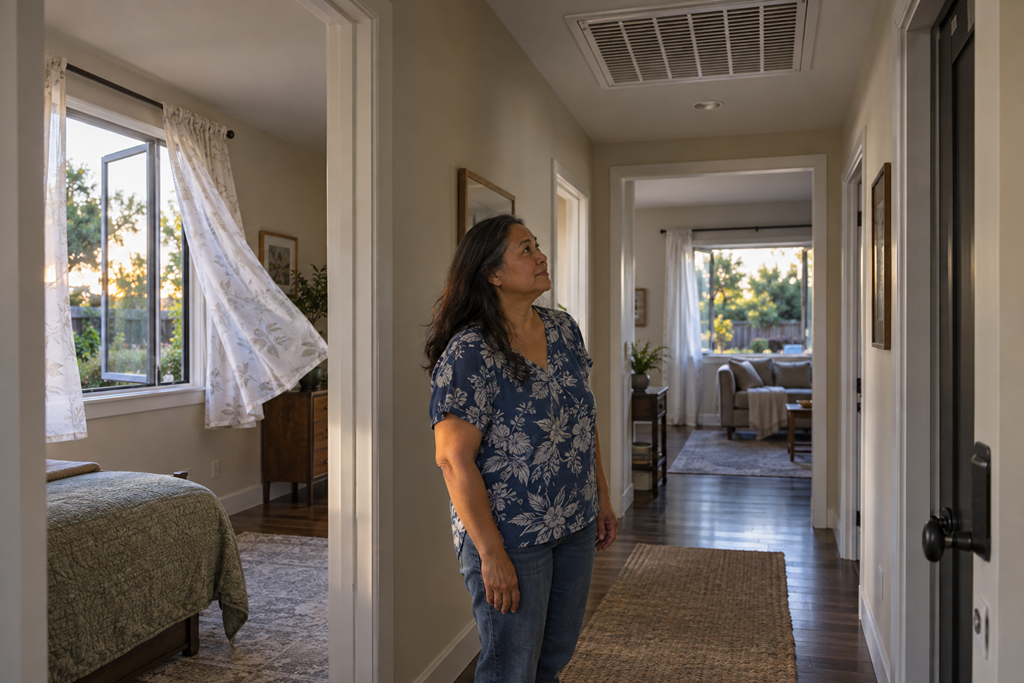
Curtains moving strongly near one window while another area feels relatively unchanged can provide a simple visual clue that the airflow is concentrated.
Interior doors can also make pressure differences more noticeable. A door that moves, pulls toward its frame, or behaves differently while the fan is operating may be another sign that the airflow path deserves attention.
The useful takeaway is not to diagnose the system yourself. It is to notice the pattern.
Knowing which rooms feel drafty, which rooms remain warm, which windows are open, and when the problem occurs gives an installer much more useful information than simply saying, "The fan is uncomfortable."
More Ventilation Is Not Automatically More Comfortable
It can be tempting to assume that if some fan operation helps, more operation will help even more.
Comfort does not always work that way.
Once the indoor space has reached a comfortable point, continuing to bring in outdoor air may eventually make some rooms cooler than desired. Outdoor conditions can also change while the fan is operating.
That means the goal does not have to be maximizing fan runtime. The better goal is using ventilation during conditions when it actually supports the comfort of the house.
This also helps explain why a whole house fan may feel very useful on one evening and much less useful on another. The system is interacting with conditions both inside and outside the home.
Whole House Fans and Air Conditioning Do Different Jobs
Another common source of confusion is treating a whole house fan as though it were simply another type of air conditioner.
The two systems approach comfort differently.
Air conditioning cools and conditions indoor air. A whole house fan replaces indoor air with outdoor air. Because those are different strategies, homeowners may use them at different times depending on conditions and the design of the home.
If you have questions about how your fan should be coordinated with your HVAC system, follow the operating guidance for your equipment or discuss the issue with the installer. This is especially worthwhile if you have recently moved into a home with an existing whole house fan and were never shown how the system was intended to be used.
Understanding that difference can prevent a lot of frustration. A whole house fan does not need to perform every cooling job to be useful. It simply needs to be used for the job it was designed to do.
Comfort Problems Can Tell You What to Ask About
Some homeowners assume drafts, excessive noise, uneven airflow, or uncomfortable room conditions are simply part of owning a whole house fan.
They are better treated as information.
The issue could relate to how the system is being used, the location and amount of incoming airflow, the fan controls, the home's layout, the installation, attic ventilation, or another system-specific factor.
You do not have to identify the cause before speaking with a professional.
Instead, pay attention to the circumstances surrounding the problem. A clear description of when the issue appears can help a local pro understand what needs to be evaluated without requiring you to inspect equipment, enter an attic, or make adjustments yourself.
Questions Worth Asking When the System Does Not Feel Right
If comfort problems continue, a few focused questions can make a service conversation more useful:
- How much window opening is recommended for this particular fan?
- Are certain rooms or window locations affecting how the airflow is distributed?
- What outdoor conditions are best suited to using this system?
- Could the noise or door movement I am noticing indicate an airflow or installation issue?
- How should this fan be coordinated with the home's air-conditioning system?
- Are the fan size, controls, and attic ventilation appropriate for the way this home is being used?
These questions keep the conversation centered on comfort and system expectations rather than assuming that one specific repair or adjustment is necessary.
The Goal Is Comfortable Airflow, Not Maximum Airflow
Using a whole house fan comfortably is less about running it as much as possible and more about matching ventilation to the right conditions.
Pay attention to whether the outdoor air is actually more comfortable, where that air is entering the house, and whether certain rooms are receiving noticeably more or less airflow than others. If the system consistently creates uncomfortable drafts, unusual door movement, excessive noise, or uneven results, those patterns are worth discussing with a qualified local professional.
For Sacramento-area homeowners, understanding those basic relationships can make an existing whole house fan easier to use and make future service conversations more productive. The goal is not simply to move the greatest amount of air. It is to use the system in a way that makes the home feel more comfortable.