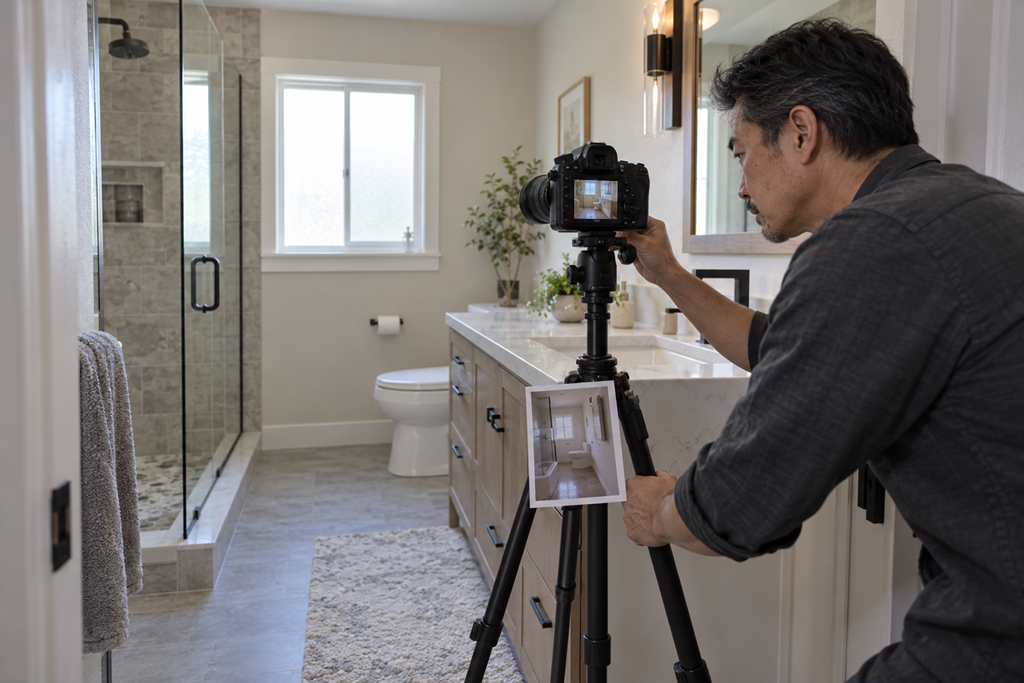
Before-and-after photos can help prospective customers see how a service business has changed a real space, but they cannot tell the entire story of a project. For a Sacramento-area bathroom remodeling company, a photo comparison might show new tile, an updated shower, or a redesigned vanity. It usually cannot establish the quality of concealed work, the full project scope, the cost, or how the remodeling process was managed. Business owners who understand this distinction can use project photography to demonstrate genuine experience without asking customers to draw conclusions the images cannot support.
For local service businesses, project photographs can be valuable evidence of completed work. They give potential customers something more concrete than a general statement about craftsmanship or experience.
However, a visually impressive transformation and a well-supported claim about a company's work are not necessarily the same thing.
The difference matters when someone is deciding whether to contact a business, request an estimate, or explore a potential project.
What Before-And-After Photos Actually Demonstrate
A well-documented before-and-after comparison can help a prospective customer understand the visible changes made to a property.
In bathroom remodeling, those changes might include:
- Replacing an existing bathtub with a walk-in shower.
- Updating a vanity, countertop, or bathroom fixtures.
- Changing the tile, flooring, or visible wall finishes.
- Improving the layout or appearance of a bathroom.
- Transforming an outdated room into a more contemporary space.
These comparisons are useful because they make the company's work easier to picture.
A homeowner considering a similar project may recognize a bathroom arrangement, material choice, or design challenge resembling their own.
That connection can make the business feel more relevant to the customer's needs.
The strongest photographs also make it reasonably clear that the images show the same space at different stages. Recognizable room features, consistent camera positions, and accurate descriptions can help establish that relationship.
Yet even when the transformation is authentic, the photograph demonstrates only what can reasonably be observed.
A finished shower may look attractive, but its appearance alone does not verify the waterproofing beneath the tile. A new vanity may fit the room beautifully, but the image does not establish what plumbing changes were necessary or whether the project stayed within its original budget.
Those details require information beyond the photograph.
Why Attractive Transformations Are Not Complete Proof
One difficulty with before-and-after photography is that customers may interpret visual appeal as evidence of broader project quality.
This is understandable. Most homeowners cannot see concealed building components after a remodel is completed. They are often judging the information available to them, including photographs, descriptions, reviews, and conversations with the company.
A beautiful finished bathroom may create a favorable first impression.
But several important aspects of the project remain outside the camera frame.
The scope of work may be unclear
A photo showing a completely refreshed bathroom does not necessarily indicate whether the company replaced all the visible features, completed a limited portion of the work, or collaborated with other professionals.
Without a description, customers may attribute every visible change to the business displaying the image.
Concealed workmanship cannot usually be evaluated
Photos of finished tile, fixtures, and cabinetry are not sufficient to confirm the quality of plumbing connections, waterproofing assemblies, electrical installations, or underlying structural work.
Even photographs taken during construction may show only a limited portion of those systems. Technical quality and compliance require appropriate professional evaluation and supporting records where applicable.
Project conditions may differ
Two bathrooms that look similar after remodeling may have started with very different existing conditions.
One could have required relatively straightforward surface updates. Another might have involved additional work discovered during the project.
The finished appearance alone does not reveal those differences.
Photography can influence perception
Lighting, camera position, lens selection, staging, and editing can make a space appear larger, brighter, or more polished.
Professional photography is not inherently misleading. The concern arises when presentation choices create an impression that does not fairly represent the completed work.
These limitations do not make before-and-after photos unhelpful. They explain why photographs are strongest when accompanied by accurate context.
The Questions Customers Still Have After Seeing The Photos
Imagine a Sacramento homeowner exploring bathroom remodeling companies online.
The homeowner finds a gallery containing several impressive transformations. The rooms appear finished, attractive, and professionally presented.
The gallery may answer an immediate question: Does this company show examples of bathroom designs I find appealing?
But the homeowner may still wonder whether the company has experience with bathrooms similar in size or configuration to their own.
Other questions may follow.
Did the company complete the entire renovation? Were the fixtures relocated? What kinds of materials were used? Did the project involve significant changes beyond what appears in the photographs?
The customer may also want to understand how the company approaches estimates, project scheduling, change requests, and communication.
If none of that information is available, the photographs may attract interest without supplying enough context to help the person evaluate whether the company is an appropriate fit.
That is a communication limitation, not proof that the business lacks experience or provides poor service.
The company might have extensive, legitimate project experience that simply has not been documented or explained online.
How Project Photo Galleries Can Create Unintended Confusion
Several common presentation patterns can make otherwise useful photographs less informative.
Unmatched photo angles. When the before and after views show different parts of a room, customers may struggle to determine what actually changed.
Missing project descriptions. A series of images without context can leave customers guessing about the work performed and the company's role.
Selective representation. A gallery consisting entirely of dramatic transformations may create an incomplete picture of the company's typical services if the business also handles smaller, more focused projects.
Unclear image origins. Customers may not know whether photographs show the company's own completed projects, manufacturer examples, design renderings, or images supplied by another party.
Unsupported quality claims. Describing a visually appealing project as proof of superior construction quality goes beyond what finished photographs can verify.
None of these patterns automatically establishes that a business is being deceptive.
They identify places where additional explanation could help customers interpret the evidence accurately.
A Simple Way To Evaluate Your Own Project Photos
A bathroom remodeling business owner can review one publicly visible project gallery or a completed-project example on the company's website.
Choose a before-and-after comparison that represents work the business actually performed.
Look at the images as someone unfamiliar with the company might. Can that person reasonably identify the same bathroom in both photographs, recognize the visible changes, and distinguish the company's documented work from anything the images leave uncertain?
Then examine the accompanying description. Does it accurately explain the main project scope, the company's role, and any important limitations on what the images demonstrate?
This brief review can reveal opportunities to make the presentation more informative. It cannot establish how customers actually interpret the page, whether the business has earned their trust, or whether the gallery affects inquiries.
Those broader questions would require additional evidence.
The immediate objective is narrower: make sure the visual example supports the claims being made about it.
Giving Customers Useful Context Without Overexplaining
Business owners do not need to publish a detailed construction report alongside every project photograph.
A concise, factual description can often make a meaningful difference.
For example, a bathroom remodeling company might identify a project as a guest bathroom renovation involving replacement of an existing tub, new tile finishes, and installation of a replacement vanity.
If accurate, the description could also clarify that the original room layout was retained.
That additional information helps customers understand what kind of work the photographs represent.
Other useful context may include the general type of property, an unusual design constraint, or a distinction between work completed by the company and work performed by other specialists.
Owners should share only details they can support and are authorized to disclose. Homeowner privacy, project permissions, and any relevant contractual restrictions also deserve consideration.
A straightforward description is often more credible than broad claims such as perfect workmanship or flawless results.
The business is showing a real example, not trying to prove everything about its capabilities from a pair of images.
A Sacramento Bathroom Remodeling Example
Consider a hypothetical bathroom remodeling business serving Sacramento-area homeowners.
Its website displays a striking transformation: an older bathroom with a built-in bathtub becomes a bright space featuring a walk-in shower, new flooring, and a modern vanity.
The images clearly show a substantial visual change.
However, the gallery provides no explanation of the project's scope.
A prospective customer might reasonably assume that the remodeling company completed every part of the renovation, including work that is not visible.
Now imagine the company adds a short, accurate description identifying the services it performed and explaining that the existing bathroom footprint remained unchanged.
If the company has appropriate documentation and permission, it might also include a genuine image from an intermediate stage of the project, clearly identifying what that image depicts.
The finished appearance remains the same.
What changes is the amount of useful information available to the customer.
The business has not proven that the project was superior to competing work. It has made the example more understandable and easier to evaluate.
This is an illustrative scenario, not a documented review of an actual Sacramento remodeling company.
When Other Evidence Matters More Than Another Photograph
Adding more before-and-after comparisons is not always the most useful improvement.
Sometimes the missing information concerns the experience of working with the business rather than the appearance of its finished projects.
Authentic customer reviews, when presented with appropriate authorization, may offer insight into communication, scheduling, and the customer's experience. Individual reviews are still subjective accounts and should not be treated as guarantees.
Clear explanations of the company's estimate and project-management processes can help customers understand what happens before and during a renovation.
Accurate business information, appropriately described credentials, and consistent descriptions of services can also help prospective customers assess the business's identity and qualifications.
These forms of supporting evidence answer different questions.
A project photograph can show what a completed space looked like. A process explanation describes how the business approaches its work. A customer review may describe one person's experience.
None guarantees what will happen on a future project, but together they can provide a more informative picture than appearance alone.
Being Trusted Online Requires More Than Looking Professional
For Sacramento service businesses, the ability to be found online is only the beginning.
Customers also need to understand what the company offers and whether it may fit their situation.
Then they need credible reasons to consider taking the next step.
This is the relationship behind the Discovered → Understood → Trusted framework.
Before-and-after photography primarily supports the Trusted stage when it provides authentic, relevant evidence of completed work.
However, photography contributes to credibility only to the extent that it is accurate and appropriately explained.
A beautifully designed website cannot substitute for genuine project experience. Likewise, genuine experience may be difficult for potential customers to evaluate when the business presents only attractive photographs without context.
The objective is not to manufacture trust through marketing.
It is to make legitimate evidence easier for customers to recognize and assess.
Let The Photographs Show What They Can Prove
Before-and-after photographs work best when they are treated as visual evidence of a specific change rather than as complete proof of a business's quality or reliability.
For a bathroom remodeling company, the pictures can demonstrate visible transformations, illustrate design possibilities, and help customers identify relevant project experience.
They cannot independently verify concealed workmanship, financial details, customer satisfaction, or the full experience of working with the contractor.
When business owners pair authentic photography with accurate descriptions and appropriate supporting information, they give prospective customers a fairer basis for evaluation.
The goal is not to make every photograph prove more. It is to help customers understand exactly what the photograph shows—and what they still need to learn.
About the Author
Rodrick Etienne is the founder of Sacramento Local Pros and a Local Online Visibility Expert. He helps local businesses better understand how they are discovered, understood, and trusted online.