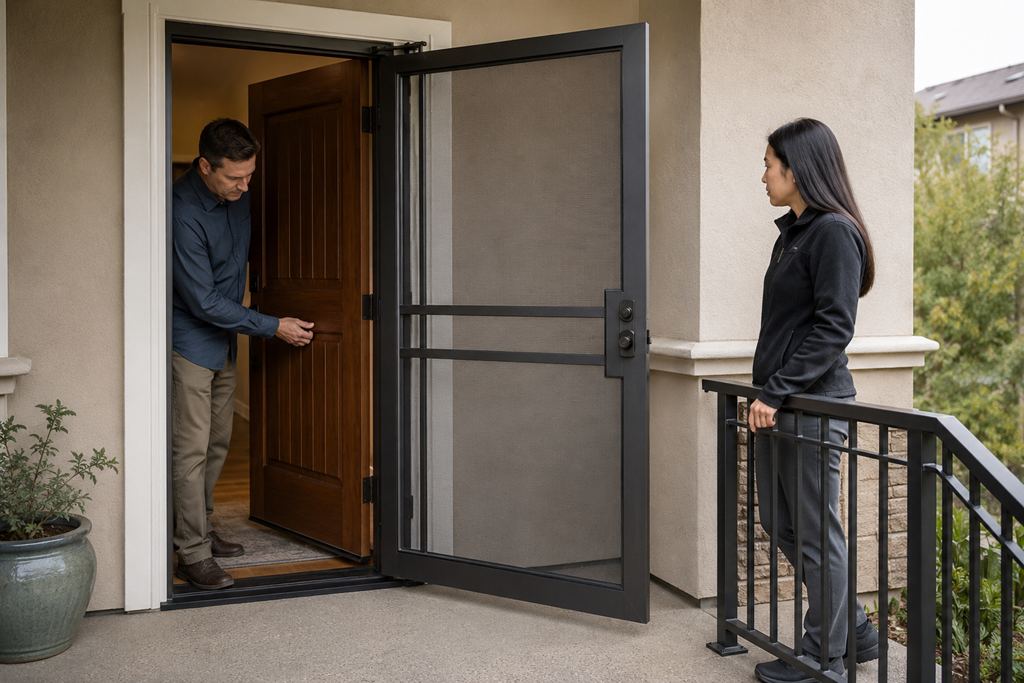
When discussing a security door, ask how the hinges, frame, lock, and screen will work together at your specific entry—not simply whether each part is “heavy-duty.” The useful questions are about fit, attachment, door swing, daily operation, security, airflow, visibility, maintenance, and what happens if one component needs adjustment or replacement later.
It is easy to focus on the appearance of a security door or the strength of its metal construction. However, the experience of using the door every day often depends on less noticeable details. A strong door can still feel awkward if its hinges interfere with the entryway, its frame does not match the existing opening, its lock conflicts with the primary door, or its screen does not provide the airflow and visibility the homeowner expected.
For Sacramento-area homeowners comparing security door installation options, the goal is not to become an expert in door hardware. It is to ask enough specific questions to understand what is being proposed and whether the entire entry system will work as expected.
A Security Door Is More Than a Metal Panel
The hinges, frame, lock, and screen are sometimes discussed as separate features. In practice, they affect one another.
The frame supports the door and provides the surfaces where the hinges and locking hardware operate. The hinges control the door’s movement and positioning. The lock must line up correctly with the frame while remaining practical to use alongside the primary entry door. The screen affects airflow, visibility, insect protection, privacy, and the overall feel of the entrance.
This is why a product description alone may not answer the most important questions. A particular hinge, lock, or screen may sound impressive, but its value depends on how well it fits the home, the doorway, and the homeowner’s daily routine.
A useful conversation should move beyond “Is this strong?” and toward “How will this work here?”
Ask How the Hinges Affect the Door’s Movement
Hinges are easy to overlook because they sit along the edge of the door. Yet they influence how smoothly the door opens, how far it can swing, how it rests when closed, and whether it remains aligned over time.
Start by asking which direction the security door will open and why that direction is appropriate for the entry. Many security doors open outward, but the surrounding porch, railing, wall, column, steps, planter, or walkway can affect whether the proposed swing feels practical.
Other useful questions include:
- Will the door open far enough to provide a comfortable walking path?
- Could the door edge or handle come close to a wall, railing, light fixture, or other obstruction?
- How are the hinges protected against unwanted removal or tampering?
- Are the hinges adjustable or serviceable if the door begins to sag or rub?
- Is the hinge system appropriate for the weight and construction of the proposed door?
The installer should be able to explain how the door will move in the actual space. A general statement that the hinges are “standard” or “heavy-duty” does not reveal whether the swing will work comfortably at that particular entrance.
The Existing Entry Frame Deserves Its Own Conversation
The security door frame is not merely decorative trim around the new door. It helps support the door, hold the hinges, receive the locking hardware, and keep the system properly aligned.
Ask what the new frame will attach to and whether the existing entry appears capable of supporting the proposed installation. Painted trim can sometimes hide deterioration, separation, uneven surfaces, past repairs, or other conditions that become important once installation planning begins.
The homeowner does not need to diagnose the frame. The installer should evaluate it and explain what was found.
Helpful questions include:
- What part of the existing entry will support the new frame?
- Is the opening reasonably square and level?
- Is any damaged, loose, compressed, or deteriorated material visible?
- Would frame preparation or repair be needed before installation?
- Is that preparation included in the estimate?
- How will gaps, uneven surfaces, or unusual trim be addressed?
- Will the installation alter the existing doorway, molding, stucco, or painted finish?
These questions can reveal whether the quoted scope covers the full installation or only the placement of the security door itself.
A provider who notices a frame concern should explain how it affects the project rather than minimizing it or proceeding without discussion.
A Lock Should Make Sense During Everyday Use
Locks are often described by brand, design, number of locking points, or resistance features. Those details may matter, but homeowners should also understand how the lock will function during ordinary entry and exit.
Ask to see where the security door handle and lock will sit in relation to the hardware on the primary door. Two separately functioning doors can become inconvenient when their knobs, levers, deadbolts, or handles occupy the same limited space.
Questions worth discussing include:
- Will the security door handle interfere with the primary door handle or deadbolt?
- Can both doors open and close without one handle striking the other?
- How will the security door be locked and unlocked from each side?
- Will household members need a separate key?
- Can the security door be keyed to match another lock, if that option is available?
- What happens if the latch or lock becomes misaligned?
- Which lock components are replaceable or serviceable later?
- Is the proposed hardware comfortable for the people who will use it regularly?
This conversation is especially important when children, older adults, frequent visitors, caregivers, or household members with limited grip strength use the entrance.
A security feature that is confusing or inconvenient may not be used consistently. Everyday operation is therefore part of the decision, not a separate concern to discover after installation.
The Screen Determines More Than Whether Bugs Stay Out
The term “screen” can refer to materials with very different levels of openness, visibility, strength, airflow, and privacy.
A more open screen may allow stronger airflow and a clearer exterior view. A denser or heavier material may feel more private or substantial but can change how much light and air pass through the entry. Some screen options may be designed mainly for insects, while others are integrated into the protective structure of the door.
Ask what the proposed screen is intended to do rather than assuming every screen provides the same benefits.
Useful questions include:
- Is the screen primarily for insect protection, airflow, visibility, privacy, or added resistance?
- How clearly can someone see through it from inside and outside?
- How much will it reduce airflow or natural light?
- Could pet claws or routine household activity damage it?
- Can the screen be cleaned without removing the entire door?
- Is the screen replaceable if it becomes torn, bent, clogged, or worn?
- Will replacement require a specialized part or service visit?
Sacramento-area homes can experience extended periods when homeowners want ventilation without leaving the primary entry fully exposed. The right screen choice depends on what the household expects from that experience.
Ask to See How the Four Parts Work Together
One of the most useful requests is also one of the simplest: ask the provider to explain the complete entry sequence.
That means showing or describing how the homeowner will approach the door, unlock it, open it, move through the entrance, operate the primary door, close both doors, and secure the entry again.
This can reveal practical concerns that individual product specifications do not show:
- A security door may swing into the normal walking path.
- The hinge side may crowd nearby trim or a porch column.
- Two handles may sit too close together.
- A dense screen may reduce the expected view or airflow.
- An uneven frame may affect latch alignment.
- A closer or spring mechanism may cause the door to move differently than expected.
- A threshold or lower frame section may affect carts, strollers, mobility devices, or pet movement.
The purpose is not to search for a perfect door with no tradeoffs. It is to understand the tradeoffs before choosing.
Questions That Make Provider Comparisons More Useful
When comparing local security door installers, broad questions can produce broad answers. Asking the same specific questions of each provider makes the differences easier to recognize.
Consider asking:
- What did you observe about my existing doorway that affects this installation?
- How will the proposed hinge placement affect the swing and walking space?
- What material will the frame attach to?
- Is any entry repair or preparation excluded from the estimate?
- How will the security door lock interact with the primary door hardware?
- What is the screen designed to provide, and what are its limitations?
- Which components can be adjusted, repaired, or replaced later?
- What maintenance does this particular door system normally require?
- Can you explain the installation scope in writing?
The strongest answers are usually specific to the entry. They should connect the recommendation to visible conditions rather than relying only on product claims.
Vague Descriptions Can Hide Important Differences
Words such as “reinforced,” “premium,” “secure,” and “heavy-duty” may describe genuine features, but they do not explain exactly what the homeowner is receiving.
Two providers may use similar language while proposing different hinge designs, frame attachment methods, locking hardware, screen materials, preparation work, or service coverage.
Listen for explanations that identify:
- The exact component being discussed
- Its intended purpose
- How it fits the existing entry
- Any limitations or tradeoffs
- What installation work is included
- What could create an additional decision or cost
- What can be serviced after installation
A provider does not need to criticize other products to give a useful explanation. Clear descriptions of the proposed system should be enough for the homeowner to understand why it is being recommended.
The Best Questions Are About Fit, Use, and Expectations
A security door should not be evaluated only by how solid it feels in a showroom or how attractive it appears in a photograph. Its hinges, frame, lock, and screen must operate together at the home where it will be installed.
Before comparing quotes or committing to an installation, ask how each component affects the doorway, daily movement, locking routine, ventilation, visibility, maintenance, and future service. Specific answers make it easier to recognize whether a provider has evaluated the entry carefully or is simply recommending a standard product.
The goal is not to ask the greatest number of questions. It is to leave the conversation understanding how the proposed door will actually function once it becomes part of the home.