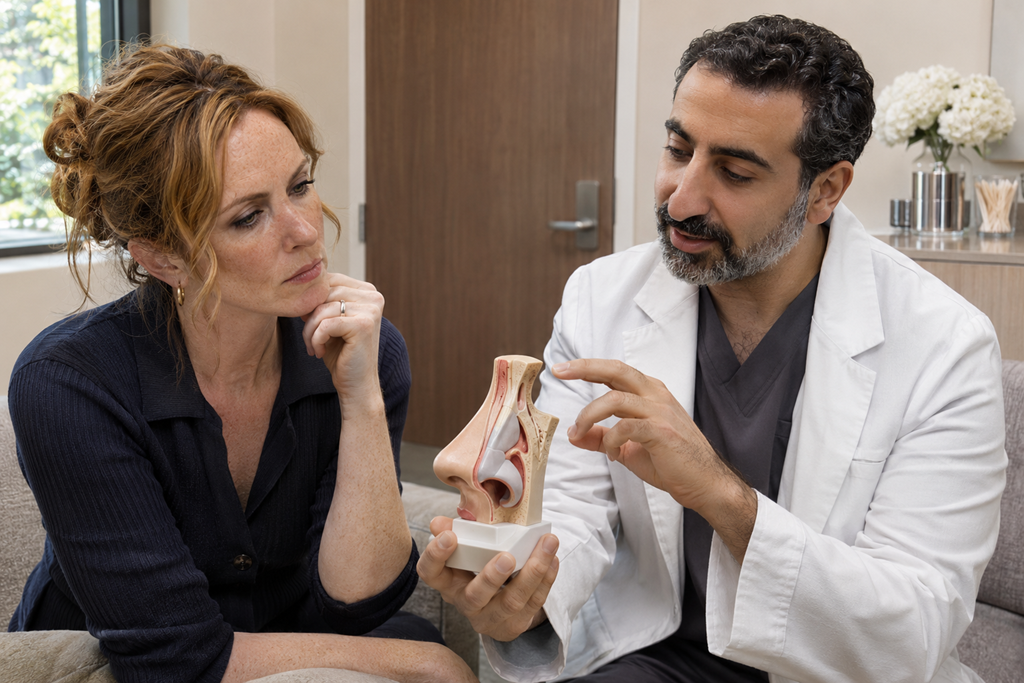
Choosing a rhinoplasty surgeon involves more than reviewing before-and-after photos or finding a convenient Sacramento-area office. You are choosing a physician to evaluate your goals, explain what surgery may realistically change, consider breathing and health concerns, and manage your care before and after the procedure. The most useful questions reveal the surgeon’s relevant training, experience, judgment, safety arrangements, and willingness to discuss limits—not simply whether they can produce a look you like.
Rhinoplasty is a personal decision, and comparing surgeons can be difficult when their websites, photographs, credentials, and consultation styles all appear reassuring. One practice may emphasize cosmetic refinements, another may discuss nasal function extensively, and another may have particular experience with patients who have undergone previous nasal surgery.
For Sacramento-area residents, the goal is not to identify a surgeon based on advertising, popularity, or price alone. It is to understand whether a particular surgeon has appropriate qualifications, relevant experience, sound clinical judgment, and a clear approach to your individual concerns.
This guide explains what to ask, how to interpret the answers, and what to clarify before deciding whether to proceed.
Start by asking about qualifications and rhinoplasty experience
A surgeon's qualifications are an important starting point, but they should be evaluated carefully rather than accepted based on a short biography or impressive-sounding title.
Rhinoplasty may be performed by appropriately trained surgeons from different professional backgrounds, including plastic surgery and facial plastic surgery. Their training pathways and experience may differ.
The most useful question is not simply whether someone is a surgeon. It is whether their training and actual surgical practice are relevant to the specific rhinoplasty procedure you are considering.
What board certification does the surgeon hold?
Ask the surgeon to identify the board that granted their certification and explain how their training relates to rhinoplasty.
Relevant credentials may include certification through the American Board of Plastic Surgery or qualifications associated with otolaryngology–head and neck surgery and facial plastic and reconstructive surgery.
These credentials are not interchangeable, and different certifying organizations have different requirements. Patients should understand the exact certification being claimed rather than assuming every certification with "cosmetic" or "plastic" in its name represents the same training.
Consider asking:
- Which medical specialty are you board-certified in?
- Which organization granted that certification?
- How does your surgical training specifically prepare you to perform rhinoplasty?
- How can I independently verify your credentials?
The American Board of Plastic Surgery provides a public certification verification system. Other certifying boards maintain their own verification processes.
Board certification is an important qualification to investigate, but it does not guarantee a particular surgical outcome.
How much of the surgeon's practice involves rhinoplasty?
General surgical experience and experience with a particular procedure are not necessarily the same thing.
Someone may be highly experienced in plastic surgery while performing relatively few rhinoplasty procedures. Another surgeon may regularly evaluate complex nasal concerns, including breathing problems or revision cases.
Ask:
- How frequently do you perform rhinoplasty?
- What types of rhinoplasty cases make up most of your practice?
- How much experience do you have with concerns similar to mine?
- Do you routinely evaluate both cosmetic and functional nasal concerns?
- Are there cases you refer to another specialist?
The answers should help you understand how closely the surgeon's experience matches your needs.
A large procedure count is not, by itself, proof of superior results. What matters is whether the surgeon can explain their experience meaningfully and demonstrate thoughtful judgment about your situation.
Find out how the surgeon evaluates your actual goals
A useful rhinoplasty consultation should involve more than identifying a desired appearance and discussing how to achieve it.
The surgeon needs to understand what concerns you, evaluate your individual anatomy, and explain which changes may or may not be appropriate.
This is where differences in surgical judgment can become particularly important.
Ask what the surgeon believes is realistically achievable
Some patients are concerned about the nasal bridge, tip, width, profile, or asymmetry. Others want to preserve most of their natural appearance while discussing a limited refinement.
A surgeon should help distinguish your preferred result from what may be realistic for your anatomy.
Questions worth asking include:
- What changes might be realistic for my nasal structure?
- What limitations should I understand before considering surgery?
- Which parts of my goals may be difficult to achieve?
- How might the proposed change affect the overall balance of my face?
- What features could reasonably remain unchanged?
Pay attention to whether the surgeon explains both possibilities and limitations.
A thoughtful surgeon may disagree with a requested change or explain why a particular expectation is unrealistic. That disagreement can be useful when it is supported by a clear professional explanation.
The purpose of the consultation is not to obtain agreement with every preference. It is to understand the reasoning behind the recommendation.
Discuss breathing concerns separately from appearance goals
Rhinoplasty is often associated with cosmetic changes, but some patients also have functional concerns involving nasal breathing.
These concerns deserve individualized evaluation rather than assumptions about what cosmetic surgery will accomplish.
For example, a person who wants a change in nasal appearance and also reports breathing difficulty should ask how each concern will be assessed.
Useful questions include:
- Will you evaluate my nasal breathing as part of the consultation?
- Could my cosmetic goals interact with nasal function?
- Are there functional concerns that require separate evaluation?
- Would another specialist need to be involved?
- How would any functional treatment differ from the proposed cosmetic work?
Breathing symptoms should not automatically be attributed to the nose's visible shape. A qualified medical professional should evaluate their cause and discuss appropriate options.
You should understand whether the surgeon is discussing appearance, function, or both before interpreting the proposed surgical plan.
Ask what would make the surgeon recommend waiting or not proceeding
One revealing question is whether the surgeon can explain circumstances in which rhinoplasty would not be appropriate.
Not every patient is necessarily a suitable candidate, and not every desired change is advisable.
A surgeon may need to consider medical history, anatomy, previous procedures, expectations, or other individual circumstances before making a recommendation.
Ask what factors could lead them to recommend further evaluation, another approach, postponement, or no surgery.
A willingness to discuss these possibilities helps show that the consultation is an individualized medical evaluation rather than simply a discussion about purchasing a procedure.
Understand the surgeon's proposed approach before comparing recommendations
Two surgeons may hear similar concerns but suggest different approaches.
That does not automatically mean one recommendation is incorrect. Surgical planning may reflect differences in anatomy, clinical judgment, goals, or the issues each surgeon believes need attention.
Your responsibility as a prospective patient is not to decide which technical method is medically superior. It is to understand the reasoning well enough to recognize whether your questions have been addressed.
Ask why a particular approach is recommended
Instead of asking only what procedure will be performed, ask why the surgeon believes that approach fits your situation.
For example:
- What are the main goals of the procedure you recommend?
- Why do you prefer this approach for my concerns?
- What alternatives should I understand?
- What tradeoffs come with your recommendation?
- How would prior injury or previous nasal surgery affect your planning?
The surgeon may discuss different surgical approaches or explain why certain changes could require more extensive planning.
You do not need to master the terminology. What matters is whether you understand the purpose of the proposed work, its limitations, and the reasons it may be appropriate for you.
Previous nasal surgery deserves a separate discussion
If you have already undergone rhinoplasty or another nasal procedure, tell the surgeon before discussing a new surgical plan.
Previous surgery can affect nasal anatomy, the available treatment options, and the complexity of subsequent procedures.
Not every surgeon has the same experience with revision rhinoplasty.
If you are considering surgery after a previous procedure, ask specifically about the surgeon's experience evaluating revision cases and whether any additional records or specialist input would be helpful.
A surgeon who routinely performs first-time cosmetic rhinoplasty may not necessarily be the right fit for every revision situation.
Look beyond before-and-after photographs
Before-and-after photographs are a common part of rhinoplasty research.
They can help prospective patients understand the kinds of changes a surgeon has performed, but they are not enough to establish qualifications, surgical judgment, patient safety, or the likelihood of a particular outcome.
Photographs also have important limitations.
Lighting, camera angle, facial expression, image quality, timing, and individual anatomy can all influence how results appear.
Ask to see examples relevant to your concerns
When viewing photographs, focus on whether the examples help you understand the surgeon's work with concerns resembling yours.
Ask:
- Can you show examples of patients with similar starting concerns, with their permission?
- How long after surgery were the postoperative photographs taken?
- What limitations should I keep in mind when reviewing these examples?
- How might my anatomy make my result different?
A surgeon may be able to discuss general approaches and realistic changes without suggesting that a particular photograph predicts your result.
Also consider whether the explanation addresses appearance from different angles rather than focusing only on an attractive profile photograph.
Treat simulations as discussion tools, not promises
Some practices may use digital imaging or simulations during the consultation.
These tools can help patients communicate preferences and understand a proposed direction.
However, a digitally modified image is not a guaranteed surgical outcome.
Ask the surgeon how any simulation relates to the actual surgical plan and which details may differ because of anatomy, healing, or other factors.
You should not feel that the image represents a result the surgeon has promised to reproduce exactly.
Ask specific questions about surgical safety and responsibility
Choosing a rhinoplasty surgeon also means understanding the medical setting in which the procedure would take place.
The quality of the consultation room or the appearance of the practice does not establish that all appropriate surgical safety arrangements are in place.
Questions about the facility, anesthesia, and responsibility for complications deserve direct answers before you make a commitment.
Where would the surgery take place?
Rhinoplasty may be performed in different types of surgical facilities.
Ask where the proposed procedure would occur and what licensing, accreditation, or certification applies to that facility.
You can also ask:
- Who will administer and monitor anesthesia?
- What qualifications do the anesthesia professionals hold?
- What safety and emergency arrangements are available?
- Does the surgeon have relevant hospital privileges?
- What happens if a patient requires care beyond what the facility can provide?
You do not need to personally evaluate medical equipment or clinical procedures.
The goal is to confirm that the surgeon can explain the surgical setting and provide verifiable information about the professionals and facility involved.
The American Society of Plastic Surgeons includes surgical facility credentials, anesthesia-related considerations, and hospital privileges among its recommended rhinoplasty consultation questions.
What risks are particularly relevant to your situation?
Every surgical procedure involves potential risks, and rhinoplasty is no exception.
Possible concerns may include anesthesia complications, infection, scarring, changes in sensation, breathing difficulties, unsatisfactory appearance, or the possibility of additional surgery.
A qualified surgeon should explain relevant risks in the context of your health history and proposed procedure rather than relying solely on a generic consent form.
Ask:
- Which risks are most relevant to my proposed procedure?
- How could my medical history affect those risks?
- What complications might require additional treatment?
- How would your practice handle an unexpected problem?
- What should I understand before giving informed consent?
A reassuring answer should not dismiss possible complications or promise that they will never occur.
It should help you understand the issues you need to consider with your medical team.
Clarify recovery and follow-up responsibility
The relationship with a rhinoplasty surgeon does not end when the operation is completed.
Recovery, medical follow-up, and communication after surgery are part of the overall care experience.
A surgeon may provide a thorough explanation of the procedure while leaving important postoperative details unclear. Those details deserve attention before choosing the provider.
Ask who will oversee your recovery
Find out how the practice organizes follow-up care.
Important questions include:
- Who will examine me during postoperative appointments?
- What follow-up visits are generally anticipated?
- How does the practice monitor healing over time?
- Who should I contact if I have concerns between appointments?
- What arrangements exist when the surgeon is unavailable?
You should understand whether the surgeon, another qualified clinician, or a combination of team members will provide postoperative care.
It is also useful to know how urgent concerns are handled outside ordinary office hours.
Reviewing additional questions about follow-up care after rhinoplasty can help you clarify appointment schedules, communication responsibilities, and postoperative support before choosing a surgeon.
Clear answers help establish what the practice is responsible for and how patients are expected to communicate during recovery.
Understand that healing and visible results may take time
Rhinoplasty recovery involves more than the initial period away from work or ordinary activities.
Swelling and changes in appearance may continue as healing progresses. The timing and extent of those changes can vary.
Ask your surgeon how the expected recovery relates to your individual procedure, including activity restrictions, follow-up visits, and when different aspects of the result may be evaluated.
This distinction matters when reviewing before-and-after photographs or making plans around important personal commitments.
A surgeon should be willing to explain the difference between early postoperative appearance and longer-term results without promising an exact healing timeline.
Make sure you understand the full financial commitment
Rhinoplasty estimates can vary because procedures, facilities, surgical plans, and included services are not identical.
Comparing only the total quoted amount may hide meaningful differences between practices.
For Sacramento-area patients, the more useful question is what each estimate covers and what additional financial responsibilities may arise.
Ask for a clear breakdown of the estimate
Before making a financial commitment, ask for written information explaining the proposed charges.
Relevant items may include:
- The surgeon's professional fee
- Surgical facility charges
- Anesthesia-related fees
- Preoperative evaluation or testing
- Postoperative appointments
- Medications or other recovery-related expenses
- Potential charges not included in the initial estimate
Not every practice uses the same billing structure.
Understanding the factors that affect the cost of rhinoplasty can help you compare estimates that reflect different surgical plans, facility arrangements, and included services.
For example, one estimate might bundle several services while another lists them separately. The important point is whether you understand the actual scope.
Ask what could change the estimate and which charges would require separate payment.
Clarify cosmetic and medically necessary services
If your concerns involve both appearance and breathing, ask how the practice distinguishes cosmetic services from any medically necessary evaluation or treatment.
Insurance coverage, when applicable, may depend on the diagnosis, recommended treatment, policy terms, and other factors.
Do not assume that a procedure will be covered simply because breathing concerns are involved.
Likewise, do not assume that a combined cosmetic and functional surgical plan will be billed as one covered service.
The surgeon's office and your insurance provider, when relevant, can explain their respective roles in determining billing and coverage.
Ask what happens if additional treatment becomes necessary
An initial surgical estimate may not answer every financial question.
Consider asking how the practice handles costs related to complications, additional evaluations, or possible revision surgery.
You should also review payment terms, cancellation policies, deposits, and any financing arrangements before agreeing.
A low initial estimate does not necessarily represent the lowest overall financial exposure. A higher estimate does not automatically represent better care.
The decision should consider qualifications, clinical recommendations, safety arrangements, follow-up responsibilities, and financial transparency together.
Pay attention to how the consultation is conducted
A consultation helps you evaluate the surgeon's clinical explanation, but it also reveals how the practice communicates with prospective patients.
You should not expect a surgeon to agree with every request or provide immediate answers to every medical question.
You should expect reasonable opportunities to discuss your concerns, understand the proposed approach, and ask for clarification.
Notice whether the surgeon listens before recommending
A useful consultation should give the surgeon enough information to understand your goals and relevant health concerns.
Pay attention to whether your questions receive individualized answers rather than repeated general assurances.
For example, a patient who asks about breathing should receive an appropriate explanation of how that issue will be evaluated, not merely a discussion of cosmetic appearance.
Similarly, someone concerned about preserving natural facial characteristics should be able to discuss that preference without feeling dismissed.
Good communication does not mean the surgeon must share every preference. It means the discussion should be respectful, specific, and medically appropriate.
Recognize reasons to seek another opinion
Certain experiences may justify slowing down and consulting another qualified surgeon.
Examples include:
- Unclear or unverifiable professional credentials
- Reluctance to explain relevant rhinoplasty experience
- Promises of perfect symmetry or guaranteed results
- Dismissal of questions about breathing or functional concerns
- Vague answers about surgical facilities or anesthesia
- Minimizing risks without meaningful explanation
- Pressure to schedule surgery before questions are answered
- Unclear written financial terms or follow-up responsibilities
- An unwillingness to discuss reasonable alternatives or limitations
One unanswered question does not necessarily establish that a surgeon is unqualified.
However, repeated difficulty obtaining important information can make it harder to assess whether the practice is right for you.
There is no obligation to proceed merely because you attended a consultation.
Compare surgeons using the same decision criteria
Comparing rhinoplasty surgeons becomes more useful when you evaluate the same important considerations across consultations.
Without a consistent approach, it is easy to remember the practice with the most attractive photographs, the friendliest office, or the most persuasive explanation.
Those impressions may be meaningful, but they should not replace more substantive information.
A simple comparison framework can help.
Comparison factor | What to look for |
|---|---|
Qualifications | Verifiable credentials and appropriate specialty training |
Relevant experience | Demonstrated familiarity with your particular rhinoplasty concerns |
Individual evaluation | Attention to anatomy, goals, health history, and nasal function |
Proposed approach | Clear explanation of recommendations, alternatives, and limitations |
Surgical safety | Understandable, verifiable facility and anesthesia arrangements |
Risk discussion | Specific explanations without unrealistic reassurances |
Recovery support | Defined postoperative responsibilities and communication procedures |
Financial transparency | Clear written estimate, inclusions, exclusions, and payment terms |
Communication | Respectful answers and enough time to make an informed decision |
This is not a numerical scoring system.
Some factors, particularly appropriate qualifications and safe surgical arrangements, are fundamental rather than optional preferences.
Other considerations may help distinguish between otherwise suitable providers.
For instance, two appropriately qualified surgeons might propose different approaches. You may need additional explanation or another opinion to understand those differences.
Avoid choosing based solely on which surgeon sounds more certain. Confidence in a recommendation should be supported by understandable reasoning.
What if two surgeons recommend different things?
Different recommendations can make a decision more complicated, especially when both surgeons appear appropriately qualified.
Rather than assuming one person must be wrong, ask each surgeon to explain the reasoning behind their recommendation.
Consider whether the difference involves the intended appearance, treatment of a functional concern, surgical complexity, or another aspect of the plan.
You can also ask what factors might make one approach more appropriate than another.
A further opinion from a qualified surgeon may help when important questions remain unresolved.
The goal is not to collect consultations until every surgeon agrees. It is to understand the available recommendations well enough to make an informed decision.
Prepare a focused list of questions before your appointment
A rhinoplasty consultation can involve a considerable amount of information.
Having a short list of priorities can help you cover the issues that matter most without turning the appointment into an exhausting interview.
Before meeting with a surgeon, consider gathering:
- A brief description of your main appearance or functional concerns
- Any relevant history of nasal injuries or previous procedures
- Information about medical conditions, allergies, medications, and supplements
- A few reference photographs, if they help explain your preferences
- Questions about expectations, qualifications, safety, recovery, and cost
- Notes about work, family responsibilities, or other scheduling considerations
Preparing for a rhinoplasty consultation ahead of time can help you organize your concerns, health history, and questions before meeting with a surgeon.
The surgeon can determine which details are medically relevant. Your role is to provide accurate information and communicate your concerns.
Ten questions worth taking to the consultation
If you want a manageable starting point, these questions cover the major areas of surgeon selection:
- What are your board certifications, and how does your training relate specifically to rhinoplasty?
- How much experience do you have with patients whose concerns resemble mine?
- What changes might realistically be possible, and what limitations should I understand?
- How will you evaluate any breathing or functional concerns?
- Why do you recommend this surgical approach, and what alternatives should I consider?
- Where would surgery take place, and who would manage anesthesia?
- What risks or complications are particularly relevant to my situation?
- Who would oversee my recovery, and how would postoperative concerns be handled?
- What does the written estimate include, and what additional costs might arise?
- What circumstances would make you recommend postponing surgery or not proceeding?
You do not need to ask every question in precisely this order.
Use the list to guide a natural conversation and make notes about anything that requires clarification.
If you leave without understanding an important answer, request additional information before making a decision.
Choose a surgeon only when the important questions have been answered
Choosing a rhinoplasty surgeon should not come down to a single impressive photograph, a professional title, a persuasive consultation, or an attractive price.
The more meaningful decision is whether you have found an appropriately qualified surgeon whose experience fits your concerns, whose recommendations are understandable, and whose practice can explain the medical, practical, and financial responsibilities involved.
For Sacramento-area residents, comparing surgeons carefully means considering credentials, individualized evaluation, realistic expectations, safety, recovery support, and communication together.
It is reasonable to take additional time, request clarification, or seek another qualified opinion when important differences remain unresolved.
Rhinoplasty is an elective decision for many patients, and choosing not to proceed is also a valid outcome of an informed consultation.
The purpose of asking better questions is not to guarantee a particular surgical result. It is to make sure the decision rests on information you understand and guidance from a qualified medical professional who has evaluated your individual circumstances.