Hiring a security screen installation provider involves more than choosing strong-looking mesh or comparing the lowest quote. Sacramento-area homeowners need to know whether a proposed screen suits the opening, how its frame and hardware will work, what installation services are included, and how the provider will address questions about everyday access, airflow, and security claims before work begins.
A security screen may appear straightforward when viewed in a showroom or product photograph. Once installation becomes part of the decision, however, details such as frame condition, door clearance, locking hardware, screen construction, and installation responsibilities can make one proposal quite different from another.
The challenge is that homeowners may not know which questions reveal those differences. One provider might emphasize materials and appearance, while another focuses on the opening itself. Both perspectives can be useful, but neither gives the full picture without an explanation of how the finished installation will function.
For Sacramento-area homeowners considering security screens for entry doors, patio openings, or windows, asking focused questions before hiring can help distinguish a suitable recommendation from an incomplete proposal.
Start by asking what the provider will evaluate
Before discussing specific screen products, find out how the provider plans to assess the opening.
Security screens are installed as part of an existing door or window assembly. Their suitability depends not only on the screen material but also on the surrounding frame, mounting surfaces, operating hardware, and available space.
An installer who considers those conditions can give you a more meaningful recommendation than someone who assumes an opening is suitable based on approximate dimensions alone.
For a closer look at the product and property considerations, see what to know before adding security screens to your home.
Will you inspect the actual opening before recommending a screen?
Ask whether the provider will visit the property, examine the intended opening, and verify the conditions needed for installation.
An evaluation may involve:
- The dimensions and shape of the opening.
- The condition of the existing frame and surrounding trim.
- The available surfaces for attaching the screen assembly.
- Clearance for handles, hinges, tracks, or other hardware.
- The way the existing door or window operates.
- Visible deterioration or conditions that might require preparation.
- The amount of accessible working space around the opening.
You do not need to determine the technical installation requirements yourself. The important point is whether the provider will examine the relevant conditions and explain anything that could affect the recommendation.
A preliminary estimate based on photographs or measurements may be useful, but ask whether an on-site evaluation or final measurement will be required before the price and scope are confirmed.
What could make my opening unsuitable for the proposed system?
Not every security screen design works equally well with every opening.
A hinged screen door, for example, must work with the existing entry door and surrounding space. A sliding security screen depends on the configuration and condition of the opening and its operating components.
Window installations introduce different considerations, including window operation, accessibility, and appropriate emergency-release arrangements where needed.
Ask the provider to identify any limitations before recommending a particular system.
An explanation that recognizes potential restrictions is often more informative than a promise that almost any screen can be installed anywhere.
Ask what the security screen actually includes
The term security screen can describe products with different construction, hardware, and intended performance.
A reinforced mesh panel is not necessarily equivalent to a complete security screen assembly designed for a particular opening.
Before hiring, ask the provider to describe the actual system rather than relying on a general product category.
What materials and components are included?
A security screen installation may involve several interconnected parts:
- Screen mesh or another protective screening material.
- A supporting frame.
- Hinges, tracks, or other operating components.
- Locks, latches, handles, and release mechanisms.
- Attachment hardware.
- Closers, seals, and related accessories where applicable.
- Finishes or coatings appropriate to the product.
Ask which components come with the proposed system and which are optional upgrades.
For example, a provider may show a strong mesh sample while providing relatively little information about the frame or locking arrangement.
That does not necessarily make the product unsuitable. It means the homeowner still needs an explanation of how the complete assembly is designed to function.
What makes this product appropriate for my needs?
A useful recommendation should connect product features to the reasons you want security screens.
You might want additional resistance to unauthorized entry, ventilation while an interior door is open, a more substantial barrier than an insect screen, or a particular appearance.
Different priorities can lead to different product choices.
Ask the provider to explain:
- Why the proposed design fits your opening.
- Which features address your main concerns.
- How it differs from less expensive or more expensive alternatives.
- Which upgrades are optional rather than necessary.
- Whether the product has documented performance testing or relevant certifications.
- What limitations remain even with the recommended system.
Be especially careful with broad claims such as intruder-proof, unbreakable, or guaranteed security.
No screen should be treated as a guarantee against unauthorized entry. Product testing may describe performance under particular conditions, but it does not establish unlimited protection in every real-world situation.
A qualified provider should be willing to explain what the manufacturer actually claims and what those claims do not mean.
Find out how the screen will affect everyday use
A security screen can be appropriately installed and still be inconvenient if its operating characteristics do not match how the household uses the opening.
Before hiring, discuss the practical experience of using the finished screen.
How will the screen open, close, and lock?
For an entry door, ask how the security screen will interact with the existing primary door.
Consider whether the arrangement affects:
- The direction in which the screen opens.
- Access to handles and locks.
- The space available on the porch or landing.
- Movement through the entrance.
- The ability to carry packages or larger items.
- Children, pets, or household members with mobility limitations.
- Normal entry and exit routines.
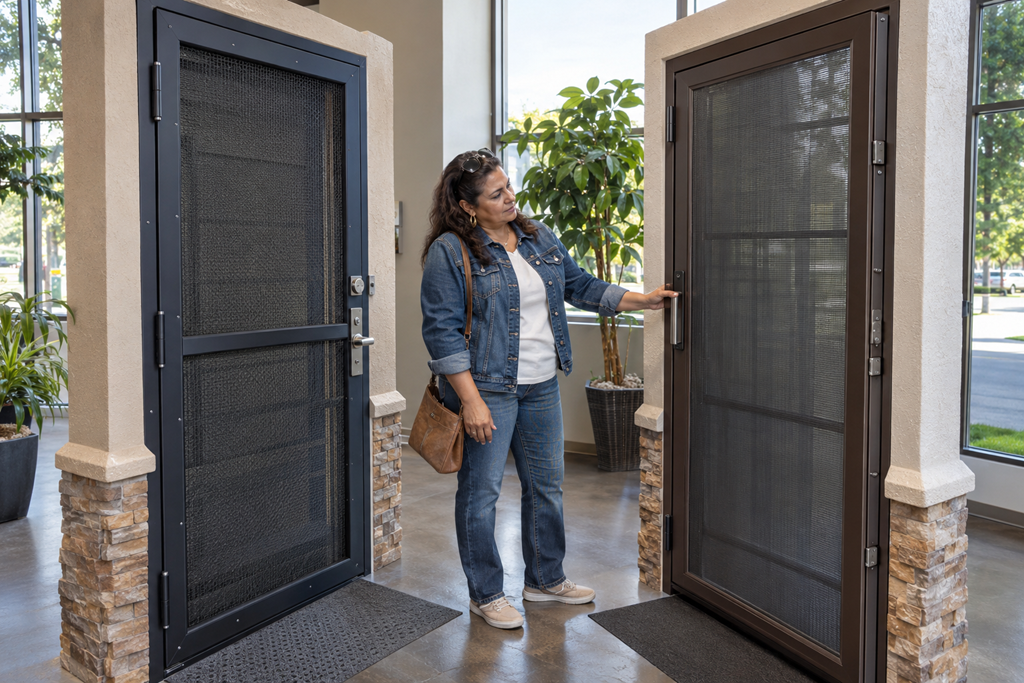
A demonstration can be particularly useful when several locking or operating arrangements are available.
Ask to try the hardware or see a representative installation operating normally.
For patio openings, find out whether the screen changes the usable width of the passage or introduces different track-maintenance requirements.
For windows, ask how the product affects opening, closing, cleaning, and any required emergency access or release functions.
Will the screen interfere with emergency exit?
This question deserves particular attention when the proposed installation involves a window or door that may serve as an emergency escape route.
Ask the provider whether the screen could affect required emergency opening, exit access, or release operation.
If a proposed screen includes a release mechanism, request an explanation and demonstration of how the intended users would operate it.
The suitability of an installation may depend on the building configuration and applicable requirements. A qualified professional should assess those considerations rather than asking the homeowner to assume that a security feature automatically meets emergency-access needs.
If the provider cannot explain how normal and emergency operation will be preserved, clarify the issue before approving the work.
What should I expect from airflow, light, and visibility?
Sacramento-area homeowners may be interested in security screens partly because they want to use natural ventilation during suitable weather.
However, different mesh materials and designs can affect airflow, visibility, and natural light.
Ask whether the provider can demonstrate the proposed material under realistic viewing conditions.
A screen that appears relatively transparent from one angle might offer less visibility from another. Privacy can also change depending on interior lighting, exterior lighting, and the direction of observation.
Consider these questions:
- How much will the screen affect my view through the opening?
- Does the mesh noticeably reduce airflow compared with a standard insect screen?
- What should I expect when looking through it from inside and outside?
- Will the screen change how much natural light reaches the room?
- Are there tradeoffs between visibility, screening density, and other features?
Do not assume that a product described as providing privacy will prevent people outside from seeing into the home under all lighting conditions.
A realistic demonstration is more useful than relying only on product photographs.
Clarify who will perform the installation
Choosing a product and choosing an installation provider are related but different decisions.
A company may sell a particular security screen system while using separate personnel or subcontractors to perform the work.
Before hiring, ask who will actually be responsible for the installation and how that responsibility will be managed.
Who will install the screen, and what experience do they have?
Useful questions include:
- Do your installers regularly work with this type of security screen?
- Have they installed the proposed system on openings similar to mine?
- Will the installation be handled by employees or subcontractors?
- Who is responsible for measurements and confirming product fit?
- Who should I contact if an installation issue occurs?
- What business qualifications, licensing, and insurance are applicable to this work?
Do not assume that every security screen project requires identical credentials or that all providers operate under the same business arrangement.
Ask about the qualifications appropriate to the proposed work and verify relevant credentials independently when necessary.
Experience with the particular system matters because operating hardware, mounting requirements, and installation procedures may differ between manufacturers.
What happens if the existing frame needs attention?
Sometimes the opening requires preparation before the screen can be installed.
Possible concerns include deteriorated wood, uneven framing, damaged trim, incompatible hardware, or an existing track that is no longer functioning properly.
Ask whether the provider will evaluate those conditions and explain the available options.
In particular, clarify whether the installer handles related repairs or whether another qualified professional would need to complete that work first.
A recommendation to repair an existing condition should be accompanied by an explanation of why the condition matters and how it affects the proposed installation.
You should not have to approve additional work simply because the provider describes it as necessary without explaining the relationship to the screen installation.
Make sure the written estimate describes the complete project
Security screen estimates can be difficult to compare when they describe different products or leave installation details unspecified.
A quote that lists only a product name and total price may not provide enough information to evaluate the proposal.
Ask for a written estimate that distinguishes the product from the work required to install it.
What exactly is included in the quoted price?
The estimate should make clear which opening or openings will be covered and what is being provided.
Depending on the project, relevant details may include:
- Product manufacturer, model, or identifiable system specifications.
- Screen mesh, frame, and finish.
- Locking and operating hardware.
- Measurement and installation labor.
- Preparation or adjustments included in the scope.
- Removal of existing screens or components, if needed.
- Disposal and cleanup responsibilities.
- Any applicable delivery or other project charges.
- Optional upgrades and their separate costs.
- Exclusions or conditions that could affect the final price.
The goal is not to obtain a highly technical document. It is to understand what you are agreeing to purchase and what the installer is agreeing to perform.
For additional context when reviewing estimates, explore the factors that affect security screen installation costs.
What could change the price after the estimate?
Some costs may remain uncertain until measurements are confirmed or existing conditions are evaluated.
Ask the provider to identify those uncertainties before work begins.
For example, an opening that appears straightforward might require additional preparation if the surrounding frame is unsuitable for the selected system.
The important questions are whether that possibility has been discussed and how any resulting change would be handled.
Ask:
"If additional work becomes necessary, will you explain the reason, provide the added cost, and obtain my approval before proceeding?"
A clear change-approval process helps prevent misunderstandings about work that was not part of the original agreement.
How much is due before installation?
Payment arrangements can vary.
Ask whether a deposit is required, when remaining payments are due, what payment methods are accepted, and whether any payment depends on particular project milestones.
Also clarify what happens if a custom-sized product has been ordered but the project is canceled or changed.
The answer may depend on the written agreement and the provider's policies. Reviewing those terms before approving a custom order can help avoid confusion later.
Ask about scheduling, preparation, and completion
Security screen projects may involve more than one visit.
An initial consultation, final measurements, product preparation, and installation may occur at different times.
Before hiring, ask the provider to describe the expected sequence.
To better understand the stages involved, review how security screen installation works from estimate to completion.
What happens between approval and installation?
Find out whether the proposed screen is a standard product or one that will be prepared for the specific opening.
Ask:
- Will another measurement appointment be necessary?
- When will the product selection and specifications become final?
- What factors could affect the proposed schedule?
- Who will contact me about the installation appointment?
- Will the work require more than one visit?
- What should I do to make the installation area accessible?
Avoid assuming that an estimated completion date is guaranteed unless the agreement specifically establishes that commitment and explains relevant conditions.
Homeowners should also mention access restrictions, pets, parking considerations, or other circumstances that could affect installation logistics.
For renters, obtaining the property owner's authorization before ordering an alteration may be necessary. Homeowners in properties subject to association rules should also clarify any applicable approval requirements.
How will we confirm that the installation is complete?
A finished security screen should be more than visually attractive.
Ask the provider how the completed work will be reviewed.
The final walkthrough might include observing the screen open and close, checking latch operation, reviewing hardware, discussing maintenance, and identifying any remaining adjustments.
You can ask for a demonstration rather than attempting to judge technical installation quality yourself.
Before the installer leaves, clarify:
- Whether the installed system matches the approved product and specifications.
- How its locks, latches, and releases are intended to operate.
- Whether the provider considers the agreed work complete.
- What documentation or warranty information will be provided.
- Whom to contact if an operating issue becomes apparent afterward.
This creates an opportunity to address questions while the installer is available to explain the finished work.
Understand the warranties before accepting the proposal
Security screen installations may involve separate warranties covering different aspects of the purchase.
A manufacturer's product warranty might address certain materials or components, while the installation provider may offer separate coverage for workmanship.
Those warranties should not be assumed to provide identical protection.
What does each warranty cover?
Ask the provider to explain the coverage for the screen material, frame, finish, locks, hinges, operating components, and installation labor.
You may also want to know:
- Whether the manufacturer and installer provide separate warranties.
- When each warranty begins.
- Whether particular types of wear, damage, or environmental exposure are excluded.
- What routine maintenance is expected.
- Whether adjustments or service visits are covered.
- How warranty claims are submitted.
- Who handles a problem when its cause is unclear.
Request the actual warranty terms where available.
A verbal statement that a screen is covered by a long warranty is less useful than knowing which components are covered and what circumstances may limit coverage.
What maintenance should I expect?
Even durable security screen systems may require cleaning, inspection, and occasional attention to operating hardware.
Ask which maintenance activities the manufacturer recommends and whether special cleaning products or procedures should be avoided.
For Sacramento-area properties, sun exposure, dust, rain, and regular use may influence maintenance considerations depending on the product and location.
Ask what changes in operation or appearance should prompt a call to the provider.
Understanding those expectations before installation helps distinguish ordinary care from a potential service concern.
Use the provider's answers to compare recommendations
Once you have spoken with more than one installation provider, the challenge becomes comparing their proposals fairly.
The lowest price may represent a smaller scope, different materials, fewer included services, or another installation arrangement. A higher price does not automatically establish superior workmanship or better protection.
Look at the explanation behind each recommendation.
Comparison factor | What to look for |
|---|---|
Opening evaluation | The provider considers the actual frame, access, and operating conditions. |
Product recommendation | Features and limitations are connected to your stated needs. |
Installation experience | The provider can explain relevant experience and who performs the work. |
Written scope | Materials, hardware, labor, preparation, and exclusions are identified. |
Daily operation | The proposal addresses access, locking, ventilation, and appropriate release functions. |
Scheduling | Measurements, ordering, installation, and possible delays are explained. |
Warranty support | Product and workmanship responsibilities are distinguishable. |
Communication | Questions receive specific answers without unnecessary pressure. |
A provider does not need to use your preferred terminology or offer the most elaborate presentation.
What matters is whether the information is understandable, consistent, and sufficient for the decision.
For example, suppose two providers recommend apparently similar security screens for the same entry.
One proposal identifies the product, includes a final measurement visit, explains the door clearance, and specifies the installation work.
The other provides a lower total but does not identify the locking hardware or explain whether frame preparation is included.
That difference does not establish which provider is better. It does show why you would need more information before treating the estimates as equivalent.
The most useful comparison is between clearly defined proposals rather than prices alone.
Recognize answers that deserve a closer look
Not every unclear answer indicates a serious problem. A provider may need to inspect the property, consult a manufacturer, or confirm a detail before responding.
However, certain patterns should encourage you to slow down and request clarification.
Be cautious about unsupported security claims
Statements that a security screen is impossible to defeat or guarantees protection deserve further questions.
Ask what product testing, documentation, or limitations support the claim.
Be wary of recommendations based mainly on dramatic demonstrations of a small material sample without explaining the complete installed assembly.
A useful explanation should address the system as a whole.
Watch for recommendations made without evaluating fit
A provider who recommends a specific system without asking about the opening, existing frame, or intended use may be overlooking details that affect installation.
This is especially worth questioning when the opening has visible deterioration, unusual dimensions, limited clearance, or complicated operating requirements.
An initial recommendation can be provisional. The concern arises when the provider presents it as final without adequately considering conditions that might change the scope.
Pay attention to vague project responsibilities
Uncertainty about who takes final measurements, who performs the installation, who handles frame repairs, or who addresses problems afterward can create confusion.
Ask for those responsibilities to be clarified before approving the project.
The same applies to estimates that mention installation but do not specify important preparation work or exclusions.
Do not let pressure replace an explanation
A provider may have legitimate scheduling constraints or product-ordering deadlines.
Those circumstances do not eliminate the need for a clear proposal.
Be cautious when someone repeatedly discourages comparison, dismisses reasonable questions, or pressures you to approve work before the essential details are explained.
A thoughtful hiring decision requires enough information to understand the product, installation scope, and obligations.
Prepare a short list of questions for the first conversation
You do not need to interview every provider with an exhaustive technical checklist.
A focused set of questions can cover the main decision points while allowing the provider to explain the project naturally.
Consider starting with these ten:
- Will you evaluate my actual door or window opening before making a final recommendation?
- Why is this particular security screen system appropriate for my opening and intended use?
- What materials, frame components, locks, and other hardware are included?
- What documented security performance does the product offer, and what are its limitations?
- How will the screen affect everyday operation, ventilation, access, and emergency exit where applicable?
- Who will take the final measurements and perform the installation?
- What does the written estimate include, exclude, and identify as a potential additional cost?
- What is the expected process from approval through installation and final inspection?
- What warranties apply to the product and the installation, and who handles service problems?
- What should I understand about payment terms, possible changes, and cancellation before signing?
These questions cover the main issues without requiring you to understand every technical detail.
Use the answers to identify follow-up questions specific to your property.
What to have ready before requesting estimates
A little preparation can make the initial conversation more productive.
Identify which doors or windows you are considering and why those openings matter.
It may help to prepare:
- A list of the openings where you want security screens.
- Photographs showing the openings and surrounding areas.
- Your main reasons for considering the installation.
- Any known problems with existing frames, doors, windows, or tracks.
- Preferences involving ventilation, visibility, privacy, and appearance.
- Household access or mobility considerations.
- Questions about locks, release mechanisms, or daily operation.
- Your preferred general project timing.
You do not need to take technical measurements or inspect attachment points yourself.
Clear photographs and a description of how the openings are used can help the provider understand your goals before an in-person evaluation.
If you are comparing multiple companies, provide them with substantially the same description of your needs. This gives you a more consistent starting point for reviewing their recommendations.
Make your hiring decision based on the complete installation
The most useful question before hiring a security screen installation provider is not simply, "Which screen is strongest?" or "Who has the lowest price?"
It is whether the provider has explained a complete installation that makes sense for your property.
The product should be appropriate for the opening, the hardware should support the intended use, and the proposal should make the installation responsibilities understandable. Security claims should have reasonable support, and you should know what happens if conditions change or service is needed afterward.
For Sacramento-area homeowners, a good hiring decision comes from connecting the screen itself with the opening, the installer, and the way the household will use the finished system.
Before signing, make sure you can explain what will be installed, why it was recommended, what the work includes, and which questions have been resolved.
That understanding is more valuable than choosing a provider based on a product demonstration or price alone.