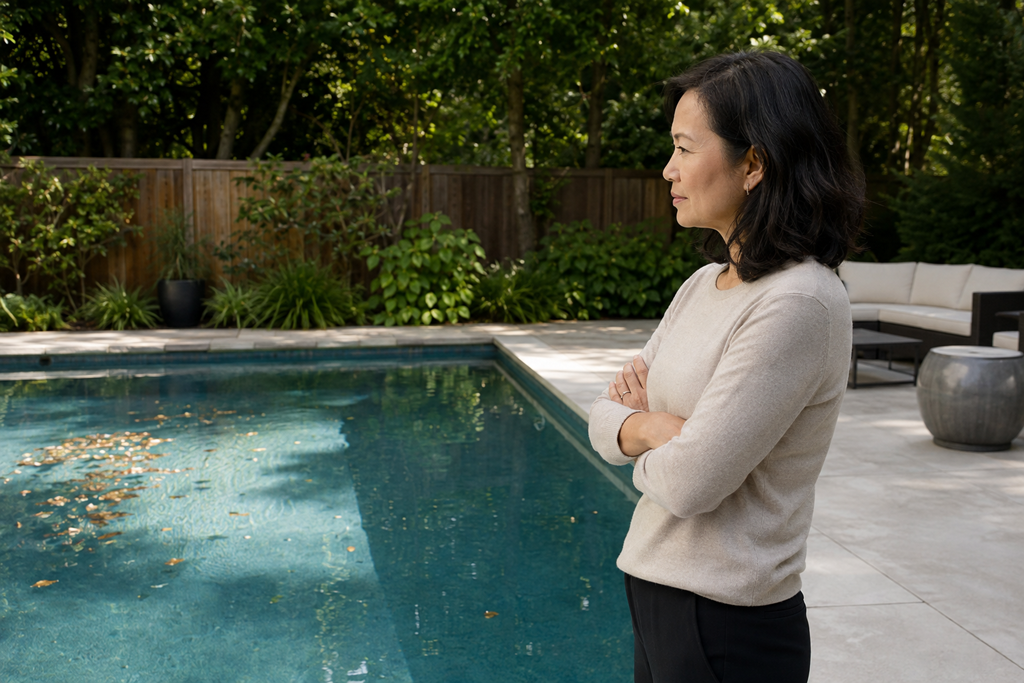
Between professional pool service visits, the most useful thing a homeowner can do is pay attention to changes rather than trying to duplicate the technician’s work. A quick visual check of the water, pool surface, surrounding deck, equipment area, and basic access points can reveal small issues worth noting before they become harder to explain later.
For many homeowners, the uncertain part is knowing what deserves attention. The pool may have looked perfectly normal when the service professional left, but a few days later there may be more debris, a different water level, an unfamiliar sound near the equipment, or something around the pool that simply looks different. Checking between visits is less about diagnosing those changes and more about noticing them early enough to ask useful questions.
Focus on what has changed since the last visit
A useful between-visit check starts with comparison. Instead of asking whether every part of the pool looks perfect, ask whether anything looks noticeably different from what you normally see.
That might include:
- water that suddenly looks less clear than usual
- an unusual amount of leaves or other surface debris
- a noticeable change in the water level
- new staining, discoloration, or buildup you do not remember seeing
- a wet area around equipment or plumbing that is normally dry
- an unfamiliar sound from the equipment area
- a pool accessory, cover, fitting, or nearby object that has shifted or become damaged
These observations do not automatically mean something is wrong. Weather, regular use, landscaping, evaporation, and ordinary household activity can all change the appearance of a pool area. What matters is recognizing when something is different enough that it is worth watching or mentioning to the professional who services the pool.
Look at the water without trying to diagnose it
The water itself is often the first thing homeowners notice, but appearance alone cannot explain every pool condition.
Between visits, a visual check can still be useful. Look across the pool rather than only straight down into the water. This makes it easier to notice changes in clarity, floating material, unusual color, or debris collecting in one area.
It is also helpful to notice whether the water level appears substantially different from its usual position. A modest change may have an ordinary explanation, while a persistent or unusually large change is something you can bring to your service provider’s attention.
The goal is observation, not chemical troubleshooting. Avoid making unfamiliar chemical adjustments or combining pool chemicals based only on a visual guess. Follow product instructions and the guidance provided by your pool professional for any routine homeowner tasks they expect you to handle.
Check the surrounding area, not only the pool
A pool-service visit naturally draws attention toward the water and equipment, but some useful observations happen around the perimeter.
Walk around the pool area and look for conditions that could affect normal use or make the next service visit more difficult. Loose objects, accumulated leaves, blocked access, shifted furniture, damaged covers, or clutter near gates and equipment can all be worth addressing at a household level.
For Sacramento-area homeowners, outdoor spaces may be used frequently for long stretches of the year, so ordinary activity can gradually change how accessible and organized the pool area remains. Something that was neatly out of the way after a service visit may end up beside equipment, across a walking path, or close to the pool edge several days later.
Keeping the service area reasonably accessible is different from preparing it like a work site. You generally do not need to clear the entire backyard. The more useful goal is to make sure the professional can reach the pool and the equipment they normally service without unnecessary obstacles.
Treat the equipment area as a place to observe, not repair
You do not need to understand every valve, pipe, control, or piece of pool equipment to notice when the area looks or sounds different.
Without opening equipment or attempting repairs, you can pay attention to obvious changes such as persistent wetness, visible damage, something that appears displaced, or a sound that is clearly unusual for your system.
This distinction matters because homeowners sometimes assume that noticing a problem means they should immediately determine the cause. It does not.
A better approach is to remember what you observed, when you first noticed it, and whether it continued. That information may be much more useful to a qualified professional than an attempted diagnosis.
If you see damaged electrical components, significant leaking, or another condition that appears unsafe, keep clear of the affected area and contact an appropriate qualified professional rather than attempting a repair yourself.
Clear water does not mean there is nothing to check
One common misunderstanding is that a visually clear pool needs no attention between service visits.
Clear water is reassuring, but a between-visit check includes more than water appearance. Access conditions, debris, water level, the surrounding deck, visible equipment changes, and the general condition of the pool area can all provide useful information.
The opposite misunderstanding can also create unnecessary work: assuming that every leaf, minor level change, or unfamiliar detail requires immediate correction.
Professional service exists partly because pool systems involve tasks that require knowledge, testing, equipment, and safe chemical handling. A homeowner’s role between scheduled visits can remain much simpler.
Observe what is normal. Notice meaningful changes. Handle only the ordinary tasks you are comfortable performing and that your provider or manufacturer expects homeowners to manage.
Patterns are more useful than isolated observations
A single unusual observation may not tell you much. Repeated observations often provide better context.
For example, you might notice that debris continually collects in the same area, the water level seems lower than expected more than once, or an unfamiliar sound appears whenever the equipment is operating. You do not need to determine the cause yourself to make that pattern useful.
If something keeps catching your attention, make a brief note or take a photo for your own reference. This can help you explain the concern accurately during the next visit instead of trying to remember what happened several days earlier.
That is especially useful when a condition appears intermittently. By the time the professional arrives, the pool may look completely normal again.
Keep routine household tasks separate from professional service work
Between professional visits, it helps to know which tasks are simply part of keeping the area usable and which belong to the service professional.
Removing an ordinary object that has fallen near the pool, putting commonly used accessories back where they belong, or maintaining a clear route to the equipment area are straightforward household tasks.
Adjusting unfamiliar equipment, diagnosing circulation problems, opening electrical components, or experimenting with chemical treatments are different matters.
If you are unsure where that line falls for your particular pool, ask your service provider what they expect you to handle between appointments. Different pools, equipment setups, service agreements, and household routines may lead to different answers.
A brief conversation about responsibilities can prevent the awkward situation where the homeowner assumes the professional is handling something the professional expects the homeowner to monitor—or vice versa.
A few useful questions can clarify your role
You do not need an extensive checklist for every professional visit. A few specific questions can make between-visit care easier to understand:
- What changes would you want me to contact you about before the next visit?
- Are there routine observations you want me to make between appointments?
- Which ordinary tasks are appropriate for me to handle?
- Is there anything around the equipment area that should remain clear or accessible?
- If I notice something unusual, would a photo help you evaluate whether it can wait until the next visit?
The answers give you a clearer picture of what deserves attention without turning routine pool ownership into constant inspection.
The goal is awareness, not another service routine
Checking around your pool between professional visits does not need to become a second maintenance program. A short look at the water, pool perimeter, access areas, and visible equipment conditions is often enough to notice whether anything has changed.
The useful habit is simply knowing what normal looks like for your pool. When something differs from that baseline, you can decide whether to watch it, handle an ordinary household task, or bring it to your service professional’s attention.
That keeps the homeowner’s role manageable while giving the professional better information when a question does arise.
Related resource: For ideas on keeping ordinary pool-care accessories organized and easier to manage between visits, see How to Organize Basic Pool-Care Accessories Between Professional Visits.