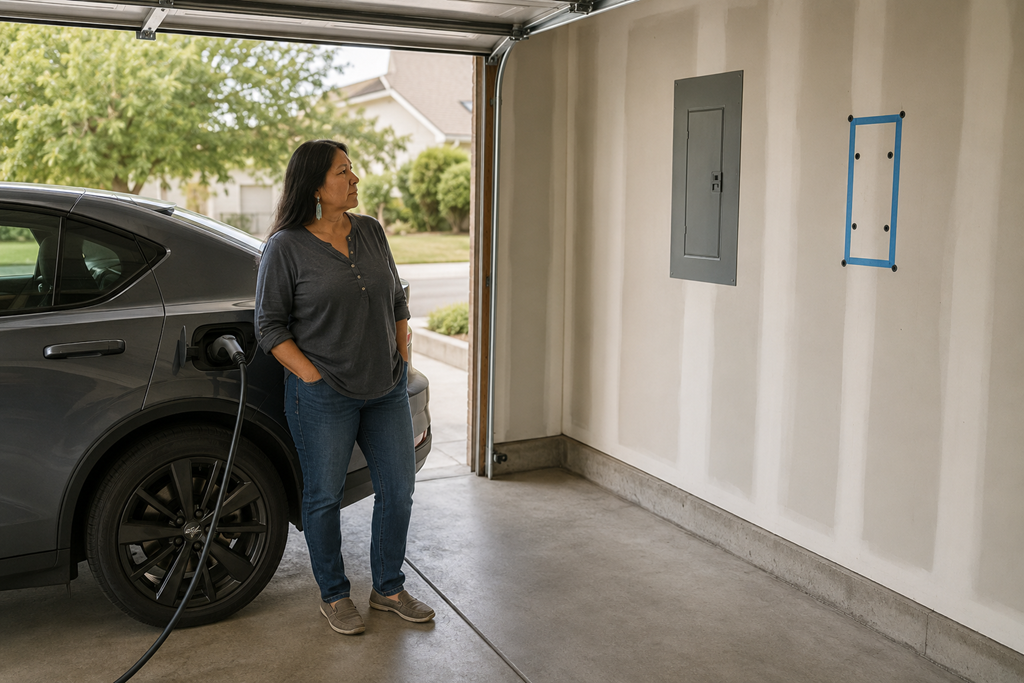
Before hiring help with EV charging, look for a provider who takes time to understand the whole charging setup—not just the charger on the wall. The right conversation should connect your vehicle, parking location, electrical system, charging habits, installation path, and the exact work included in the estimate. If those pieces remain vague, it can be difficult to compare providers or know what you are actually agreeing to.
That distinction matters because an EV charging project can look simple from the outside. You may already know which charger you want, where you normally park, or how quickly you would like the vehicle to charge. But the actual service decision may involve several connected parts of the property.
For Sacramento-area homeowners, the goal before hiring is not to become an electrical expert. It is to understand whether the provider is looking at enough of the situation to give you a clear recommendation and a reasonably defined scope of work.
The Charger Is Only One Part of the Decision
It is easy for the conversation to become centered on the charging unit itself.
A provider may discuss charger brands, features, charging speeds, or mounting locations. Those details can matter, but they do not automatically tell you whether the proposed setup makes sense for your home and everyday routine.
A useful evaluation should also consider where the vehicle will actually be parked, how the charging cable will reach it, where the relevant electrical equipment is located, and what path the installation may need to follow.
Those physical relationships can influence the project.
For example, two homeowners purchasing the same charger could have very different installation situations because one parks next to the relevant electrical equipment while the other parks farther away or on a different side of the property.
The important question is therefore not simply, “Can this charger be installed?”
A better hiring question is whether the provider has taken enough of your actual property and charging routine into account to explain what the proposed installation involves.
Pay Attention to How Much the Provider Wants to Understand
One useful sign during the early conversation is the quality of the questions you are being asked.
A provider evaluating EV charging help may want to understand things such as where you normally park, what vehicle you have, what charging equipment you are considering, how often you expect to charge, and where the home's electrical equipment is located.
They may also need to evaluate conditions that are not obvious from a short phone conversation or a photo.
That does not mean every project requires the same process. It means the recommendation should be based on more than an assumption that all residential charging installations are alike.
If you receive a firm recommendation before the provider has enough information to understand the property, it is reasonable to ask what that recommendation is based on.
Make Sure the Estimate Describes the Actual Scope
A price by itself does not necessarily tell you what will happen at your home.
Before comparing EV charging estimates, try to understand what each provider believes is included.
One estimate might cover a relatively straightforward installation. Another could account for a longer installation path, additional electrical work, different equipment, coordination requirements, or other property-specific considerations.
Without that context, two prices that look very different may not represent the same scope.
The reverse can also happen. Two estimates may appear similar in price while including different responsibilities.
You should be able to get a plain-language explanation of what the provider expects to do, what equipment is included or excluded, and what could cause the scope to change after the project begins.
The Parking Position Deserves More Attention Than It Usually Gets
Where the vehicle sits during normal charging can be surprisingly important to the hiring conversation.
A charger mounted in a technically possible location may still be inconvenient if the charging cable has to stretch awkwardly across the garage, cross an area people frequently walk through, or depend on always parking the vehicle in an unusual position.
Think about the way the space functions on an ordinary day.
Where does the vehicle usually stop?
Which side of the vehicle contains the charging connection?
Will another vehicle share the garage or driveway?
Would the charger still be conveniently located if your parking habits change?
These are not questions you need to solve technically yourself. They are practical details worth discussing so that the proposed installation reflects how you expect to use it.
A Thorough Provider Should Be Able to Explain the Electrical Side Clearly
Electrical capacity is another part of the project that should not be reduced to a quick assumption.
You do not need to determine electrical capacity yourself or open electrical equipment to investigate it. That evaluation belongs with an appropriately qualified professional.
What you can evaluate is the quality of the explanation you receive.
If additional electrical work is recommended, ask why it is being considered and how it relates to the charging setup being proposed.
If the provider believes no additional changes are necessary, you can still ask what they evaluated in reaching that conclusion.
A good explanation does not have to turn into an electrical lesson. It should simply help you understand how the condition of the home relates to the proposed charging project.
Be Clear About Equipment and Responsibilities
Another source of confusion is assuming that everyone is talking about the same equipment and responsibilities.
Some homeowners purchase charging equipment themselves. In other situations, the provider may supply some or all of it.
Before agreeing to the work, clarify who is responsible for obtaining the charger and any other major equipment associated with the proposed installation.
It is also useful to understand who will handle any permits, inspections, utility coordination, or other approvals that may apply to the particular project.
You do not need to predict every administrative step. You simply want to avoid discovering later that something you assumed was included was actually your responsibility.
Watch for Answers That Stay Vague When the Questions Become Specific
Not every unclear answer is a warning sign. Sometimes a provider legitimately needs to inspect the property or gather more information before giving a definite response.
The more important distinction is whether uncertainty is acknowledged and explained.
There is a difference between:
“We need to evaluate that before we can tell you.”
and an answer that repeatedly avoids defining what is included, what still needs to be evaluated, or what could change.
A provider does not need to know everything immediately. But you should gradually gain a clearer picture of the project as the evaluation moves forward.
If the conversation becomes less clear the closer you get to approving the work, slowing down and asking additional questions can be useful.
A Few Questions Can Reveal a Lot Before You Hire
You do not need a long technical checklist. A few practical questions can help determine whether you understand the proposed service:
- What parts of my property and electrical system did you evaluate when recommending this setup?
- Does the estimate cover the complete installation you are proposing?
- Is the charging location based on where I normally park the vehicle?
- Is there anything you still need to inspect before the scope is considered final?
- What circumstances could change the estimate?
- Who is providing the charging equipment?
- Who handles any permits, inspections, utility coordination, or approvals that may apply?
- What happens if a problem with the installation becomes apparent after the work is completed?
The usefulness of these questions is not just in the answers themselves. They can also show how willing the provider is to explain the project in terms you can follow.
Do Not Let the Charger Purchase Rush the Service Decision
Buying charging equipment can create a feeling that the installation now needs to happen quickly.
That can lead homeowners to focus on finding someone who can install the equipment rather than determining whether the proposed setup is right for the property.
Owning the charger does not remove the value of comparing providers or asking questions.
Likewise, having a new vehicle arriving soon does not mean you have to approve a service scope you do not understand.
Scheduling matters, but it is separate from understanding what you are hiring someone to do.
The Best Comparison Is Between Complete Proposals
When comparing EV charging help, the lowest price, fastest appointment, or preferred charger brand may be useful information. None of those factors alone tells you whether one provider is the better fit.
Try to compare the entire proposal.
Does the provider understand your charging needs?
Has the property been evaluated appropriately?
Does the location make sense for everyday use?
Is the electrical portion of the recommendation understandable?
Can you identify what is included in the estimate?
Do you know what could change?
When those pieces are clear, the price becomes much easier to evaluate in context.
Know What You Are Hiring Before You Commit
Hiring help with EV charging should leave you with a clearer understanding of how your vehicle, parking location, charging equipment, electrical system, and proposed installation fit together.
You do not need to know how to perform the electrical work yourself. You only need enough information to understand what a qualified provider is recommending and what you are agreeing to pay for.
Before committing, make sure the proposed solution feels connected to the way you actually use your property—not simply to the charger that needs to be installed.