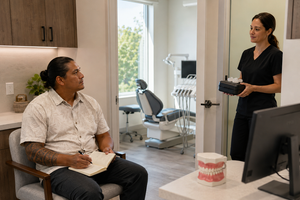
A gynecomastia consultation should do more than confirm that surgery is available. It should help you understand what may realistically change, what may remain imperfect, and what the process could involve in your individual situation.
That conversation matters because terms such as “flatter,” “more masculine,” “more balanced,” or “normal-looking” can mean different things to different people. Unless those expectations are discussed clearly, a patient and provider may believe they are talking about the same goal when they are actually imagining different outcomes.
For Sacramento-area patients considering gynecomastia surgery, a useful consultation should replace vague hopes with a more specific and realistic understanding of the possible benefits, limitations, tradeoffs, and recovery.
“Looking Better” Is Not a Precise Surgical Goal
Many people enter a consultation knowing that they are unhappy with the appearance of their chest but struggling to describe exactly what they want changed.
They may be concerned about:
- fullness beneath the nipple area
- a chest that appears uneven
- tissue that remains noticeable through shirts
- puffy or projected nipples
- loose skin after weight changes
- one side appearing different from the other
These concerns are understandable, but each one may involve different anatomical factors. Saying that you want your chest to “look better” does not tell a provider which features matter most to you or which compromises you would consider acceptable.
A thoughtful provider should ask questions that help turn a broad concern into a clearer goal. The purpose is not to promise an exact appearance. It is to make sure the provider understands what you are hoping to improve and that you understand what surgery may reasonably accomplish.
Your Anatomy Helps Define What Is Realistic
Gynecomastia is not identical from one person to another. The visible fullness may involve glandular tissue, fatty tissue, skin laxity, natural chest shape, weight changes, or a combination of factors.
The position of the nipples, the elasticity of the skin, existing asymmetry, prior procedures, overall health, and other individual considerations may also affect the discussion.
This is why another patient’s photographs or experience cannot determine your likely outcome. Even when two people have similar concerns, their treatment options, scars, recovery, and results may differ.
A qualified provider should evaluate your situation individually and explain how your anatomy affects what may be possible. The consultation should also include discussion of whether further medical evaluation may be appropriate before any cosmetic procedure is considered.
Clear Expectations Include the Limits of Surgery
A useful consultation should explain not only what surgery may improve but also what it cannot guarantee.
For example, surgery may improve chest contour without creating perfect symmetry. It may reduce prominence without producing the exact chest shape seen in a reference photograph. Skin may tighten to some degree, but the amount can vary. Scars may fade over time, but they do not disappear completely.
These limitations do not automatically mean that surgery is unsuitable. They simply belong in an informed conversation.
Be cautious when a consultation focuses entirely on an ideal result while giving little attention to natural variation, healing differences, scarring, contour irregularities, asymmetry, or the possibility that additional care could be needed.
Honest uncertainty is often more useful than overly confident reassurance.
Photographs Should Start a Conversation, Not Create a Promise
Before-and-after photographs can help patients understand the kinds of changes a provider has achieved in other cases. They may also help you explain what you like or dislike about a particular chest contour.
However, photographs should not be treated as a menu from which you can select an exact result.
A provider should be able to explain why another patient’s outcome may not apply directly to you. Useful comparisons may involve similar anatomy, skin characteristics, degree of fullness, or treatment approach, but no photograph can predict precisely how your body will heal.
The most productive question is not, “Can you make me look exactly like this?”
A better question is, “Which parts of this result may or may not be realistic for my anatomy?”
Scars and Tradeoffs Belong in the Same Discussion
It is easy to focus entirely on reducing chest fullness. However, the method used to change the contour may involve tradeoffs related to incision placement, skin removal, nipple position, sensation, healing, and recovery.
In some situations, achieving a greater change in contour may involve more visible scarring. In others, limiting the incision may also limit how much loose skin can be addressed.
These are not minor details to discuss after a decision has been made. They are part of deciding whether the possible outcome is worth the process to you.
Ask where scars may be located, how noticeable they may initially appear, and how individual healing can affect their final appearance. The explanation should be specific enough to help you make a decision without implying that scarring can be predicted perfectly.
Recovery Expectations Affect the Overall Decision
Clear expectations are not limited to appearance. They should also cover the practical experience of recovery.
Depending on the procedure and the provider’s recommendations, recovery discussions may involve activity restrictions, compression garments, swelling, bruising, discomfort, follow-up visits, work responsibilities, exercise, sleep positions, driving, and help at home.
The goal is not to memorize a rigid timeline during the first consultation. It is to understand how recovery could affect your normal routine and which details may vary.
A patient with a physically demanding job may need to consider different practical issues than someone who works from home. A person who lives alone may have different preparation needs than someone with reliable help available.
A provider should explain the general recovery process while making it clear that healing does not follow an identical schedule for everyone.
A Consultation Should Explore What Success Means to You
People consider gynecomastia surgery for different reasons. Some want to feel more comfortable in fitted shirts. Others are concerned about asymmetry, nipple projection, exercise clothing, swimming, or the way the chest looks from the side.
These are personal concerns, and they should be discussed without embarrassment or pressure.
At the same time, surgery should not be presented as a guaranteed solution for confidence, relationships, social comfort, or every concern someone has about their body. A physical change may be meaningful, but emotional outcomes are personal and cannot be promised.
A responsible consultation should help distinguish between the physical change being considered and the broader hopes attached to it.
Questions That Can Make the Conversation More Specific
A few focused questions can reveal whether expectations are being discussed clearly:
- Which parts of my concern appear most likely to improve?
- What limitations do you see based on my anatomy?
- How much asymmetry might remain?
- Where could scars be located?
- What tradeoffs may come with a larger change?
- What might the chest look like during early healing?
- Which parts of recovery are predictable, and which vary?
- What outcome would you consider realistic in my case?
- Are there reasons to seek additional medical evaluation first?
- What happens if healing or contour does not progress as expected?
The provider’s answers should be understandable and specific to you. It is reasonable to ask for clarification when an explanation feels overly technical, vague, or rushed.
Watch for Promises That Sound Too Certain
No provider can guarantee perfect symmetry, invisible scars, a complication-free recovery, or an exact final appearance.
Also pay attention when a consultation seems designed to move quickly toward scheduling without giving you enough room to discuss alternatives, limitations, risks, recovery, or whether surgery is appropriate.
Clear communication does not mean hearing only reassuring information. It means receiving enough balanced information to understand the decision.
You should leave with a better sense of what the procedure may accomplish, what it may not change, and which uncertainties remain.
A Good Consultation Makes the Decision More Understandable
The purpose of a gynecomastia consultation is not simply to persuade you to proceed. It is to help you determine whether the proposed approach, likely tradeoffs, provider communication, and realistic range of outcomes fit your priorities.
For Sacramento residents comparing local providers, the quality of this conversation can be as important as the procedure being discussed. A provider who takes expectations seriously should be willing to explain individual limitations, answer direct questions, and avoid promising a result that cannot be guaranteed.
Gynecomastia surgery is a personal medical and cosmetic decision. Discuss diagnosis, candidacy, risks, treatment options, recovery, and possible outcomes with a qualified provider who can evaluate your specific situation.