The right awning size depends less on how large the wall or patio looks and more on what you want the shaded area to do. A small awning may be enough to soften direct sun near a doorway or window, while a larger outdoor seating or dining area may need broader coverage. Matching the awning to the way the space is actually used can help Sacramento-area homeowners avoid choosing something that looks appropriate on paper but feels too small, too deep, or poorly placed once everyday use begins.
Start With The Area You Actually Want To Use
It is easy to think about awning size as a measurement problem: there is a certain amount of wall space available, so the awning should simply fit within it.
But the more useful question is what needs to happen underneath the awning.
One homeowner may want shade over a pair of chairs near a back door. Another may want enough coverage for a dining table where several people regularly sit. Someone else may be trying to make a larger patio more comfortable during periods of direct Sacramento sun.
Those are different uses, even when the patios themselves are similar in size.
That is why the physical dimensions of the building are only part of the conversation. The intended shaded zone matters too.
Width And Projection Affect Different Parts Of The Experience
Awning dimensions are commonly discussed in terms of how wide the awning is and how far it extends outward from the building.
Those measurements can affect the usable space in different ways.
Width helps determine how much of the wall, doorway, window, or patio area can be covered from side to side. Projection affects how far that coverage reaches into the outdoor space.
A wide awning with limited projection may cover a long section of the house without reaching far enough over a dining table. A deeper awning that is too narrow may leave parts of a seating arrangement exposed.
The important point for a homeowner is not to calculate those dimensions independently. It is to understand what portion of the space each dimension is supposed to serve and discuss that with the installer.
Furniture Placement Can Reveal The Real Size Question
Outdoor furniture often makes the decision easier to visualize.
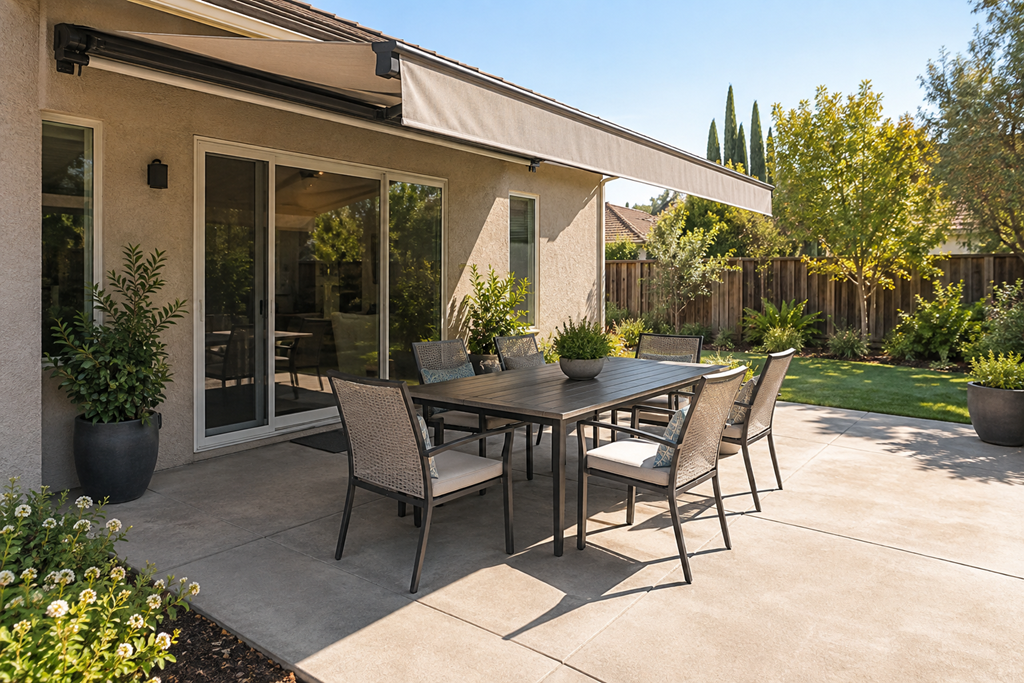
Imagine a patio with a table and six chairs. The table itself may fit comfortably within the proposed shaded area, but people do not remain directly against the table. Chairs are pulled back. Someone walks behind them. A person may sit near the edge rather than directly in the center.
The functional area can therefore be larger than the footprint of the furniture.
The same idea applies to lounge chairs, children's play areas, outdoor cooking areas, or a small conversation space.
Looking at how people occupy the area can be more useful than looking only at the dimensions of the objects sitting there.
Sunlight Does Not Stay In One Place
Another reason awning size deserves some thought is that shade is not a fixed shape throughout the day.
The relationship among the sun, the home, and the awning changes over time. An area that appears well covered at one point may receive more direct sun at another.
Sacramento-area homeowners dealing with strong seasonal sun may especially notice this when trying to make patios, windows, or outdoor seating areas more comfortable.
This does not mean an awning has to shade every part of a patio all day. It means the homeowner should be clear about when the space matters most.
If the patio is mainly used for late-afternoon meals, for example, that use may deserve more attention than how the same area looks at another time when nobody normally sits there.
Bigger Is Not Automatically Better
It can be tempting to solve uncertainty by simply choosing a larger awning.
But maximum coverage is not necessarily the same thing as the best fit.
A larger awning can change how the outdoor area feels visually. It may also interact differently with doors, windows, walkways, landscaping, furniture placement, and other parts of the property.
The building itself can also affect what sizes and configurations are appropriate.
Rather than assuming that more coverage is always better, it is useful to think in terms of enough coverage for the intended use while still fitting the property appropriately.
A qualified awning professional can evaluate the installation area and explain what options make sense for the specific structure and desired coverage.
A Small Shade Goal May Call For A Small Awning
Not every project is about creating an outdoor room.
Sometimes the purpose is much narrower.
A homeowner might want additional shade near a frequently used entry, over a particular window, or across a compact sitting area. In those situations, extending coverage far beyond the area that matters may not add much practical value.
Defining that limited goal early can make discussions with local providers more productive.
Instead of saying, “We need an awning over this patio,” the homeowner can explain, “We mainly want this seating area shaded when we use it in the afternoon.”
That gives the provider a much clearer picture of what the finished installation is expected to accomplish.
Large Patios Often Contain More Than One Use Zone
A patio may look like one continuous space while functioning as several smaller spaces.
There might be a dining table near the house, lounge seating farther away, a pathway between the door and yard, and an open section that rarely needs shade.
Trying to cover the entire patio simply because it is there can miss that distinction.
It may be more useful to identify which portion of the patio people actually want to make more comfortable.
This is especially important when comparing proposals. Two awning recommendations may have noticeably different dimensions because the providers are envisioning different areas being covered.
That does not automatically make one proposal wrong. It may mean the assumed project scope needs to be clarified.
Do Not Judge The Size From A Rendering Alone
Drawings, photographs, product images, and visual mockups can help homeowners understand what an awning may look like, but they do not always communicate how the shaded area will feel during normal use.
A rendering may make an awning appear proportionate to the house while leaving an important question unanswered: will the chairs, table, walkway, or gathering area actually be where the shade is expected to fall?
That practical relationship is worth discussing before making a final decision.
The goal is not simply to choose an awning that looks appropriately sized from the yard. It is to choose one whose coverage corresponds to the reason for installing it.
Questions That Can Make An Estimate More Useful
When meeting with an awning installer or comparing proposals, a few focused questions can help connect dimensions to everyday use:
- What part of the patio or outdoor area is this proposed size intended to cover?
- How do the width and projection relate to our seating or dining area?
- Are you basing the recommendation on the available wall space, the area we want shaded, or both?
- How might the shade coverage change during the times we normally use this space?
- Are there property features that limit the practical size or placement?
- Would changing the dimensions noticeably change how the area can be used?
These questions are less about finding one universally correct awning size and more about making sure everyone is discussing the same goal.
The Best-Fitting Size Starts With A Clear Purpose
Awning size makes more sense when it is connected to a specific use.
Before comparing options, it helps to picture the ordinary moments the awning is supposed to improve: sitting at the table, stepping outside, relaxing in a favorite chair, protecting a particular window from direct sun, or making one section of a patio more usable.
From there, dimensions become part of a practical conversation rather than numbers chosen in isolation.
For Sacramento-area homeowners, explaining how and when the space is actually used can also make it easier to compare recommendations from local awning professionals. The goal is not necessarily the largest possible awning. It is an awning whose coverage fits the space that matters.