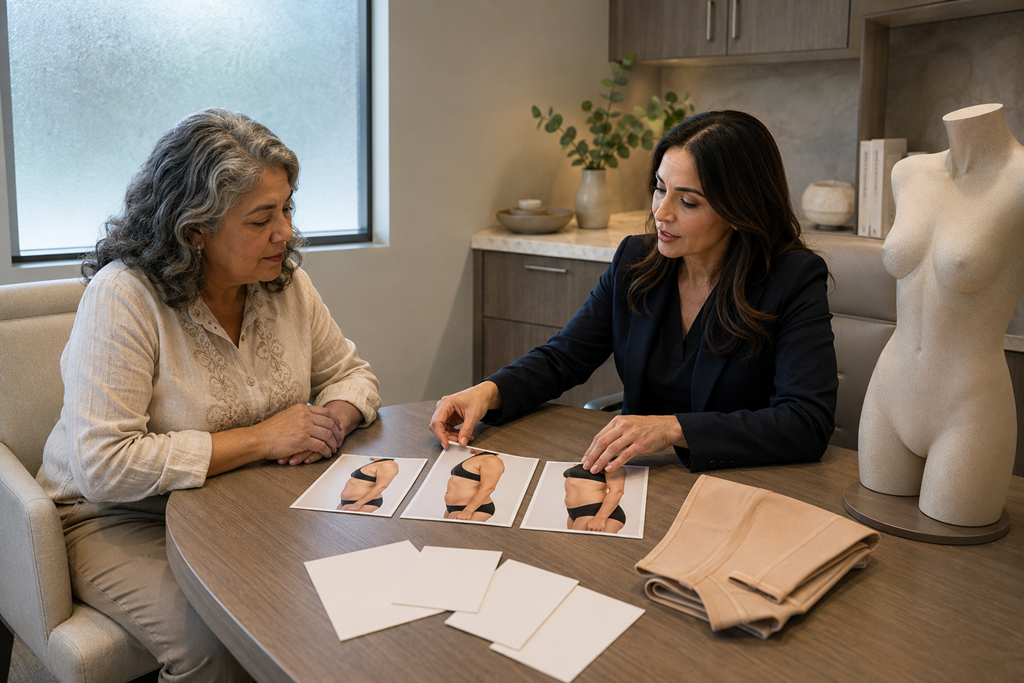
Before-and-after photos can be useful when you are comparing cosmetic surgery providers, but they should not be the only evidence you review. They show selected outcomes, not the full story behind each patient’s starting point, goals, procedure plan, healing process, follow-up care, or satisfaction. A thoughtful decision depends on seeing the photos in context and evaluating the provider’s qualifications, communication, safety approach, and ability to explain what may be realistic for you.
Photo galleries often feel like the easiest part of comparing providers. You can look at an image quickly and decide whether you like the visible change. That can make the gallery seem more revealing than a conversation about training, limitations, recovery, or individual differences.
The problem is not that before-and-after photos are useless. The problem is that they can answer only a limited set of questions.
A Photograph Shows an Outcome, Not the Full Experience
A before-and-after pair may show that a provider has treated a particular area or performed a certain type of procedure. It may also help you notice the provider’s general aesthetic preferences, such as whether results appear subtle, pronounced, balanced, or highly individualized.
However, the images usually do not tell you:
- Why that procedure was selected
- Whether other procedures were performed at the same time
- What alternatives were discussed
- How long the patient took to heal
- Whether the patient experienced complications or needed additional care
- How the result changed after the photograph was taken
- Whether the patient felt the outcome met their personal goals
That missing information matters because cosmetic surgery is not simply a visual transaction. It is a medical decision involving candidacy, expectations, risks, recovery, follow-up care, and personal anatomy.
A Gallery Is Usually a Selected Collection
Most providers naturally choose photographs that present their work favorably. That does not automatically mean the gallery is misleading, but it does mean the images are unlikely to represent every patient or every possible result.
A gallery might feature patients who healed especially well, had anatomy that responded favorably to the selected procedure, or were comfortable allowing their photographs to be shown. Patients with different starting points, more modest changes, longer recoveries, or less predictable outcomes may not appear as often.
When reviewing a Sacramento-area cosmetic surgery provider, it can be more useful to look for a meaningful range of examples than to focus on one especially impressive transformation.
Notice whether the gallery includes different body structures, facial features, ages, starting concerns, and degrees of change. A varied collection may help you understand how the provider approaches individual differences rather than repeating one preferred look.
Lighting and Positioning Can Change What You Notice
Even when photographs are authentic, presentation choices can affect how dramatic the change appears.
Differences in lighting, camera distance, angle, posture, facial expression, clothing, muscle tension, hairstyle, or background can make two images look more different than they would under matching conditions. A person standing straighter in the after photo may appear to have experienced a greater body-contouring change. Softer lighting can make skin appear smoother. A different camera angle can alter the apparent proportions of facial features.
Consistent photographs do not guarantee a particular level of quality, but they make comparisons easier. Ideally, the before and after images should use similar lighting, positioning, distance, and framing.
You are not expected to conduct a technical photo analysis. Simply noticing obvious differences can help you decide what context to request during a consultation.
Another Patient’s Result Is Not a Prediction of Yours
It is understandable to find a photograph of someone with a similar concern and think, “That is what I want.”
The difficulty is that two people who appear similar in photographs may still differ in ways that affect procedure planning and results. Personal anatomy, skin characteristics, tissue distribution, prior procedures, health history, healing patterns, and individual goals can all influence what a qualified provider considers appropriate.
A photo can help you communicate a preference. It cannot establish that the same procedure will produce the same result for you.
This distinction is especially important when a provider’s gallery contains a result you strongly admire. A thoughtful provider should be willing to explain which features of that result may be relevant to your situation and which may not be realistically comparable.
The Consultation Should Supply the Missing Context
A useful cosmetic surgery consultation should involve more than showing you a portfolio and asking which result you prefer.
The provider should help you understand:
- Whether your concern may be appropriate for the procedure being discussed
- What range of change may be realistic
- What the procedure cannot reasonably accomplish
- What risks and tradeoffs deserve consideration
- What recovery may involve
- Whether scars, swelling, asymmetry, or other visible changes may be expected
- What follow-up care is normally provided
- Whether another approach may better match your priorities
The goal is not to leave with a promise that you will look like someone in the gallery. The goal is to understand how the provider evaluates your individual situation and communicates uncertainty.
Personal questions about candidacy, risks, recovery, or likely outcomes should be discussed with a qualified plastic surgeon or other appropriately qualified medical professional.
Review the Provider Behind the Portfolio
Strong photographs may encourage you to learn more about a provider, but they should not replace a broader review.
Consider how clearly the provider explains their relevant training and experience. Ask where the procedure would take place, who would participate in your care, and how questions or concerns are handled after the procedure. Pay attention to whether the provider discusses limitations and risks as openly as potential benefits.
Communication also matters. A provider who listens carefully, explains differences between patients, and avoids promising an exact result may give you more useful information than someone who relies heavily on dramatic photos.
The consultation should feel like an evaluation and discussion, not an attempt to match you to a photograph.
Questions That Give the Images More Meaning
You do not need to ask about every photograph in a gallery. A few focused questions can reveal how much context the provider is prepared to offer:
- Were the before and after photographs taken under similar conditions?
- How long after the procedure was the after photograph taken?
- Did the patient receive any additional procedures or treatments?
- Are there examples involving concerns or starting features similar to mine?
- What differences between that patient and me could affect the result?
- What range of outcomes do you typically discuss with patients?
- How are follow-up concerns or possible revisions handled?
Clear answers are more useful than a large gallery with little explanation.
Be Cautious When the Photos Are Treated Like a Guarantee
Before-and-after photos should support a conversation, not end it.
It may be worth slowing down when a provider suggests that your result will closely match a selected image, avoids discussing individual differences, cannot explain when or how photographs were taken, or focuses on appearance without addressing recovery and risk.
Pressure to schedule quickly based on a dramatic transformation can also make it harder to evaluate the decision carefully.
A responsible discussion should leave room for limitations, alternatives, uncertainty, and questions. Cosmetic outcomes can vary, even when patients undergo procedures with the same name.
Use Photos as a Starting Point
Before-and-after photographs can help you identify a provider’s style, prepare questions, and explain what you do or do not like. They are most useful when treated as conversation starters rather than proof of what will happen.
When comparing Sacramento-area cosmetic surgery providers, look beyond the most striking image. Consider the consistency and context of the photographs, the provider’s qualifications and communication, the discussion of risks and recovery, and whether your individual goals are being evaluated carefully.
The best-informed decision is not based on finding a perfect after photo. It comes from understanding what the photographs show, recognizing what they leave out, and discussing your personal situation with a qualified provider.