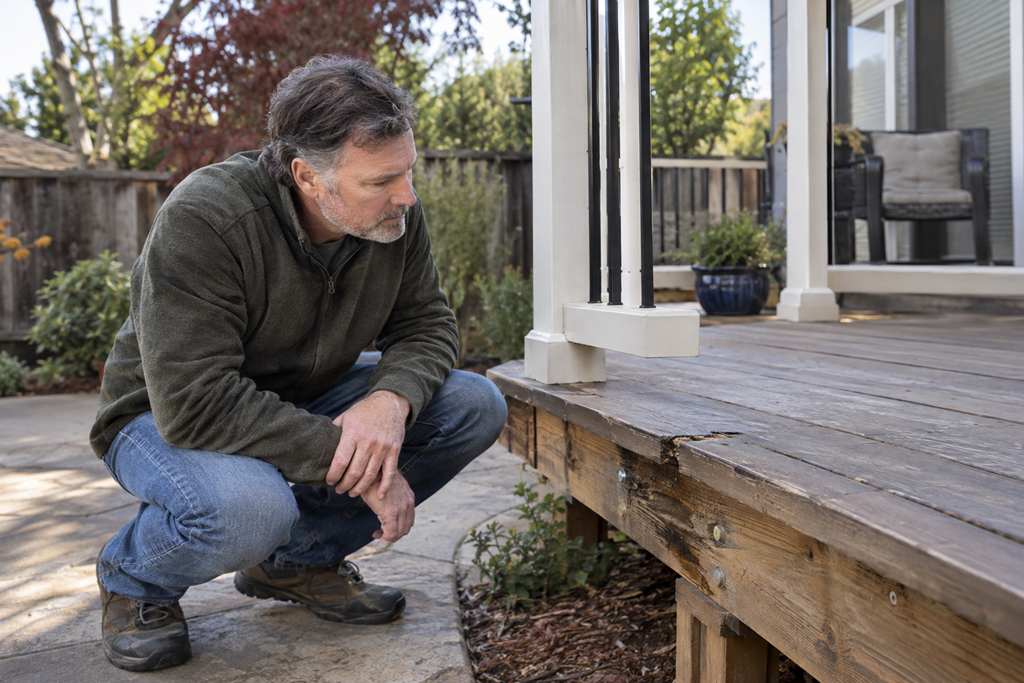
Dry rot can become a bigger deck concern because the damaged wood you notice on the surface may not show the full extent of the decay. What looks like one soft board, discolored edge, or crumbling spot can sometimes be connected to moisture reaching nearby boards, fasteners, framing, or hidden contact points. That does not automatically mean an entire deck needs to be replaced, but it does mean the visible area may be only part of what needs to be evaluated.
For a homeowner, the confusing part is often the mismatch between what the deck looks like overall and what one damaged area seems to suggest. Most of the deck may still appear solid and usable. Then one board feels softer than expected, an edge begins to break apart, or wood around a connection looks noticeably deteriorated.
It is easy to see that as an isolated board problem. Sometimes it may be. In other situations, however, the more important question is what allowed the wood to deteriorate and whether the same condition has affected nearby areas.
The Visible Damage May Be Only The Easy Part To See
What homeowners commonly call dry rot is a form of wood decay associated with fungal activity and moisture. The name can be misleading because wood decay does not simply develop because wood is dry.
From a homeowner's perspective, the important distinction is simpler: the amount of wood deterioration visible from above the deck may not tell you how far the problem extends.
Deck boards are only one part of a deck. Beneath and around them are framing members, connections, posts, stairs, railing attachment points, and other areas that may not be easy to see during ordinary use.
A small deteriorated section therefore raises two different questions:
- How much visible wood is damaged?
- Is the condition limited to that wood, or does it extend into surrounding components?
Those questions can lead to very different repair conversations.
Location Can Matter As Much As The Size Of The Spot
A small deteriorated area in one location may have different implications from a similar-looking spot somewhere else.
For example, decay near a railing connection, stair area, post, deck edge, or another important connection may deserve a closer look because those areas perform more than a cosmetic function. The same is true when visible deterioration appears near a place where moisture may repeatedly collect or where adjoining materials are difficult to inspect.
This does not mean every discolored or weathered board signals a serious structural problem.
Outdoor wood naturally changes appearance over time. Sun exposure, seasonal rain, irrigation, shade, and normal weathering can all affect how a Sacramento-area deck looks.
The useful question is not simply, "Does this deck look old?"
It is, "What does this particular damaged area involve?"
That shift can keep a homeowner from assuming either that the problem is insignificant or that the entire deck is beyond repair before anyone has evaluated it.
One Damaged Board And A Broader Moisture Pattern Are Different Problems
One reason dry rot can grow into a larger concern is that replacing a visibly damaged piece of wood does not necessarily explain why it deteriorated.
If the underlying condition involves repeated moisture exposure, drainage, a hard-to-dry connection, or deterioration extending into adjoining wood, the repair scope may be different from a straightforward board replacement.
That is why an estimate based only on the most obvious surface damage can sometimes feel incomplete.
A homeowner does not need to diagnose the cause personally. What matters is understanding that the condition of the surrounding area can be part of determining the appropriate scope.
This is especially useful when comparing deck repair recommendations. Two providers may not be describing the same project if one is discussing only visible boards while another is including nearby framing or connections that need evaluation.
Dry-Looking Wood Does Not Erase Existing Damage
Another easy misunderstanding comes from the word "dry."
A deck may look completely dry on the day you notice deterioration. That does not necessarily tell you what happened previously or whether damaged wood has regained its original strength simply because it is no longer wet.
Likewise, a period of hot or dry weather does not automatically make existing deterioration a cosmetic issue.
For Sacramento-area homeowners, this can be useful context because decks may experience very different conditions across the year. What matters during an evaluation is the condition of the wood and the surrounding assembly, not just whether the surface happens to be dry at that moment.
The Repair Decision Often Comes Down To Scope
Finding dry rot does not automatically answer the repair-versus-replacement question.
A limited area may support a limited repair. More widespread deterioration, damage in important supporting areas, or multiple connected problem spots can change the conversation.
The challenge is that homeowners usually cannot determine that scope just by looking down at the walking surface.
This is where a qualified deck professional's evaluation can become useful. The goal is not simply to receive a repair price. It is to understand what the provider believes is affected and what that conclusion is based on.
A clear estimate should help you distinguish between the visible symptom and the proposed repair scope.
A Few Questions Can Make An Estimate Easier To Understand
When discussing dry rot with a deck repair professional, concise questions can help clarify what is actually being proposed:
- Is the deterioration limited to the visible boards, or did you find concerns in adjoining wood?
- Which parts of the deck are included in the proposed repair?
- Are any supporting or connection areas involved?
- What appears to have contributed to the deterioration?
- If additional damage becomes visible after work begins, how would that be handled and communicated?
These questions are not about telling a contractor how to repair the deck. They are about making sure you understand what the estimate covers before comparing it with another recommendation.
Be Careful With Conclusions Based Only On Appearance
There are two opposite assumptions that can make this situation harder.
The first is assuming that a small visible spot must mean a small repair.
The second is assuming that any dry rot means the deck needs complete replacement.
Neither conclusion follows automatically from appearance alone.
The more useful approach is to understand the condition, location, surrounding wood, and proposed scope before making a decision.
If a provider recommends substantial work, ask what they observed that supports the larger scope. If another provider recommends a much narrower repair, ask what areas they evaluated and what they believe is unaffected.
That makes the comparison more meaningful than simply looking at the bottom-line price.
A Small Spot Can Be A Reason To Look More Closely, Not Panic
Dry rot becomes a bigger deck concern when visible deterioration is part of a broader condition involving nearby wood, hidden framing, important connections, or recurring moisture exposure.
But noticing one damaged section does not tell you by itself how extensive the problem is.
For Sacramento-area homeowners, the practical next step is to treat visible decay as useful information. A qualified evaluation can help establish whether the issue is isolated or whether the repair conversation needs to include more of the deck.
Understanding that distinction before approving work can make it easier to compare recommendations, ask better questions, and make a more informed deck repair decision.