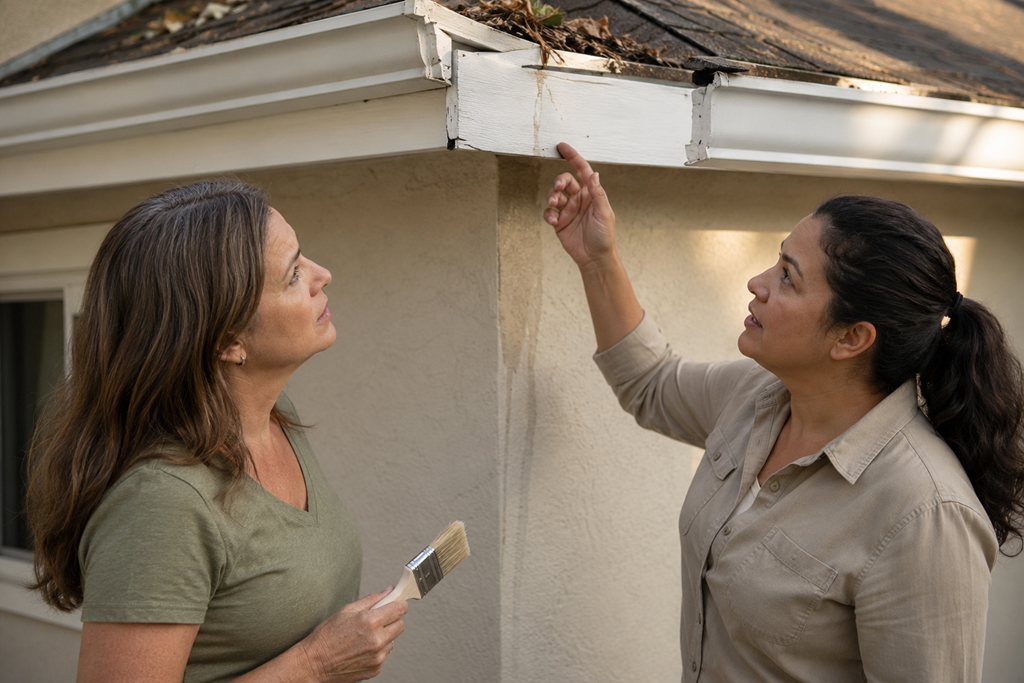
Gutters, small leaks, and poor drainage can contribute to dry rot when they repeatedly direct or hold moisture against vulnerable wood. The damage may appear at a door frame, fascia board, deck edge, or window corner even though the moisture is entering or collecting somewhere else nearby, which is why the visible spot does not always reveal the full cause.
For homeowners, this can be confusing. A small patch of peeling paint or softened trim may look like an isolated maintenance issue. After the area is painted, sealed, or patched, the problem may return because water is still reaching the wood from an overflowing gutter, leaking joint, poorly directed downspout, or low area where water collects.
Understanding that connection can help Sacramento-area homeowners ask better questions before approving a dry rot repair.
The Damaged Wood May Be Downstream From the Real Problem
Water does not always enter exactly where damage becomes visible.
It may run along roof trim, travel behind siding, move through a joint, drip from a gutter seam, or splash repeatedly against the bottom of a wall. The wood that eventually softens may be several feet away from the original entry point.
For example, damage at the lower corner of an exterior door may appear to be a threshold problem. However, the moisture could be coming from an upper trim joint, a gutter connection above the doorway, or a downspout that releases water too close to the foundation.
This is one reason a repair estimate should explain more than which boards will be replaced. It should also address where the moisture appears to be coming from and what may need to change to reduce repeated exposure.
Repeated Dampness Creates the Conditions for Decay
Wood does not usually deteriorate simply because it became wet once.
Problems are more likely when wood remains damp, cannot dry properly, or is exposed to moisture again and again. These conditions can allow wood-decay organisms to affect the material over time.
The phrase “dry rot” can be misleading because the affected wood may feel dry when it is finally discovered. The moisture that contributed to the decay may have occurred earlier, may appear only during rain, or may be hidden behind paint, trim, stucco, or another finish.
Not every crack, stain, or soft spot confirms dry rot. A qualified professional may need to examine the area to determine what is damaged, how far it extends, and whether an active moisture source is still present.
Gutters Can Redirect More Water Than the Damage Suggests
Gutters are intended to collect roof runoff and move it toward controlled discharge points. When part of that path is interrupted, water may reach wood that was not designed for frequent exposure.
Possible trouble areas include:
- A gutter seam that drips onto fascia or window trim
- A sagging section that allows water to spill over one edge
- A clogged outlet that causes runoff to back up
- A loose connection near the roofline
- A downspout that releases water beside wood siding, posts, stairs, or door trim
The visible result may be surprisingly small at first. Paint may bubble along one edge, a board may darken near a fastener, or a corner may feel slightly softer than the surrounding wood.
The limited appearance of the damage does not necessarily mean the moisture route is equally limited.
Small Leaks Can Stay Hidden Behind Finished Surfaces
Some leaks are easy to notice because water drips in plain view. Others occur behind exterior finishes and become visible only after the wood begins to change.
A narrow opening around trim, a failed joint near a roof edge, or water entering behind siding may allow moisture to reach concealed wood. The outer surface can continue looking mostly intact while the material behind it becomes discolored, separated, or softened.
This helps explain why simply painting over a damaged area may not solve the problem. Paint can improve the appearance, but it cannot stop moisture entering from another location.
Caulk can also be useful in the right application, but adding caulk to the most visible crack without understanding the water route may leave the original entry point unchanged. In some situations, sealing the wrong area can also make it harder for trapped moisture to escape.
A professional evaluation should distinguish between a surface opening that needs attention and a broader drainage or leak condition that is feeding the problem.
Poor Drainage Can Keep Lower Wood Components Wet
Drainage problems often affect wood near the ground, including door jambs, deck posts, stair stringers, siding edges, fence connections, and exterior trim.
Water may collect near these materials when:
- The ground slopes toward the structure
- A downspout empties into a low area
- A patio or walkway directs runoff toward a doorway
- Irrigation repeatedly wets the same wooden component
- Soil, mulch, or debris remains in contact with the wood
- Splashback from concrete or soil reaches painted trim
The concern is not only standing water. Even a shallow area that stays damp or receives repeated runoff can slow drying and increase exposure.
Sacramento’s long dry periods can make these conditions easy to overlook. A problem may seem inactive for much of the year and become noticeable again after seasonal rain, irrigation changes, or repeated roof runoff.
Why Cosmetic Repairs May Fail Again
Recurring paint failure is often a clue that the issue may extend beyond the coating itself.
A homeowner may repaint an affected board and see peeling, bubbling, or discoloration return in the same place. That does not automatically prove extensive decay, but it suggests that moisture may still be reaching the surface or the wood beneath it.
Replacing only the visibly damaged section can create a similar problem. The new wood may look correct initially, but it can be exposed to the same conditions if the gutter leak, drainage route, or hidden opening remains unchanged.
A more complete repair conversation usually considers three connected questions:
- What wood appears to be damaged?
- Where is the moisture coming from?
- What will help prevent the repaired area from being exposed in the same way?
The answers may involve more than one trade. A dry rot repair professional may identify the wood damage, while gutter, roofing, drainage, painting, or other work may be needed to address contributing conditions.
What to Ask During a Dry Rot Evaluation
Homeowners do not need to diagnose the moisture path themselves. They can, however, ask questions that reveal whether the evaluation is looking beyond the surface.
Useful questions include:
- What appears to be causing the wood to stay wet?
- Could the moisture be entering somewhere above or beside the damaged area?
- How will you determine how far the damage extends?
- Does the gutter, downspout, roof edge, irrigation, or nearby drainage need separate attention?
- Which parts of the estimate address damaged wood, and which address the moisture source?
- What conditions could cause the problem to return after the repair?
Clear answers should connect the proposed work to what was observed. Be cautious when an explanation focuses only on replacing or covering the visible wood without discussing why it deteriorated.
Repair Scope Should Connect the Damage to the Water Path
A repair estimate may include removing deteriorated material, checking adjacent wood, rebuilding part of a frame or trim assembly, preparing surfaces, and applying protective finishes.
The exact scope depends on the location and extent of the damage. What matters for the homeowner’s decision is whether the proposal connects those repairs to the moisture condition that contributed to them.
A larger estimate is not automatically more complete, and a smaller estimate is not automatically inadequate. The useful distinction is whether the provider can explain:
- What was observed
- What remains uncertain
- How the damaged area will be evaluated
- Which moisture-related conditions are included
- Which conditions require another provider or a separate project
This explanation can make it easier to compare quotes that initially seem to describe different jobs.
Look Beyond the Soft Board
Gutters, leaks, and drainage do not cause every instance of damaged wood, but they are important conditions to consider when wood decay appears near roof edges, openings, exterior trim, decks, stairs, or ground-level components.
The most visible damaged board may be only the place where a longer moisture path finally became noticeable.
Before hiring a dry rot repair professional, look for an evaluation that addresses both sides of the problem: the wood that needs attention and the reason moisture has been reaching it. That connection can help you compare repair scopes more thoughtfully and reduce the chance of treating a recurring moisture problem as a cosmetic defect.