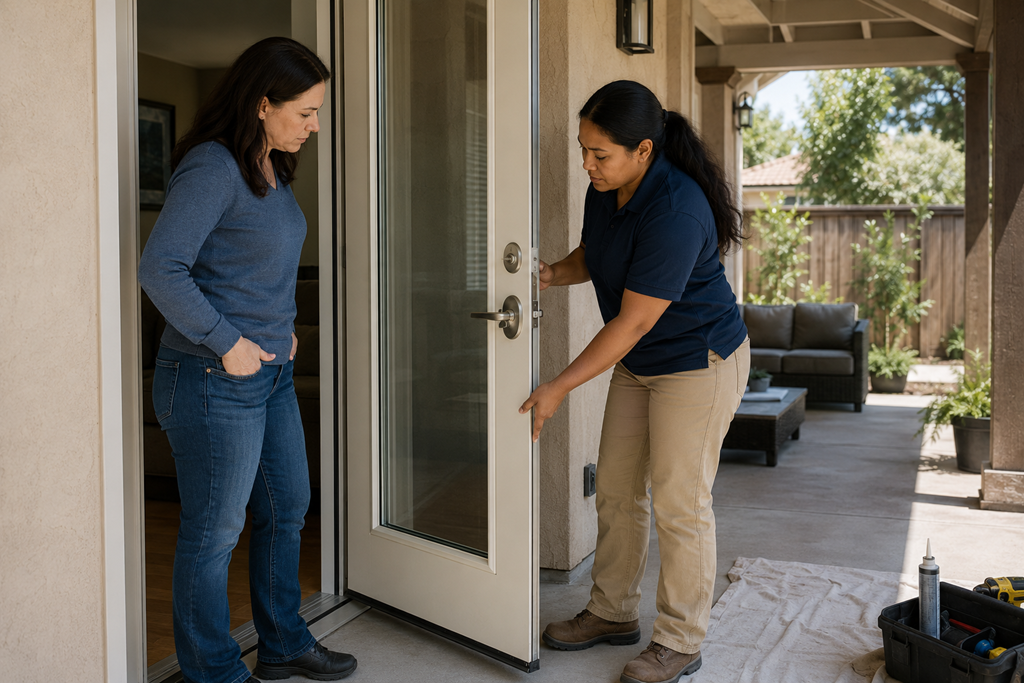
A replacement door can look attractive, feel sturdy, and still perform poorly if it is installed into an opening that is out of square, inadequately sealed, or poorly fastened. Installation quality matters because the door, frame, threshold, weatherstripping, and surrounding wall must work together for the finished entry to operate smoothly and protect the home.
Homeowners often notice installation problems through small, repeated frustrations. The deadbolt may require an extra push before it turns. The door may swing open or closed on its own. Light may appear around one corner, or the bottom may scrape the threshold even though the door itself is new.
These problems do not automatically mean the replacement door is defective. They may indicate that the new components were not properly fitted to the existing opening.
A New Door Is Only One Part of the Finished Entry
It is easy to focus on the visible door panel because that is the part homeowners select by color, style, material, glass design, and hardware. However, the panel cannot perform properly unless the surrounding components support it.
A complete entry may include:
- The door panel
- Hinges and lock hardware
- The jamb or frame
- Weatherstripping
- The sill or threshold
- Interior and exterior trim
- Sealing materials around the opening
- The surrounding wall structure
Each component affects how the others perform. A quality door installed in a poorly prepared frame may stick, leak air, fail to latch smoothly, or wear unevenly. By contrast, a properly evaluated opening can help a modest door perform reliably.
This is why comparing door products alone does not provide a complete picture of replacement quality.
Small Alignment Problems Can Become Daily Annoyances
A door opening does not need to look dramatically crooked to cause operational problems. A slight difference between the hinge side and lock side may be enough to move the latch away from the center of the strike opening.
The homeowner may then compensate without realizing it. They may lift the handle, press a shoulder against the door, pull it inward while locking it, or close it more forcefully than expected.
Over time, that repeated pressure can affect the hardware, weatherstripping, finish, or surrounding frame. The original installation issue may begin to look like a problem with the handle, deadbolt, hinges, or door panel.
A qualified door professional should consider the complete pattern rather than treating each symptom as an isolated hardware problem.
The Existing Opening Deserves Careful Evaluation
Sacramento-area homes include properties built during many different periods. Some openings may have shifted slightly over time, while others may contain layers from previous flooring, trim, siding, or door projects.
An older entry may have:
- A frame that is no longer square
- A raised floor transition near the threshold
- Previous fastener holes or repair areas
- Uneven wall surfaces
- Deteriorated material hidden behind trim
- A nonstandard opening size
- Earlier modifications that are not visible until removal begins
These conditions do not necessarily make replacement unusually difficult. They do make it important for the provider to understand the opening before promising a simple installation.
Measurements should help determine more than whether a door will physically fit. They should also help identify how the frame, sill, trim, hardware, and surrounding surfaces will be handled.
Sealing Depends on More Than New Weatherstripping
New weatherstripping can improve the contact between the door and frame, but it cannot correct every gap.
If the frame is uneven, one section of weatherstripping may be tightly compressed while another section barely touches the door. The entry may look sealed from across the room while still allowing light or air through one corner.
The same principle applies to the threshold. Raising or lowering one part without considering the door’s alignment may create a new rubbing point or leave an inconsistent bottom seal.
Sacramento heat, direct sun, dry conditions, and seasonal rain can make weaknesses around an exterior opening more noticeable. The goal is not simply to add more sealing material. It is to create consistent contact around a properly aligned entry.
Installation Scope Matters When Comparing Estimates
Two estimates may list similar-looking doors while describing very different amounts of installation work.
One provider may be pricing a straightforward panel replacement that keeps much of the existing frame. Another may be proposing a prehung unit with a new frame. A third may include trim removal, threshold work, perimeter sealing, minor opening corrections, and disposal.
The total price alone does not reveal which proposal is more complete or more appropriate.
Before comparing estimates, homeowners should understand what each provider plans to remove, retain, adjust, replace, and finish. A lower quote may be reasonable when the existing opening is in good condition. It may be less useful when important corrective work has simply been left out.
Clear scope is more valuable than a long list of product features that does not explain how the door will be installed.
Good Installation Should Address the Cause of the Problem
Homeowners sometimes begin replacement because of one visible concern, such as a loose handle, draft, sticking lock, damaged surface, or worn threshold.
That concern should still be evaluated in context.
For example, replacing a deadbolt may not solve a lock that repeatedly falls below the strike opening. Installing a new door panel may not eliminate a draft caused by gaps around the frame. Adding thicker weatherstripping may make a misaligned door harder to close.
The installation plan should connect the proposed work to the condition that prompted the project. A provider should be able to explain why the recommended replacement scope is likely to address the problem rather than merely cover it with new materials.
Useful Questions to Ask Before Hiring
A few focused questions can help reveal how thoroughly a provider has considered the installation:
- Will the complete opening be checked before the replacement door is ordered?
- Does the estimate cover a door panel, a prehung unit, or a broader opening replacement?
- Which parts of the existing frame, threshold, and trim will remain?
- How will uneven gaps or lock-alignment problems be addressed?
- What happens if damaged or altered material is found after the old door is removed?
- How will the finished door be checked before the project is considered complete?
The provider does not need to predict every hidden condition. However, the explanation should show that the opening has been considered as part of the project rather than as an afterthought.
A Finished Door Should Work Without Special Techniques
A properly completed replacement should not require the homeowner to learn a new way to operate the entry.
The door should move smoothly, meet the frame consistently, and latch without unusual force. The deadbolt should align without the homeowner pushing, pulling, or lifting the door. Gaps should appear reasonably even, and the transition at the threshold should feel intentional rather than improvised.
Minor adjustments may be normal during installation. What matters is whether those adjustments create a complete, functional entry rather than temporarily hiding a larger alignment problem.
Appearance still matters, but smooth operation and consistent contact around the opening are stronger indicators of installation quality than the newness of the door alone.
The Better Decision Considers the Whole Opening
Door replacement is not only a product purchase. It is a project that connects the new door to an existing structure.
Before hiring a Sacramento-area door professional, look beyond the door model and ask how the opening will be evaluated, prepared, sealed, aligned, and finished. A provider who explains those details clearly is helping you understand how the completed entry is expected to perform, not simply what it will look like.
That distinction can make it easier to compare estimates, recognize incomplete scope, and choose a replacement plan that addresses the actual condition of the doorway.