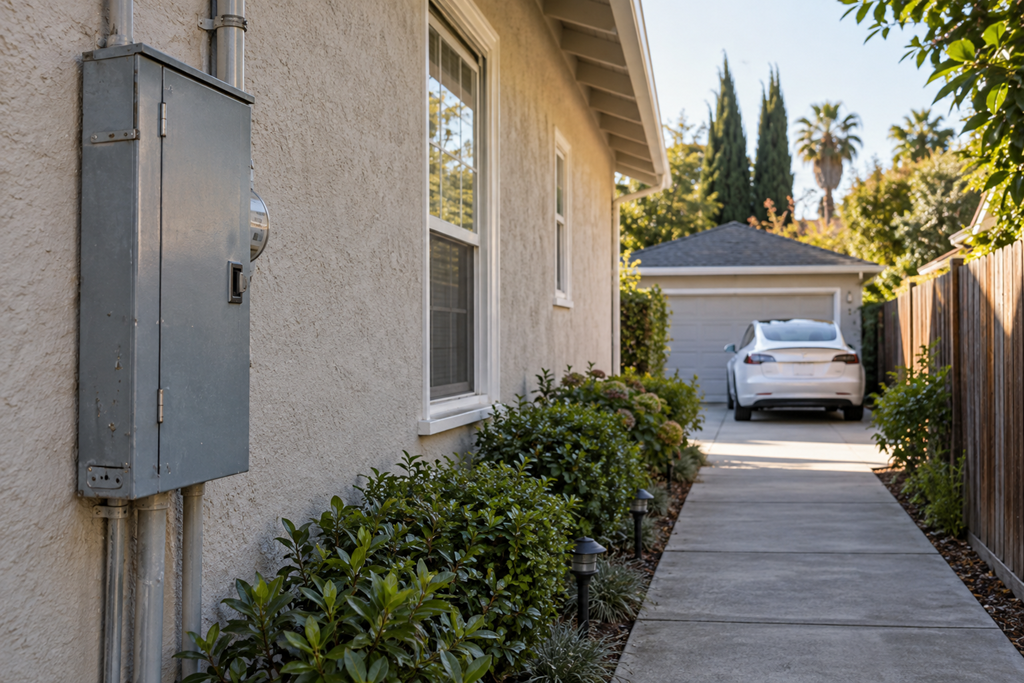
Older homes can often accommodate an EV charger, but the project may require more planning than simply choosing a charger and mounting it near the parking area. The electrical panel, available capacity, wiring route, previous upgrades, and distance between the panel and the vehicle can all affect what a qualified professional needs to evaluate before installation.
For Sacramento-area homeowners, that can be an important distinction. The charger itself may be relatively straightforward to understand, while the home's existing electrical system and physical layout are what determine how simple or involved the overall project may be.
That does not automatically mean an older home needs a major electrical upgrade. It means the existing home deserves to be evaluated as part of the project rather than treating the charger as a stand-alone appliance.
The Charger Is Only One Part of the Installation
It is easy to focus first on the charger.
Homeowners may compare charger features, think about where the vehicle will park, and picture a unit mounted conveniently on a garage or exterior wall. But before installation, a qualified professional may also need to understand how that new electrical demand fits into the home's existing system.
An older home may have electrical equipment that was installed long before electric vehicles became part of everyday household use. It may also have been modified over the years as appliances, air conditioning, additions, remodels, or other electrical needs changed.
That history can matter.
The useful question is not simply, "Is this house old?"
A better question is, "What is already here, and how does the proposed charger fit with it?"
An Older Home Does Not Automatically Mean a Panel Upgrade
One misunderstanding is assuming that an older house automatically needs a new electrical panel before a charger can be installed.
Another is assuming that because the lights and appliances work normally, the existing electrical system will automatically support whatever charger the homeowner chooses.
Neither assumption tells the whole story.
A professional evaluation can help determine what capacity is currently available, what other electrical loads already exist, and whether the proposed installation fits the home's present setup.
That distinction can help homeowners avoid going into the project expecting either a major upgrade or an extremely simple installation before anyone has actually evaluated the property.
It also makes provider conversations more useful. Instead of asking only how much a charger installation costs, the homeowner can ask what the estimate assumes about the existing electrical system.
Where the Car Parks Can Matter More Than Expected
The location of the electrical panel and the location of the vehicle are separate pieces of the same project.
In one home, the panel and desired charging location may be relatively close together. In another, the vehicle may park across the garage, in a side driveway, beneath a carport, or near a detached structure.
The path between those two points can affect project planning.
Finished walls, exterior surfaces, the configuration of the garage, and other physical features may influence how a professional evaluates the proposed route. A charger location that seems convenient for the driver may therefore involve a different installation scope than another location on the same property.
This is one reason an estimate based only on the charger model can leave important questions unanswered.
The house itself is part of the estimate.
Previous Electrical Work Can Add Another Layer of Questions
Age alone does not tell the complete story of an older home's electrical system.
Some properties may have had substantial electrical updates. Others may have a mixture of older and newer components resulting from projects completed at different times.
For a homeowner, that can make the system difficult to judge by appearance.
A panel that looks relatively recent does not necessarily explain everything about the rest of the property, just as an older-looking enclosure does not by itself tell a homeowner what work will be required.
This is where professional evaluation becomes more useful than trying to make assumptions from visible equipment.
When comparing local providers, homeowners can pay attention to whether the professional is interested in understanding the existing system and proposed charging location before describing the project as simple or complicated.
A Good Estimate Should Make the Assumptions Clear
An EV charger estimate becomes easier to evaluate when the homeowner understands what is included and what conditions the price assumes.
For example, one estimate might be based on using the existing electrical setup as it stands. Another might include additional electrical work. A third could assume a different charger location or wiring route.
Those estimates may look very different even though each provider is discussing the same vehicle and the same house.
Before comparing the numbers alone, it helps to understand the scope behind them.
That can be especially valuable with an older property because unexpected differences are often easier to discuss before work begins than after the homeowner has already committed to a particular plan.
Questions That Can Make the Estimate Easier to Understand
Homeowners do not need to become electrical experts to have a useful conversation with an EV charger installer.
A few plain-language questions can reveal how thoroughly the project has been considered:
- What parts of my existing electrical system need to be evaluated before the installation plan is finalized?
- Does this estimate assume my current electrical capacity is sufficient?
- What charger location and wiring route does this estimate assume?
- Could previous electrical upgrades affect the proposed scope?
- If additional electrical work becomes necessary, how would that be explained before I approve it?
- Are there meaningful installation differences between the charging locations I am considering?
- What is included in the estimate, and what would be considered additional work?
The goal is not to diagnose the electrical system yourself. It is to understand what the provider has evaluated and what assumptions are built into the proposed project.
Be Wary of Conclusions Made Before the Home Is Understood
Older homes can make homeowners especially vulnerable to two opposite messages.
One is that an expensive upgrade is inevitable simply because the property is older.
The other is that installing a charger will be simple regardless of the home's existing electrical setup.
A more useful conversation usually leaves room for evaluation.
If a provider recommends additional work, the homeowner can ask what existing condition or project requirement is driving that recommendation. If a provider says no additional work is needed, the homeowner can ask what was evaluated to reach that conclusion.
Clear explanations make estimates easier to compare without requiring the homeowner to decide which technical solution is correct on their own.
More Planning Does Not Necessarily Mean a Bigger Project
The phrase "older home" can make an EV charger installation sound more complicated than it may actually be.
More planning does not automatically mean more construction, a major upgrade, or a difficult installation.
Sometimes it simply means that the existing electrical system, previous improvements, parking location, and proposed wiring path deserve attention before the project is priced and scheduled.
That is useful information for Sacramento-area homeowners because it shifts the decision away from guessing what an older house might need.
Instead, the homeowner can focus on whether a local professional has looked carefully enough at the actual property to explain the proposed scope.
Before committing to an EV charger installation, understanding those assumptions can make it much easier to compare estimates, ask useful questions, and know what the project is really expected to involve.