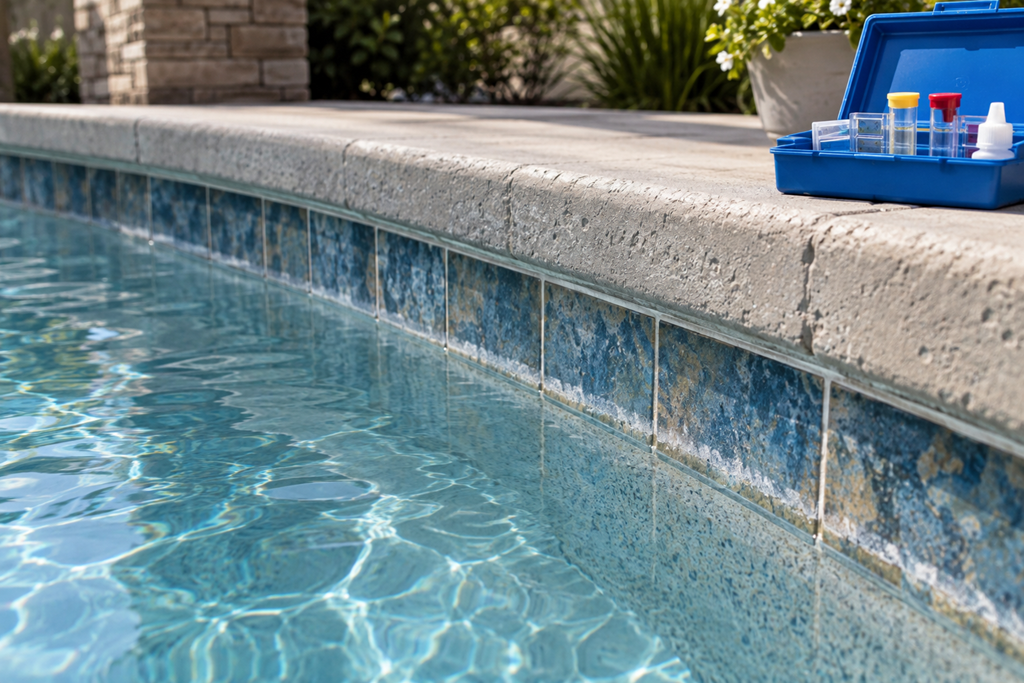
Pool chemistry can affect how tile and pool surfaces look because the balance of the water influences scale, staining, discoloration, and how deposits collect over time. A surface that looks dull, chalky, spotted, or uneven may not be only a cleaning issue; the water conditions can be part of what is changing the appearance.
That distinction matters when a Sacramento-area homeowner notices a white line around the tile, patches of discoloration, or a pool finish that no longer looks as uniform as it once did. It is easy to focus on what is visible and assume that cleaning the surface is the entire solution. Sometimes it is. Other times, the appearance is connected to what has been happening in the water.
Understanding that connection can make conversations with a pool tile cleaning or maintenance professional more useful.
The Water Can Leave Clues On The Surface
Pool water is constantly in contact with tile, grout, plaster, pebble finishes, and other materials. As water conditions change, those surfaces can sometimes show the effects.
Mineral deposits are one familiar example. As pool water evaporates, minerals do not evaporate with it. They can become more concentrated and may contribute to deposits around the waterline or other areas of the pool.
Depending on the water conditions and the surface involved, homeowners may notice:
- a whitish or chalky waterline
- dull-looking tile
- rough deposits near the edge of the water
- subtle staining or discoloration
- areas of the pool finish that look less uniform than expected
These appearances do not automatically identify the cause. The important point is that what looks like a surface problem can sometimes have a water-related component.
A Cleaning Issue And A Water-Balance Issue Can Overlap
One of the easiest misunderstandings is treating cleaning and water chemistry as completely separate subjects.
They are different services and concerns, but they can overlap.
A professional may be able to remove deposits from tile and improve its appearance. If the conditions that contributed to those deposits continue, however, similar buildup may gradually become visible again.
That does not necessarily mean the cleaning failed. It may mean the visible deposit was one part of a broader maintenance pattern.
This is why it can be helpful to distinguish between two questions:
What is on the surface now?
and
What may be contributing to it over time?
Those questions can lead to a more useful conversation than simply asking how to make the tile look clean again.
Similar-Looking Marks Can Have Different Causes
Another complication is that homeowners cannot always tell what they are seeing just by looking at it.
A white or light-colored area might be mineral buildup, but appearance alone does not necessarily confirm that. A darker mark might involve organic material, metals, surface aging, or another condition. Some changes may be primarily cosmetic, while others may reflect characteristics of the pool finish itself.
Even texture can be misleading. Something that appears to be sitting on top of a surface may not respond like an ordinary removable deposit.
That is one reason to be cautious about assuming that every stain, spot, or rough area needs the same treatment.
A qualified pool professional can help identify what appears to be surface buildup, what may be staining, and whether the condition deserves a broader look at water chemistry or the pool surface.
Sacramento Conditions Can Make The Waterline Easy To Notice
Sacramento-area pools can experience long periods of heat, sun exposure, and evaporation. Those conditions can make changes around the waterline especially noticeable.
A homeowner may see a narrow band developing where the water repeatedly meets the tile, even while the rest of the pool appears well maintained.
That can create the impression that the problem is simply dirty tile.
The visible line matters, but it can be more useful to think of it as evidence rather than a diagnosis. The waterline is one of the places where deposits and changing surface appearance can become easy to see.
This perspective can help homeowners avoid jumping directly from “the tile looks bad” to “it just needs stronger cleaning.”
Why The Appearance May Return After Cleaning
Removing visible buildup does not necessarily change the conditions that allowed it to develop.
This is an important expectation to discuss before hiring someone for pool tile cleaning.
A freshly cleaned waterline may look dramatically better, but future appearance still depends on several factors, including ongoing pool maintenance, water conditions, evaporation, the type and age of the surface, and what originally caused the discoloration or deposit.
That does not make professional cleaning less useful. It simply separates two different goals:
Improving what the surface looks like now and understanding what may influence how it looks later.
When those goals are discussed separately, it becomes easier to understand what a particular service is expected to accomplish.
Surface Condition Matters Too
Chemistry is not the only explanation for changes in appearance.
Tile, grout, plaster, pebble finishes, and other pool materials can age differently. Previous maintenance, ordinary wear, repairs, sun exposure, and the characteristics of the material itself can all affect what a homeowner sees.
A pool surface that has changed over many years may not respond the same way as relatively new tile with recent mineral buildup.
That is why a useful evaluation should not start with the assumption that chemistry explains everything.
Instead, the goal is to understand the relationship among the visible condition, the material, the water, and the cleaning method being considered.
What To Ask Before Scheduling Pool Tile Cleaning
If the appearance has become noticeable enough that you are considering professional cleaning, a few questions can help clarify the scope of the service:
- Does this look more like mineral buildup, staining, or a change in the surface itself?
- Is the issue limited to the waterline, or is it visible elsewhere in the pool?
- Could current water conditions be contributing to what I am seeing?
- What appearance change is realistic to expect from the proposed cleaning?
- Could the same type of buildup return if the underlying conditions continue?
The goal is not to diagnose the pool yourself. It is to understand what the provider believes is happening and what the proposed service is intended to address.
Clear answers can also make it easier to compare providers when two companies recommend different approaches.
Think Beyond The Visible Deposit
When pool tile or another surface starts looking chalky, stained, or uneven, the visible mark is naturally what gets attention first. But appearance can be the result of more than something simply sitting on the surface.
Water chemistry, minerals, surface material, age, maintenance conditions, and environmental exposure can all be part of the picture.
For Sacramento-area homeowners, the practical takeaway is simple: before treating an appearance problem as a cleaning-only issue, ask whether the water and the surface should be considered together. That conversation can help set more realistic expectations about what cleaning may improve and what may influence how the pool looks afterward.