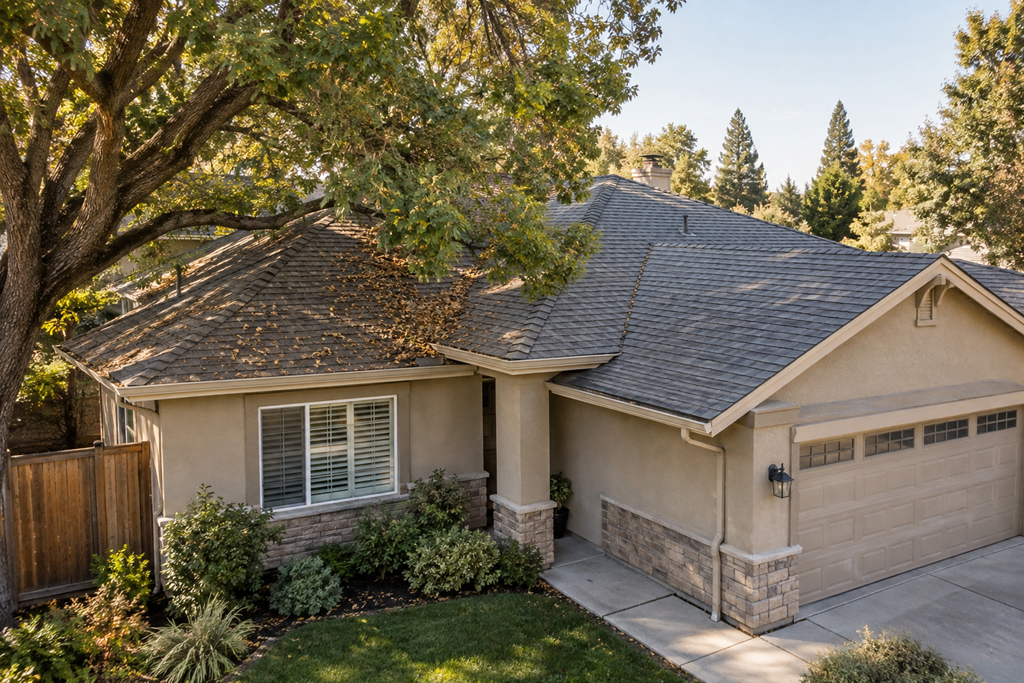
Tree coverage can make roof cleaning more important because leaves, needles, small twigs, seed pods, and other organic material can collect more quickly on a roof that sits beneath or near mature trees. Shade can also keep some roof areas damp longer after rain, so a roof that looks fine from the ground may still deserve a closer look when debris keeps returning.
For Sacramento-area homeowners, the issue is not simply whether trees are present. What matters is how the trees interact with the roof. A large tree several yards away may have little effect, while branches extending over part of the house can create a recurring pattern of shade and falling material in very specific roof areas.
That does not automatically mean a roof needs frequent cleaning. It does mean tree coverage is worth considering when deciding whether buildup should be monitored, whether professional cleaning may be appropriate, and what questions to ask before scheduling service.
Tree Coverage Changes How Debris Reaches the Roof
A roof surrounded by open sky and a roof beneath mature tree canopies are exposed to different conditions.
Trees can drop leaves, needles, blossoms, seed material, small twigs, and other natural debris throughout the year. Wind can move that material across the roof before it settles in valleys, around roof transitions, near gutters, or in other areas where it does not blow away as easily.
That is why a homeowner may clean up the yard regularly and still notice material returning to the roof.
The important point is not that trees are inherently a problem. Mature landscaping can be an attractive part of a property. The practical issue is that greater tree coverage can create a more consistent source of roof debris, which may change how closely the roof should be watched.
Shade Can Matter Even When the Roof Does Not Look Very Dirty
Falling leaves are the most obvious connection between trees and roof cleaning, but shade can matter too.
Some portions of a roof may receive direct sun for much of the day, while sections beneath or beside a tree canopy stay shaded longer. After seasonal rain or morning moisture, those shaded areas may dry more slowly than more exposed sections.
When shade and organic debris occur in the same area, the roof may hold moisture and surface buildup longer than an open, sun-exposed section of the same roof.
This helps explain why one side of a home can develop noticeably different cleaning needs from another. Looking at the roof as one uniform surface can miss those localized differences.
The Most Covered Part of the Roof May Tell You More Than the Front View
One easy misunderstanding is assuming the roof's overall appearance tells the whole story.
From the street, the most visible roof plane may receive plenty of sun and have relatively little tree coverage. The rear or side of the roof may sit beneath branches and collect significantly more natural debris.
That can create a situation where the roof appears generally clean even though certain areas repeatedly accumulate material.
Instead of asking only, "Does my roof look dirty?" it can be more useful to consider where debris tends to collect and whether those areas correspond with tree coverage, shade, or overhanging branches.
Homeowners do not need to climb onto the roof to investigate this. Visible patterns from the ground, recurring debris near roof edges or gutters, and observations made during a professional evaluation can provide useful context without turning the issue into a risky DIY inspection.
Cleaning Needs Do Not Have to Follow a Fixed Calendar
Tree coverage is one reason roof cleaning is difficult to reduce to a simple schedule.
Two neighboring homes can experience different conditions even when their roofs are similar in age. One may have substantial canopy coverage and regular leaf accumulation, while another has very little overhead vegetation.
The same property can also change over time as trees grow, branches are trimmed, landscaping changes, or previously open roof sections become more shaded.
That makes the roof's actual environment more useful than an arbitrary assumption that every roof should be cleaned at the same interval.
A qualified provider should be able to discuss the condition that exists now rather than simply recommending service because a certain amount of time has passed.
Gutter Cleaning and Roof Cleaning Are Related, but They Are Not the Same Decision
Another common assumption is that clean gutters mean the roof itself has been addressed.
Gutters collect material that reaches the roof edge, but debris can remain elsewhere on the roof before it ever reaches them. Roof valleys, transitions, shaded sections, and areas near tree branches can develop their own accumulation patterns.
Likewise, seeing leaves in a gutter does not automatically prove that the entire roof needs cleaning.
The useful question is where the material is coming from and where it is staying.
If tree coverage repeatedly places debris on certain roof sections, a roof-cleaning discussion may be worthwhile even when gutter maintenance is already part of the homeowner's routine.
More Trees Do Not Automatically Mean More Cleaning
Tree coverage should be treated as one factor, not as a diagnosis.
A heavily landscaped property does not necessarily require constant roof cleaning, and a property with few trees is not automatically free of roof buildup.
Roof material, roof shape, branch proximity, wind exposure, shade patterns, surrounding vegetation, and how easily debris leaves the roof can all affect what happens in practice.
This distinction matters when comparing local providers. A recommendation should make sense for the specific property rather than rely on a broad statement such as "You have trees, so you need this service."
A provider who can explain which areas are affected and why gives the homeowner more useful information than one who simply points to the presence of nearby trees.
What to Ask Before Scheduling Roof Cleaning
When tree coverage appears to be contributing to recurring buildup, a few focused questions can make a provider conversation more useful:
- Which parts of the roof appear most affected by tree coverage or recurring debris?
- Is the concern mainly loose material, persistent surface buildup, shaded conditions, or a combination of factors?
- Does the roofing material affect the cleaning approach being recommended?
- What parts of the roof actually need attention, rather than assuming the entire surface has the same condition?
- How will the provider protect the roofing surface, gutters, landscaping, and surrounding property during the work?
- Based on the current condition, does cleaning appear appropriate now, or is monitoring reasonable?
The goal is not to become a roof-cleaning expert. It is to understand the reasoning behind the recommendation before agreeing to the work.
Pay Attention to Patterns, Not Just One Moment
A few leaves after a windy day are different from a roof section that repeatedly collects debris beneath the same canopy.
That recurring pattern is often the more useful clue.
Sacramento-area properties can experience long dry stretches followed by seasonal rain, and mature landscaping can affect different parts of a roof in different ways. Paying attention to where shade and debris consistently overlap can help a homeowner have a more specific conversation with a roof-cleaning provider.
Tree coverage does not automatically make roof cleaning urgent, and it does not mean every shaded roof needs the same treatment. It simply changes the conditions the roof experiences.
Understanding those conditions can help you decide whether cleaning is worth discussing, evaluate a provider's explanation more carefully, and avoid making the decision based only on how the roof looks from the street.