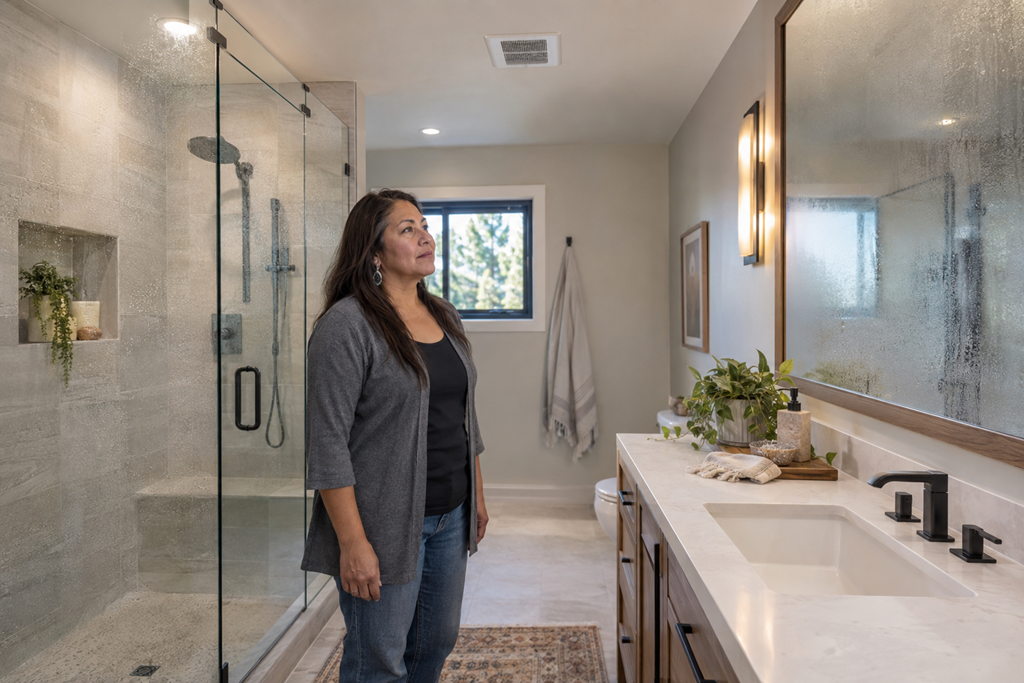
Bathroom remodeling is not only about tile, fixtures, storage, and appearance. Ventilation and moisture control matter because every shower, bath, and sink use adds humidity to a small enclosed space, and that moisture needs a practical way to leave the room instead of lingering on walls, ceilings, finishes, and nearby surfaces. A well-planned remodel considers how the bathroom will dry out during normal daily use, not just how it will look when the work is finished.
A Beautiful Bathroom Still Has To Handle Everyday Moisture
It is easy to focus on the parts of a bathroom remodel that are immediately visible: the shower, vanity, flooring, lighting, storage, hardware, and finishes.
Ventilation is less noticeable, which can make it easier to treat as a secondary detail.
But once the bathroom returns to daily use, moisture becomes part of the room again. Hot showers can leave condensation on mirrors and shower glass. Towels stay damp for a while. Humidity can remain in the room after someone leaves.
None of that automatically means something is wrong. Bathrooms regularly get wet and humid.
The more useful question during remodeling is whether the finished room has been planned to manage that moisture reasonably as part of everyday use.
The Goal Is Not To Keep The Bathroom Completely Dry
Moisture control does not mean creating a bathroom where surfaces never become wet or mirrors never fog.
A shower is naturally going to introduce water and humidity.
The goal is to think about what happens afterward.
How does humid air leave the room? How does the space dry between uses? Are moisture-prone areas being considered as part of the remodeling plan rather than treated as an afterthought?
That distinction can help homeowners have a more useful conversation with a remodeling professional.
Instead of asking only whether a particular tile, vanity, or fixture will work, you can also ask how the overall bathroom will function once people begin showering, bathing, drying towels, and using the room every day.
Ventilation Is Part Of How The Finished Room Functions
Bathroom ventilation is sometimes viewed as a small mechanical detail that can be addressed near the end of a project.
From a homeowner's perspective, it is more useful to think of it as part of the bathroom's daily function.
The layout of the room, shower configuration, ventilation approach, doors, windows, ceiling features, and other project choices can all be part of the conversation about how moisture will be managed.
You do not need to determine the technical solution yourself.
A qualified remodeling professional can evaluate the project and explain what is appropriate for the specific bathroom.
What matters before hiring or approving a remodeling plan is knowing that this conversation should happen.
If the discussion focuses heavily on appearance while ventilation receives almost no attention, it is reasonable to ask how the remodeled bathroom is expected to handle humidity during normal use.
Moisture Control Goes Beyond One Fan Or One Feature
Another common misunderstanding is assuming moisture control begins and ends with whether the bathroom has an exhaust fan.
Ventilation can certainly be an important part of the discussion, but the broader issue is how the room manages water and humidity as a complete space.
A bathroom contains several different surfaces and materials. Shower walls, flooring, painted areas, cabinetry, trim, mirrors, ceilings, towels, and other features can all experience different levels of moisture during everyday use.
That is why moisture planning is better treated as part of the overall remodel rather than as one isolated product decision.
The homeowner does not need to become an expert in ventilation systems, waterproofing methods, or construction details. The practical goal is simply to make sure the contractor can explain how moisture considerations fit into the proposed project.
Daily Use Can Reveal Issues That Are Easy To Miss During Design
A bathroom can look completely different when it is being planned than when it is being used.
During a consultation, the room may be dry, empty, and brightly lit. During normal life, someone may take a long shower, another household member may use the bathroom soon afterward, damp towels may be hanging nearby, and the door may remain closed for part of the morning.
Thinking about those ordinary routines can make the planning conversation more realistic.
For Sacramento-area homeowners, it can be helpful to describe how the bathroom is actually used rather than discussing only dimensions and finishes.
A primary bathroom used repeatedly every morning may have different practical considerations from a lightly used guest bathroom.
The important point is not to diagnose what the bathroom needs yourself. It is to give the professional enough context to explain how the proposed remodel accounts for normal use.
A Few Questions Can Make The Remodeling Conversation More Useful
You do not need a technical checklist. A few plain-language questions can reveal whether ventilation and moisture control have been considered thoughtfully:
- How is this bathroom expected to handle moisture after showers or baths?
- Is the existing ventilation approach being evaluated as part of the remodel?
- Does the proposed layout change anything about how humidity leaves the bathroom?
- Are there areas of the new design that may stay damp longer than others?
- How do the shower enclosure, room layout, and ventilation plan work together?
- Is there anything about our normal bathroom routine that would be useful for you to know before the plan is finalized?
A good explanation should help you understand the reasoning without requiring you to learn construction terminology.
Be Cautious When The Moisture Conversation Stays Vague
Not every remodeling discussion needs to become a lengthy technical presentation.
But there is a difference between a simple explanation and no explanation at all.
If you ask how ventilation or moisture will be handled and receive only a vague answer such as "it should be fine," consider asking for more context.
The same applies when a proposal makes major changes to a bathroom but no one has discussed how the room will be used after the remodel.
That does not automatically mean the project is poorly planned. It simply means there may be an important subject worth clarifying before work begins.
It is usually easier to discuss expectations during planning than to realize afterward that you and the contractor were thinking about the room differently.
Do Not Let Finish Choices Push Function Into The Background
Bathroom remodeling naturally involves many appearance decisions.
Homeowners may spend considerable time comparing tile patterns, countertop materials, faucets, shower glass, lighting, mirrors, paint, and storage.
Those choices matter because you will see and use them every day.
But a successful remodeling conversation should also include the less visible features that affect how the bathroom functions.
Ventilation and moisture management are good examples.
They may not create the dramatic visual change that new tile or cabinetry does, but they can influence how the finished room feels during regular use.
That is why asking about them is not overthinking the project. It is simply looking beyond the showroom appearance and considering what living with the remodeled bathroom will actually be like.
Plan For The Bathroom You Will Use, Not Just The One You Will Photograph
A finished bathroom should look good on the day the project is completed.
More importantly, it needs to function when showers are running, towels are damp, mirrors are fogging, doors are opening and closing, and the room is being used repeatedly.
Ventilation and moisture control deserve a place in the remodeling conversation because they are part of that everyday reality.
Before comparing Sacramento-area bathroom remodeling providers or approving a project plan, ask how the proposed bathroom is expected to manage normal moisture and how the different parts of the design support that goal.
You do not need to determine the technical solution yourself. You simply want enough explanation to understand that moisture management has been considered along with the visible parts of the remodel.