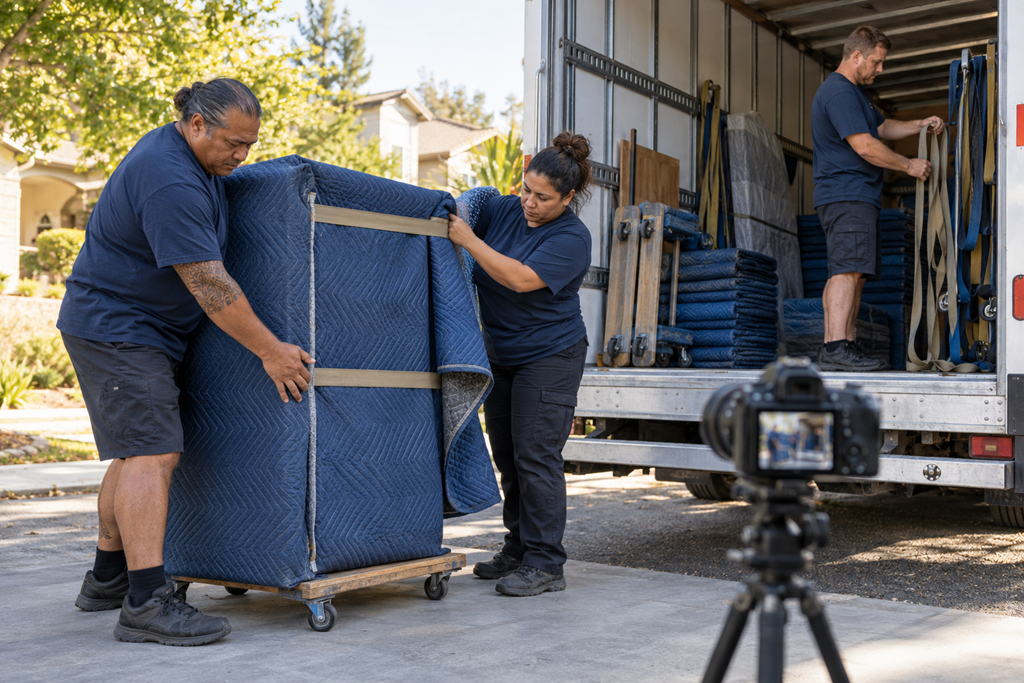
When customers are considering a Sacramento-area service business, authentic staff photos can help them prepare for their first interaction by showing who they may meet and what those employees actually do. For businesses such as moving companies, where customers may invite a crew into their homes and trust them with personal belongings, accurate images can make an unfamiliar service experience easier to understand. The value comes from showing real people in relevant professional roles, not simply adding friendly faces to a website.
A moving company might clearly explain its services, service area, and scheduling process while showing only trucks, furniture, and generic promotional pictures. Those images may communicate the type of work the company performs, but they offer little insight into the people responsible for carrying it out.
Customers may still have reasonable questions. Who will arrive at the property? Will someone conduct an estimate before the moving crew arrives? Who coordinates the move? What should the customer expect when the employees introduce themselves?
Staff photos cannot answer every question, but thoughtfully chosen images can make the people and roles behind a service more recognizable.
For Sacramento-area business owners, that is an opportunity to strengthen the connection between what a business promises and what customers can reasonably expect.
Customers Are Preparing for an Experience, Not Just Choosing a Company
When someone hires a local service provider, they are often arranging an interaction with people they have never met.
That interaction may happen inside a home, at a business property, in a professional office, or at another location where the customer needs to understand what will happen next.
Consider a homeowner preparing for a moving appointment.
The homeowner may have already reviewed the company's services and requested an estimate. However, they may still be uncertain about the difference between the estimator, the scheduling coordinator, the crew leader, and the people who physically handle the move.
A company website that introduces these roles can make the process more understandable before the appointment.
For example, a photograph of an actual moving crew preparing equipment could accompany an explanation of how the crew typically begins a job. A separate image of the business owner or coordinator could help customers understand who manages communication before moving day.
The photographs become more useful when they provide context about the service experience.
The goal is not to make customers feel that they already know the employees personally. It is to help them recognize the professional roles involved and prepare appropriate expectations.
Why Generic Staff Images May Leave Important Questions Unanswered
Stock photography is not necessarily inappropriate. It can illustrate general service concepts, equipment, or environments.
The limitation arises when generic images appear to represent actual employees or service experiences without making that distinction clear.
Several common patterns can weaken the usefulness of staff photography.
Images Show People Without Explaining Their Roles
A group photograph may introduce the team, but customers may not understand who handles scheduling, estimates, fieldwork, or customer questions.
Even a brief, accurate role description can provide useful context.
For example, identifying someone as a scheduling coordinator helps explain why that person may contact the customer before the service appointment.
Photos Represent Employees Who Are No Longer With the Business
An outdated team picture may create expectations that no longer reflect the company's staffing.
This is especially relevant when a business uses individual photographs to introduce employees as the people customers can expect to meet.
An older photograph does not automatically make the business untrustworthy. However, outdated information can create unnecessary uncertainty when customers encounter a different team.
Posed Images Replace Useful Service Context
A professional headshot can be appropriate for identifying an owner, manager, or staff member.
However, a collection of headshots may not help customers understand what employees do during a service appointment.
Photographs of actual work preparation, appropriate equipment handling, or relevant customer-facing activities can provide context that portraits alone may not offer.
Photography Creates Expectations the Business Cannot Reliably Meet
A company may feature several employees prominently even though assignments change depending on schedules, locations, and service requirements.
Customers might reasonably assume those particular people will arrive for their appointment.
A more accurate presentation explains team roles without implying that every featured employee participates in every service visit.
The distinction matters because authentic photographs should help customers form realistic expectations rather than create a false sense of certainty.
The Most Useful Photos Connect People to the Service Process
Authenticity involves more than proving that someone works for the business.
A useful staff photograph also helps answer a practical customer question.
For a moving company, several types of images may provide different kinds of information.
A picture of the actual crew preparing moving equipment can help illustrate the physical work involved. A photograph of the office coordinator can support an explanation of pre-move communication. A picture of a crew leader conducting a routine preparation activity can help customers understand how responsibilities are organized.
These images do not need to reveal private operational details or expose customers' belongings.
They need to be accurate and relevant to the business's real service process.
Captions can add meaning when they identify a genuine role or explain an actual stage of service. For example, a company might describe how its crew leader confirms the planned work with the customer before loading begins, provided that accurately reflects the company's practices.
For businesses where employees work inside customers' homes, professional presentation and role identification can be especially useful.
However, a clean uniform or friendly expression should not be presented as proof of qualifications, careful work, or service quality.
Those claims require their own supporting evidence.
Authentic Photos Support Credibility, but They Are Not Proof of Performance
This distinction is important for the Trusted part of local online visibility.
A prospective customer may discover a business through Google, a referral, a directory, or another online source. The company's service descriptions may then help that person understand what it offers.
The next question is whether the customer can find credible reasons to consider taking the next step.
Authentic staff photography can contribute to that decision by making the business's people and operations more visible.
But photographs have limits.
A picture of a moving crew does not verify that employees have completed particular training. A smiling employee does not establish customer satisfaction. A uniformed team standing beside a vehicle does not prove that a company meets every relevant professional requirement.
Those are separate claims that should be supported by appropriate facts, documentation, accurate business information, or authentic customer feedback.
Staff photography works best as one part of a consistent presentation.
When the people, roles, service explanations, reviews, and actual customer experience align, the company's online information gives customers a more coherent basis for evaluating it.
That still does not guarantee that someone will trust the business or choose to hire it.
A Simple Way to Evaluate Your Existing Staff Photos
One manageable exercise is to review the publicly visible staff photographs on your business website as though you were a customer preparing for a first appointment.
Choose one common customer interaction, such as a scheduled moving estimate or the arrival of a service crew.
Look at the photographs and accompanying explanations that a customer would encounter before that interaction.
Ask whether they accurately identify the people or roles involved, show relevant professional activities, and support the expectations described elsewhere on the website.
Also consider whether any images appear to represent current employees, specific credentials, or routine procedures that the business cannot verify.
This review can reveal gaps between the images and the service experience the business describes. It cannot establish whether customers trust the company more, whether inquiries have increased, or whether photographs influence search rankings.
The useful outcome is a clearer understanding of what your existing images actually communicate.
A Sacramento Moving Company Illustration
Consider a hypothetical independently owned moving company serving Sacramento-area households.
The business has an established team, several moving vehicles, and a process for coordinating residential moves.
Its website explains packing assistance, loading, transportation, and scheduling. However, most photographs show empty trucks, furniture arrangements, and generic images of moving activity.
The photographs are not necessarily misleading, but customers learn little about the company's actual staff.
The owner decides to introduce the people and roles involved in a typical residential move.
Rather than creating a large promotional photo session, the company captures several representative moments from its normal operations.
One image shows the actual crew leader checking moving equipment before a job. Another shows team members preparing protective materials. A third introduces the coordinator responsible for communicating scheduling information.
The business adds short, factual explanations that connect the images to its established process.
It also makes clear that crew assignments can vary.
A customer reviewing the updated material can now better understand the distinction between the person coordinating the appointment and the team performing the physical move.
That additional context may help the customer prepare relevant questions and understand the service process before moving day.
This is an illustrative example, not a documented Sacramento business or a claim of measured results.
The important improvement is the relationship between authentic visual evidence and accurate customer expectations.
Good Staff Photography Does Not Require an Elaborate Production
Some business owners may assume that useful team photography requires a major branding project.
It does not.
For many small service businesses, a modest collection of accurate, well-composed photographs can communicate more than a large library of generic images.
An owner or manager may be able to handle straightforward improvements independently, such as selecting current photographs, checking role descriptions, removing outdated images, and placing appropriate pictures beside relevant service explanations.
More specialized photography may be appropriate when lighting, visual consistency, location restrictions, or professional presentation make reliable results difficult to achieve.
Businesses should also obtain appropriate permission before publishing identifiable employee photographs and respect reasonable privacy preferences. Permission to appear in a photograph should not be assumed simply because someone works for the company.
For jobs involving customer property, permission and privacy considerations are especially important. Personal information, private belongings, home addresses, and other identifying details should not be displayed casually.
The objective is a truthful representation of the team, not unrestricted access to employees or customers.
Choose Photographs That Will Remain Accurate
Some images are likely to remain useful longer than others.
A photograph showing how employees prepare standard equipment may remain relevant while the underlying process stays the same.
An individual employee portrait may need updating when staffing changes.
Similarly, a group picture featuring temporary workers may not be the best way to introduce the company's permanent team.
For this reason, role-based photography can sometimes provide more flexibility than a gallery centered entirely on employee names.
The business can show what a crew leader or coordinator does without promising that one specific individual will always fill that role.
This supports accurate communication while keeping maintenance manageable.
The Right Image Helps the Customer Know What to Expect
Authentic staff photos are most valuable when they make a real service experience easier to understand.
For a Sacramento-area moving company, that may mean showing the people responsible for preparing equipment, coordinating appointments, and carrying out a move.
For another type of service business, the relevant roles and preparation moments will differ.
In either case, customers benefit when photographs match actual practices and help explain what will happen during their interaction with the business.
A staff photograph is not a substitute for reviews, qualifications, transparent policies, or dependable service.
It is supporting information that can make those other details easier to place in context.
The practical takeaway is simple: show real people doing relevant work, describe their roles accurately, and avoid creating expectations the business cannot support. That gives prospective customers a more useful picture of the service they are considering.
About the Author
Rodrick Etienne is the founder of Sacramento Local Pros and a Local Online Visibility Expert. He helps local businesses better understand how they are discovered, understood, and trusted online.