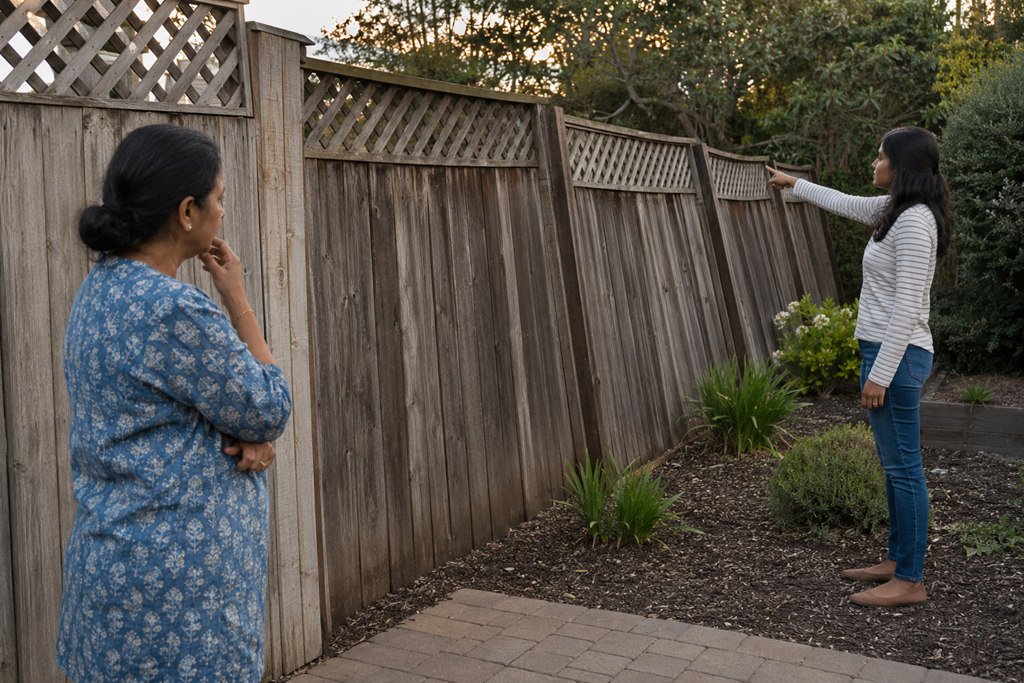
Fence wear is not one single problem. At Sacramento-area homes, fading, surface checking, loose boards, leaning sections, soft wood, rusted fasteners, and gates that no longer close cleanly can all look like “an old fence,” but they do not mean the same thing. The useful question is not simply how the fence looks. It is whether the wear is staying cosmetic or beginning to affect stability, alignment, privacy, or everyday use.
Many homeowners first notice fence wear gradually. A board looks more weathered than it used to. A gate needs an extra push. One panel appears slightly lower than the next. Because the change happens slowly, it can be difficult to tell whether the fence is aging normally, developing a limited repair need, or showing a broader pattern that deserves professional evaluation.
Weathered Does Not Automatically Mean Worn Out
Outdoor fencing is expected to change in appearance. Wood may fade, gray, develop small surface cracks, or show uneven coloring after years of exposure. Metal components can lose their original finish, and minor imperfections may become more visible under strong sunlight.
These changes can make a fence look older without necessarily preventing it from doing its job. A faded fence may still stand straight, remain firmly connected, provide privacy, and allow the gate to open and close normally.
Appearance becomes more meaningful when it is accompanied by movement, separation, softness, repeated breakage, or changes in how the fence functions. That is why evaluating fence wear solely by color or age can lead to unnecessary concern—or cause a more important problem to be overlooked.
The Pattern Often Matters More Than One Imperfection
A single damaged board does not always describe the condition of the entire fence. It may have been affected by an impact, isolated moisture exposure, plant growth, or ordinary material variation.
A repeating problem across several connected sections tells a different story. Examples might include multiple panels leaning in the same direction, several boards pulling away from their rails, or a fence line that becomes progressively lower near one area of the yard.
The location of the wear also matters. Damage near the bottom of several posts may suggest a different concern than light surface cracking near the tops of otherwise solid boards. A gate that repeatedly shifts out of alignment may point to movement around its supporting post rather than a problem with the latch alone.
Looking at the surrounding fence helps place one visible flaw in context.
Fence Wear Can Affect More Than Appearance
Fence wear generally becomes easier to understand when homeowners consider three separate questions:
Has the appearance changed?
Fading, discoloration, surface checking, minor warping, and isolated stains mainly change how a fence looks. These signs may still be worth discussing when appearance is important, but they do not automatically indicate that the fence is unstable.
Has everyday use changed?
A gate that drags, a latch that no longer lines up, a board that repeatedly comes loose, or a widening privacy gap affects how the fence performs. Functional changes often provide a clearer reason to investigate than appearance alone.
Has the fence line moved?
Leaning posts, sagging rails, separating connections, or movement across several panels may indicate that the concern extends beyond an individual board. These patterns are especially useful to point out when requesting a professional evaluation.
Keeping these questions separate can prevent a conversation about faded boards from becoming confused with a conversation about structural movement.
Small Changes Are Easy to Normalize
Fence wear often develops slowly enough that homeowners adjust to it without realizing how much has changed. Someone may begin lifting a gate slightly every time it closes or avoiding a loose section when working in the yard.
Because these workarounds become routine, the fence may seem usable even though its operation has changed.
Photographs taken from the same position at different times can help reveal whether a lean, gap, or sag is staying relatively consistent or becoming more noticeable. This does not diagnose the cause, but it can provide useful context when speaking with a fence professional.
It is also helpful to observe the top line of several connected panels rather than looking only at the most obvious damaged board. A repeating angle or gradual dip may be easier to recognize from farther away.
Different Parts of a Yard Can Age a Fence Differently
A fence does not always wear evenly from one end of the property to the other. One section may receive stronger afternoon sun, while another remains shaded by shrubs. Irrigation overspray may repeatedly reach a lower rail or post. Soil may stay damp near one part of the yard while another area remains dry.
Gates also experience repeated movement and weight that ordinary panels do not. A gate area may therefore show alignment problems even when the rest of the fence remains relatively straight.
These differences do not automatically identify the cause of the wear. They do, however, explain why replacing one visibly damaged board may not address a recurring problem if the surrounding conditions or supporting components are also involved.
A Repair Conversation Should Include the Surrounding Fence
When homeowners request an estimate, it is natural to focus attention on the most obvious defect. A useful evaluation should also consider how that defect relates to nearby posts, rails, panels, and gates.
For example, a broken board attached to solid rails and straight posts may represent a limited issue. The same broken board beside a leaning post and separating rail connections may be part of a larger pattern.
This does not mean the entire fence necessarily needs replacement. It means the scope of the problem should be understood before choosing the scope of the work.
A clear provider should be able to explain which parts are mainly cosmetic, which parts affect function, and which parts may be contributing to movement. The explanation should connect the proposed work to visible conditions rather than relying only on the fence’s estimated age.
Questions That Can Make an Estimate More Useful
Before approving fence work, Sacramento-area homeowners can ask:
- Is the visible damage limited to the boards, or are the posts and rails also affected?
- Is the fence still stable even though it looks weathered?
- What appears to be causing the gate or panel alignment problem?
- Would repairing this section leave nearby weak components in place?
- Which concerns are cosmetic, and which affect how the fence functions?
- What conditions could cause the same problem to return?
The answers should be understandable without requiring the homeowner to know construction terminology. When recommendations differ between providers, asking each one to identify the affected components can make the estimates easier to compare.
Wear Does Not Always Point to the Same Decision
One worn area may call for a limited board or hardware repair. Another may require work around a post, gate, or connected group of panels. A fence with widespread movement or deterioration may lead to a broader replacement discussion.
The right decision depends less on whether the fence looks old and more on where the wear is located, how widely it appears, and whether it is changing the fence’s stability or use.
By separating cosmetic aging from functional and structural changes, homeowners can describe the concern more clearly, ask better questions, and evaluate recommendations without assuming that every weathered fence needs the same solution.