Planning a door replacement around comfort and security means looking beyond the door’s appearance and asking how the entire entry performs in daily life. A Sacramento-area homeowner may want fewer drafts, smoother operation, better locking, or a stronger sense of separation from the outdoors, but those goals depend on the door, frame, threshold, weatherstripping, hardware, and installation working together.
This becomes easy to overlook when replacement shopping begins with colors, glass patterns, panel styles, or hardware finishes. Those choices matter, but they do not explain whether the new entry will close evenly, seal consistently, resist unwanted movement, or operate comfortably throughout normal household use.
A better plan begins by identifying what the current entry is not doing well and deciding which improvements matter most.
Comfort Problems Often Show Up During Ordinary Routines
Door-related comfort concerns are not always dramatic. They may appear as a narrow draft near the threshold, a room that feels warmer close to an exterior entry, outside noise entering around the frame, or a door that must be pushed firmly before the latch catches.
Homeowners sometimes adapt without realizing how much the entry affects the room. A chair may be moved away from the door. A towel may be placed against the bottom during certain weather. Family members may learn to pull the handle while turning the deadbolt. None of these habits automatically prove that full replacement is necessary, but they reveal what should be evaluated before selecting a new door.
For Sacramento-area properties, exposure may also differ from one entry to another. A west-facing door receiving strong afternoon sun can behave differently from a shaded side door or a rear entry protected by a covered patio. Comfort planning should reflect the actual location rather than relying only on a product description.
Security Depends on More Than Choosing a Strong Door
A solid door panel can be one part of a secure entry, but it does not work alone.
The lock must align properly with the strike opening. The frame must be in suitable condition. Hinges and hardware must operate as intended. The door should close without needing unusual pressure, and the surrounding components should support the way the entry is used.
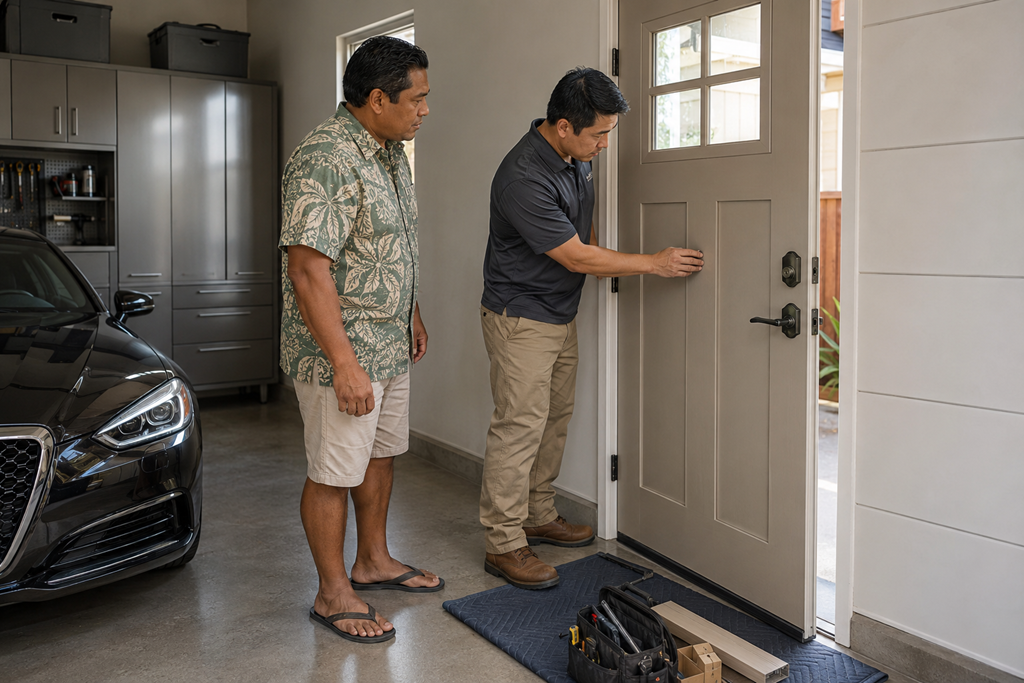
This is why a replacement conversation should include the whole opening. Installing a strong new door into a damaged, shifting, or poorly aligned frame may leave important concerns unresolved. In other situations, the existing frame may be serviceable, allowing the project scope to remain more limited.
A qualified door professional should be able to explain which parts of the entry affect security, which conditions are cosmetic, and which concerns may require a broader replacement scope.
Comfort and Security Can Point to the Same Underlying Issue
Comfort and security are often discussed as separate goals, but the same condition can affect both.
An uneven door may leave a gap that allows outdoor air to enter while also preventing the lock from engaging smoothly. A compressed or damaged seal may reduce comfort and make the door feel loose when closed. A worn threshold may create an air gap while contributing to inconsistent operation.
This does not mean every draft is a security problem or every sticking lock requires a new door. It means the symptoms should be evaluated together instead of assigning each one to an isolated component too quickly.
A homeowner who mentions only the draft may receive a different recommendation than one who explains that the door also shifts when latched. Describing the full pattern helps a professional evaluate the entry more accurately.
Start With the Experience You Want to Improve
Before comparing replacement options, it helps to define what better performance would look like in everyday terms.
For one household, the priority may be closing the door easily without pulling or pushing it into position. Another may care most about reducing the hot area near a sun-exposed entry. A family using a rear patio door repeatedly may place greater value on smooth operation and a durable threshold. Someone replacing a front entry may be especially concerned about lock alignment, visibility, glass placement, and how securely the door feels when closed.
These goals can guide product and scope discussions more effectively than beginning with a general request for the “best” door.
There is rarely one door that is automatically best for every opening. The more useful question is whether the proposed door, frame approach, hardware, glass configuration, and installation plan address the conditions at that particular entry.
The Frame and Opening Deserve Equal Attention
Homeowners naturally focus on the visible door panel. The surrounding opening receives less attention, even though it plays a major role in comfort, operation, and security.
A frame can be out of square, deteriorated in one area, separated from surrounding materials, or affected by earlier flooring and remodeling changes. The threshold may sit too high, too low, or unevenly against the bottom of the door. Existing trim can also hide conditions that are not obvious during a quick visual review.
An estimate should make clear whether the proposed work includes only the door panel, the door and frame as a complete unit, or additional work around the opening. Two quotes may appear to describe the same replacement while actually covering different amounts of labor and material.
Understanding that distinction helps homeowners compare proposals more fairly.
Product Features Cannot Correct Every Installation Problem
Energy-related ratings, upgraded locks, reinforced materials, and improved weatherstripping can all be useful considerations. However, product features do not compensate for poor fit or incomplete installation.
A door with promising performance features may still allow air movement if the frame is not set correctly or the seals do not make consistent contact. Expensive hardware may still operate poorly if the latch and strike are misaligned. Decorative glass may suit the home beautifully while creating privacy or visibility concerns the household did not consider beforehand.
The product and the installation should therefore be discussed as one plan. Homeowners should understand not only what is being installed, but how the professional will evaluate fit, alignment, sealing, operation, and final hardware function.
Decide Which Tradeoffs Fit the Household
Some door choices involve practical tradeoffs rather than simple right-or-wrong answers.
More glass can provide natural light, but the placement and visibility may affect privacy preferences. A heavier door may feel substantial, but household members still need to operate it comfortably. Certain materials may suit one exposure or maintenance preference better than another. Electronic lock features may be convenient, but the basic door alignment and locking function still need to work properly.
The household’s routines matter. Consider who uses the entry, how often it opens, whether children or older adults rely on it, whether pets pass through it, and whether the door connects to a busy walkway, garage, yard, or patio.
These details help turn a broad replacement decision into a plan based on actual use.
Questions That Can Improve the Estimate Conversation
A short group of focused questions can reveal whether a proposed replacement addresses both comfort and security:
- Does the quote cover the door panel only, or the frame and threshold as well?
- What existing conditions are contributing to the current draft, sticking, or lock problem?
- How will the new door’s fit and weather-seal contact be checked?
- Are the proposed hardware and glass choices appropriate for how this entry is used?
- What parts of the opening may require additional work once the existing materials are removed?
- How will final operation, latch alignment, and locking be tested before completion?
The answers should be specific enough to show how the recommendation relates to the property. Vague assurances that a particular door is simply stronger, more efficient, or higher quality do not explain whether it will solve the concerns at the opening.
Avoid Treating the Project as a Style Upgrade Alone
One common misunderstanding is assuming that replacing an older-looking door will automatically improve comfort and security. Age and appearance can support the decision, but they do not identify the cause of poor performance.
The opposite misunderstanding also occurs. A door may still look attractive while having repeated operational, sealing, frame, or hardware concerns that deserve evaluation.
Replacement planning works best when appearance is one consideration rather than the only consideration. A visually appealing result is more satisfying when the entry also closes smoothly, seals evenly, locks without extra pressure, and suits the household’s daily routines.
Compare Recommendations, Not Just Door Prices
When reviewing local door replacement estimates, homeowners should compare the reasoning behind each recommendation.
One provider may propose a complete prehung unit because the existing frame is damaged or misaligned. Another may determine that a narrower scope is reasonable. Differences like these are worth discussing rather than assuming one quote is automatically overpriced or incomplete.
Ask each provider to explain what was observed, what the proposed scope includes, and how the work addresses the comfort and security goals discussed during the visit. Clear explanations make it easier to distinguish a meaningful scope difference from a simple price difference.
A Better Door Plan Begins With the Whole Entry
Door replacement can improve the appearance of a home, but the more important everyday benefits often come from how the completed entry performs.
Sacramento homeowners can plan more effectively by describing the full pattern of concerns, considering how the entry is used, and asking providers to evaluate the door, frame, threshold, seals, and hardware together. That approach makes it easier to compare recommendations and select a replacement scope that supports both household comfort and practical security.