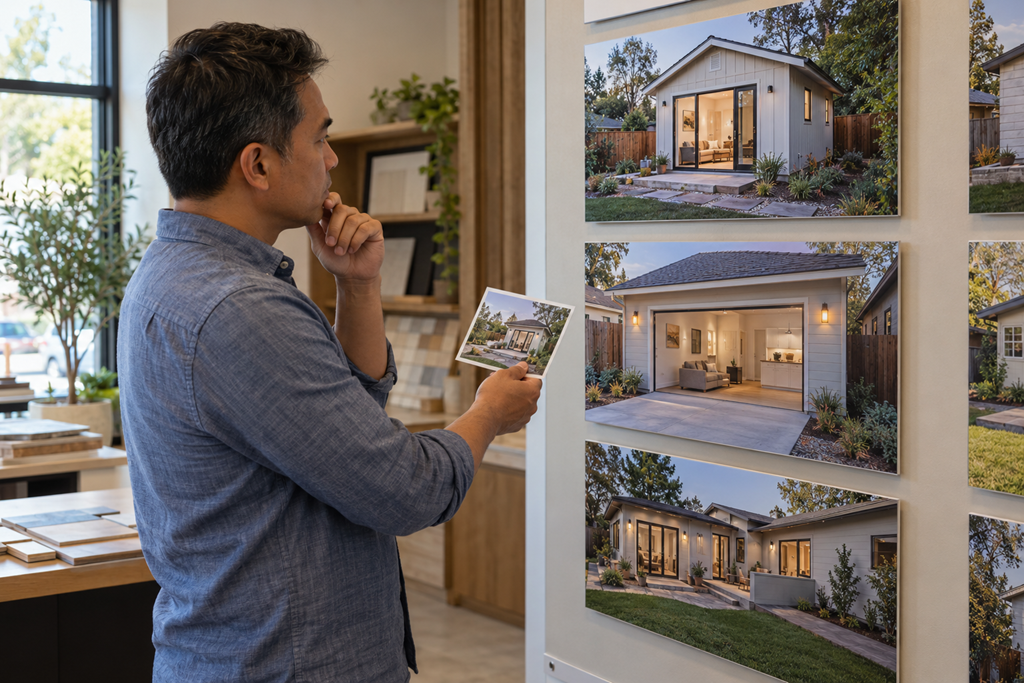
Building an accessory dwelling unit (ADU) can change how you use your property, accommodate family needs, or plan for the future. But choosing a contractor involves more than finding someone who can build a small home. Sacramento-area homeowners need to compare how contractors evaluate the property, define the project, explain responsibilities, prepare estimates, and manage the work. Understanding those differences before committing can help you identify a contractor whose approach fits your goals, property, and expectations.
ADU projects involve several connected decisions. A contractor may be comfortable constructing a straightforward detached unit but less experienced with garage conversions, challenging property access, or projects requiring substantial coordination before construction begins. Two contractors may also describe similar finished results while proposing different services, assumptions, and responsibilities.
That makes a simple price comparison less useful than it first appears.
The goal is not to become a construction expert before interviewing contractors. It is to recognize what a meaningful comparison looks like, understand where proposals may differ, and identify questions that deserve answers before you sign an agreement.
Start by identifying the ADU project you want contractors to evaluate
Before comparing contractors, establish a reasonably consistent description of what you hope to build.
You do not need finished architectural plans to begin exploring your options. However, contractors cannot provide equally meaningful preliminary recommendations when they are working from substantially different assumptions.
Clarify the intended use
Think about why you want the ADU and how you expect it to function.
For example, you may be considering:
- A detached unit for a family member who wants more independence.
- A conversion of an existing garage or other potentially suitable space.
- An attached unit that provides additional living accommodations.
- A separate living space that may accommodate changing household needs.
- An ADU intended for possible rental use, subject to applicable requirements.
The intended use may influence layout preferences, accessibility considerations, privacy, available outdoor space, and how the unit relates to the main residence.
These preferences are useful when discussing a project, even if some details remain undecided.
Identify what you already know about the property
A contractor's preliminary assessment may depend on more than available square footage.
Property considerations can include:
- The location and condition of existing structures.
- Access from the street to the proposed construction area.
- Utility locations and potential connection requirements.
- The relationship between the proposed ADU and the main residence.
- Drainage, grading, and other site conditions.
- Existing landscaping, fencing, and outdoor features.
- Space needed for construction equipment and material deliveries.
You are not expected to determine whether the property meets every applicable requirement.
Instead, give each contractor the same basic information and ask what needs to be evaluated before the proposed work can be considered feasible.
A useful starting question: "Based on what you know so far, what parts of this ADU proposal can you evaluate now, and what still needs professional assessment?"
A contractor who distinguishes preliminary possibilities from confirmed project conditions gives you a more useful basis for comparison than one who treats every early assumption as settled.
Compare experience with your particular type of ADU
General construction experience matters, but experience with the kind of ADU you are planning may be more informative.
A contractor who regularly handles detached new construction may approach a garage conversion differently from a contractor whose work primarily involves modifications to existing structures.
Neither background automatically makes someone unsuitable. The important question is how closely their experience matches the work being considered.
Ask for relevant project examples
Rather than requesting a general portfolio, ask about completed projects with characteristics similar to yours.
Consider whether the examples demonstrate:
- The same general ADU type.
- Similar property or access constraints.
- Experience coordinating design and construction.
- Work involving existing buildings, when relevant.
- Comparable levels of project complexity.
Photographs can help you evaluate workmanship and design preferences, but finished photographs rarely explain what happened during planning, how responsibilities were divided, or how unexpected conditions were handled.
Ask contractors to explain those parts of the project as well.
For example:
"What were the main challenges with a similar ADU project, and how were they addressed?"
A useful answer should demonstrate familiarity with the process without suggesting that your project will have exactly the same conditions or outcome.
Distinguish ADU experience from broad remodeling experience
Someone who performs kitchen renovations or general residential construction may have transferable skills. However, a complete ADU can involve a different combination of design coordination, utility considerations, approvals, construction stages, and final project completion responsibilities.
Find out which parts of an ADU project the contractor has actually managed.
A contractor may have experience performing construction under plans prepared and approved by others without offering the broader planning coordination you need.
That distinction can affect both the services you receive and the responsibilities you retain.
Understand what each contractor is actually offering
One of the most important ADU contractor comparisons involves service boundaries.
Two businesses may both advertise ADU construction while offering significantly different levels of project involvement.
Design-build versus construction-focused services
A design-build company may coordinate design and construction through a more integrated process.
A construction-focused contractor may expect the homeowner to obtain architectural or design services separately before entering the construction phase.
Other businesses may use outside designers, engineers, consultants, or subcontractors while coordinating some aspects of the process internally.
These arrangements can all be appropriate, depending on the project.
What matters is whether you understand who will perform and coordinate each responsibility.
Project responsibility | What to clarify |
|---|---|
Initial property evaluation | Who evaluates whether the proposed project appears practical? |
Design development | Is design included, coordinated, or handled separately? |
Engineering | Who determines when specialized engineering is needed and arranges it? |
Permit coordination | Who prepares, submits, tracks, and responds to required permit materials? |
Utility coordination | Who identifies possible connection needs and manages related coordination? |
Construction management | Who schedules trades, oversees work, and communicates progress? |
Inspections and completion | Who coordinates required inspections and explains project closeout? |
This is not a list of services every contractor must provide. It is a way to identify differences between their proposals.
Look for gaps between project stages
A contractor may offer a preliminary design discussion without including complete design documents.
Another may provide a construction estimate based on plans that someone else must prepare.
A third may coordinate most of the work but exclude certain utility-related services or outside professional fees.
If these differences are not identified early, you may believe you are comparing complete project proposals when you are actually comparing different portions of the project.
Ask each contractor to describe the work from your first agreement through the point at which its contractual responsibilities end.
A useful comparison question: "Which parts of this ADU project would your company be directly responsible for, and which parts would I need to arrange separately?"
Evaluate how contractors investigate the property
An ADU proposal depends partly on what can be reasonably established about the property before construction.
A contractor should be able to explain the difference between what appears possible and what has been verified through appropriate review.
What an early property visit can establish
An initial site visit may help a contractor understand the desired location, general access, existing improvements, and possible project complications.
It does not necessarily establish that every element of the proposed ADU is permissible, practical, or fully priced.
The scope of the visit matters.
One contractor may offer a brief preliminary consultation. Another may provide a more detailed assessment that involves additional professionals or a separate paid planning phase.
Neither approach should automatically be considered better.
Compare what each assessment is intended to accomplish and whether its conclusions will be useful for your next decision.
Why assumptions about utilities deserve attention
Utility work can be a meaningful source of uncertainty in ADU planning.
The project may require evaluation of electrical service, water supply, wastewater connections, or other existing infrastructure.
The extent of work cannot be assumed simply because utilities already serve the main residence.
When reviewing contractors, ask:
- Have you identified the utility conditions that need further review?
- What information is still missing?
- Would outside utility providers or other professionals need to participate?
- How would discoveries about utility requirements affect the proposed scope?
- Are potential utility-related expenses included, estimated separately, or not yet determined?
You do not need to know the technical solution.
You need to understand whether the contractor recognizes the uncertainty and has a reasonable process for evaluating it.
Consider access and disruption
A Sacramento-area property with limited side-yard access may present different construction logistics from a property with a straightforward route to the proposed building area.
Ask how contractors evaluate material deliveries, equipment movement, temporary access arrangements, and protection of existing property features.
Also ask what the household should reasonably expect during construction.
For a homeowner planning to remain in the main residence, communication about parking, noise, access restrictions, and use of outdoor areas can be just as important as the proposed building itself.
Learn why preliminary ADU estimates can differ
Contractors may provide different numbers for an apparently similar ADU because their estimates use different assumptions or cover different stages of the project.
The price alone does not tell you which proposal offers better value.
Separate a preliminary budget from a defined construction proposal
Early budget discussions can help homeowners decide whether further planning makes sense.
However, a preliminary budget based on general dimensions and design preferences is not necessarily comparable to a construction proposal developed from detailed project information.
Before treating any amount as reliable for decision-making, establish its purpose.
Ask whether the estimate reflects:
- A broad preliminary budget.
- An assumed layout and level of finishes.
- Existing plans or preliminary drawings.
- Identified site conditions.
- A more developed scope supported by further evaluation.
The more unresolved information a proposal contains, the more important it becomes to understand its limitations.
Compare what is included and excluded
A lower estimate may omit responsibilities that another proposal includes.
Differences might involve design services, site preparation, utility work, finish selections, outside professional services, or other project components.
The exact comparison depends on the project.
Do not assume every expense should be included in one contract. Instead, determine which costs each proposal covers and which remain outside it.
Consider this illustrative situation:
Contractor A offers a preliminary construction figure that assumes completed design documents and excludes certain site-related work.
Contractor B offers a broader planning and construction arrangement covering additional coordination and identified project components.
Even if Contractor A initially appears less expensive, the difference may reflect scope rather than efficiency.
The homeowner needs to compare the full responsibilities and anticipated remaining expenses before drawing a conclusion.
Examine allowances and selections
Some proposals may use allowances for materials or finishes that have not been chosen.
An allowance is generally a budgeted amount associated with an item or category that remains to be finalized.
Ask which selections are based on actual specifications and which are provisional.
For example, cabinetry, flooring, fixtures, and other finishes can differ in quality, appearance, availability, and cost.
A proposal using basic assumed selections may not be directly comparable to one that reflects more developed preferences.
The most useful estimate is not necessarily the one with the most detail or the lowest amount. It is the one whose scope, assumptions, and unresolved costs you can clearly understand.
Compare how contractors approach planning and scheduling
ADU construction is a sequence of connected activities, not one continuous building task.
Depending on the arrangement, planning, professional evaluations, design, approvals, purchasing, construction, inspections, and closeout may involve different people.
A contractor's explanation of that sequence can reveal how the business manages expectations.
Ask what must happen before construction begins
A contractor may describe an anticipated construction duration without including the planning and approval work that must occur beforehand.
Ask for a clear distinction between the phases.
Useful questions include:
- What must be completed before construction can be scheduled?
- Which steps depend on outside professionals or agencies?
- What decisions must the homeowner make during planning?
- When are finish selections or other material decisions needed?
- Which schedule assumptions have not yet been confirmed?
A knowledgeable contractor should be able to describe the general sequence without promising that every step will take a particular amount of time.
Look for realistic explanations of uncertainty
Weather, materials, design revisions, site discoveries, inspections, and coordination with others can affect construction schedules.
No contractor can eliminate every source of uncertainty.
What you are comparing is how each contractor discusses foreseeable dependencies, monitors progress, and communicates changes.
Ask how schedule updates are delivered and when the homeowner would be informed about a material change.
A specific communication process is more useful than a broad promise that the project will run smoothly.
Review the people and responsibilities behind the proposal
A contractor's sales presentation may not fully represent the people who will manage the project after an agreement is signed.
This is particularly important when comparing businesses with different operating structures.
Find out who will manage day-to-day construction
Ask who will serve as your primary contact once work begins.
Will that person be a company owner, project manager, superintendent, or another designated representative?
Clarify:
- Who handles routine homeowner questions.
- Who coordinates subcontractors.
- Who makes day-to-day scheduling decisions.
- Who explains unexpected site conditions.
- Who communicates proposed changes involving cost or scope.
- How concerns are escalated when they cannot be resolved immediately.
A larger company is not automatically better organized than a smaller one. Likewise, direct owner involvement does not guarantee more effective communication.
Evaluate the actual management arrangement rather than the business's size.
Verify qualifications rather than relying on presentation
Professional-looking websites, attractive project photographs, and favorable reviews can contribute to your initial assessment, but they should not replace verification.
For contractors working on Sacramento-area projects, independently review relevant licensing information and ask about insurance coverage and the qualifications appropriate to the proposed work.
The California Contractors State License Board provides resources for checking contractor license information and understanding contractor-related consumer protections.
Verify that the information applies to the business and work you are considering. Ask about relevant coverage and obtain documentation where appropriate.
Reviews and references can then help you evaluate matters such as communication, responsiveness, project management, and follow-through.
When possible, ask references about projects that resemble your intended ADU rather than relying only on general satisfaction comments.
Look closely at how project changes will be handled
ADU proposals often begin while some design details, selections, or property conditions remain unresolved.
That makes change management an important part of contractor selection.
Understand the difference between a decision and a change
Before construction, a homeowner may still be choosing finishes or refining design preferences.
After a scope has been agreed upon, changes to the design, materials, or work may have consequences for cost and scheduling.
Unforeseen site conditions can also create a need to reconsider the agreed scope.
Ask each contractor how it distinguishes ordinary decisions within the original agreement from work that requires additional approval.
Ask for the change approval process
A useful process should make it clear how proposed changes are described, evaluated, authorized, and documented.
Questions worth asking include:
- How will I learn that a scope change is being proposed?
- Will the cost and potential schedule effects be explained before I approve it?
- Who has authority to authorize additional work?
- How will changes be reflected in project records?
- What happens when an unexpected condition requires further professional evaluation?
A contractor's willingness to explain this process before a project begins can help you understand how the working relationship may function when conditions change.
Be cautious about vague assurances that unexpected work can simply be sorted out later.
Build a comparison that reflects the whole project
After initial conversations, you may have several proposals containing different amounts of detail.
Instead of ranking them immediately by price, organize what you have learned into consistent comparison categories.
A simple comparison worksheet can help identify differences that deserve follow-up.
Comparison factor | Contractor A | Contractor B | Contractor C |
|---|---|---|---|
Experience with your ADU type | |||
Services included | |||
Property assessment completed | |||
Unresolved site or utility questions | |||
Estimate basis and exclusions | |||
Planning and scheduling explanation | |||
Project management contact | |||
Change approval process | |||
License and insurance verification | |||
Relevant references reviewed |
You do not need to give every factor a numerical score.
The worksheet is meant to reveal missing information and meaningful differences, not manufacture a ranking.
Compare contractors using the same follow-up questions
If one contractor identifies a possible utility concern that the others have not discussed, that does not automatically mean the first contractor is better or that the others overlooked it.
The issue may not have been evaluated yet.
Bring the concern to the other contractors and ask how they would assess it.
Similarly, if one proposal contains a broader scope, ask the others whether they offer those services or expect someone else to provide them.
This is how a comparison becomes progressively more useful: you establish common questions instead of comparing incomplete assumptions.
Recognize when proposals are not ready for comparison
Sometimes, the appropriate next step is not choosing a contractor.
It may be obtaining more detailed information about the property, clarifying the intended ADU, or completing a preliminary design or feasibility phase.
When too many basic project conditions remain unknown, selecting a construction proposal prematurely can create avoidable confusion.
A contractor who recommends additional evaluation before offering a more definitive proposal may be exercising reasonable professional judgment.
The important distinction is whether the recommended evaluation has a clear purpose, deliverables, responsibilities, and associated terms.
Recognize warning signs before committing
No single interaction proves that a contractor will perform poorly.
However, certain patterns deserve additional questions or an independent comparison.
Pay attention when a contractor:
- Offers strong assurances about project feasibility without explaining what has been evaluated.
- Provides a price without reasonably describing its scope or assumptions.
- Cannot explain which services the business will perform and which are excluded.
- Dismisses questions about utilities, access, approvals, or other relevant property conditions.
- Gives schedule promises without acknowledging steps involving outside parties.
- Is unwilling to identify who will manage the work.
- Cannot explain how additional work or project changes will be approved.
- Pressures you to sign before you can review the proposed agreement.
- Resists reasonable requests for licensing, insurance, or relevant experience information.
One vague answer may simply call for clarification.
Repeated evasiveness, inconsistent explanations, or pressure to make a substantial commitment without adequate documentation can be reasons to slow down.
You are evaluating whether the contractor's process is understandable and dependable enough for a project involving significant property changes.
Know what should be clear before you sign
The final comparison stage is about determining whether you understand the agreement you are considering.
The contract should reflect the particular project and the services being purchased, rather than relying on assumptions formed during early conversations.
Before signing, make sure you can identify:
- The agreed scope: What work and services are actually being provided?
- The project documents: Which plans, specifications, and other materials define the work?
- The responsibilities: What will the contractor coordinate, and what remains with you or other professionals?
- The financial terms: How are the contract price, payment provisions, allowances, exclusions, and changes described?
- The scheduling expectations: What project stages or milestones are identified, and what dependencies remain?
- The communication process: Who is responsible for updates and issue resolution?
- The completion process: How are inspections, outstanding items, documentation, and any applicable warranties addressed?
These are review topics, not substitutes for applicable contract requirements or individualized legal advice.
A substantial or unclear agreement may warrant review by a qualified professional before signing.
Also distinguish between committing to a limited preliminary planning service and committing to an entire construction project. Those agreements may involve different deliverables, costs, and obligations.
Make sure you understand which commitment is actually being requested.
Make your final decision around fit, scope, and accountability
Comparing ADU contractors is not about identifying the most persuasive presentation or the lowest preliminary number.
It is about finding a contractor whose relevant experience, proposed services, evaluation process, communication, and documented responsibilities fit the project you intend to pursue.
A strong candidate should help you understand what has been established, what still requires evaluation, who will handle each stage, and how important decisions will be managed.
If one proposal seems attractive but leaves major uncertainties unanswered, request clarification before committing. If the contractors are working from different assumptions, bring the comparison back to a consistent scope.
For Sacramento-area homeowners, that approach turns contractor selection into a more informed decision about the entire working relationship—not just the finished ADU.