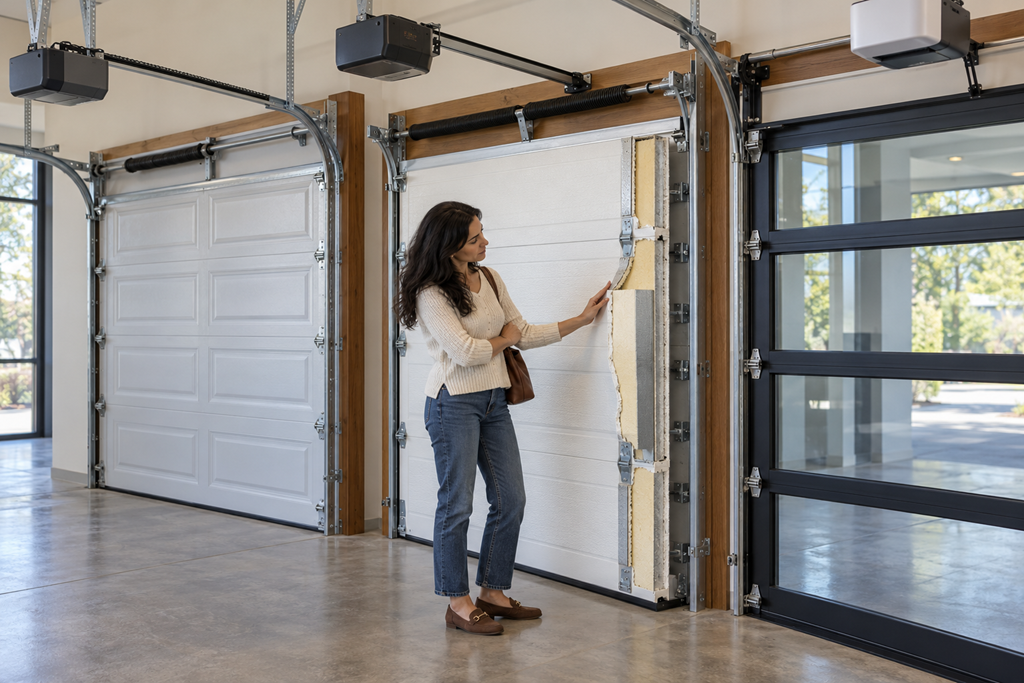
Choosing a new garage door involves more than finding a style that looks good from the street. The door material affects durability, maintenance, appearance, and weight. Insulation can influence comfort and temperature conditions inside the garage, while the opener affects everyday convenience, noise, and how the door operates. For Sacramento-area homeowners, understanding how these choices work together can make it easier to compare recommendations, recognize meaningful differences between quotes, and select a garage door system that fits the property and household.
A garage door is a combination of components that must work together. A particular door material may offer the appearance you want but require more upkeep. A heavily insulated door may be appealing, but its value depends partly on how the garage is used. An opener may offer convenient features, yet those features matter less if the equipment is not properly matched to the door.
The goal is not to purchase the most expensive material, the highest insulation rating, or the opener with the longest feature list. It is to understand which characteristics matter for your garage and which differences are worth discussing with a qualified garage door professional.
Start with how your garage is actually used
Before comparing products, consider what the garage needs to do for your household.
Two garages with similar dimensions may have very different priorities. One might be used primarily for parking, while another also serves as a laundry area, hobby space, storage room, or regular household entryway.
These differences can influence which door characteristics deserve the most attention.
A garage used mainly for parking
If your garage primarily protects vehicles and stores occasional household items, you may place greater importance on durability, dependable operation, appearance, and reasonable maintenance.
Insulation may still be worth considering, particularly where the garage receives substantial sun exposure or shares walls with living spaces. However, the benefits should be evaluated against the garage's actual construction and use.
A garage used for projects or frequent activities
A garage used for exercise, hobbies, household projects, or other regular activities may benefit from additional attention to temperature conditions, door construction, and operating noise.
An insulated door can help reduce heat transfer through the door itself, but it does not necessarily make the garage comfortable throughout the year.
Windows, walls, ventilation, air leaks, and other building characteristics also affect the space.
A garage attached to the house
An attached garage may require different considerations from a detached garage.
For example, noise from the opener may be more noticeable in nearby bedrooms or living areas. Temperature conditions in the garage may also influence adjacent spaces, depending on the building's construction.
If household members frequently enter and exit through the garage, reliable operation and convenient access features may deserve additional attention.
The useful starting point is to identify the garage's most important functions before deciding which product features are worth paying for.
Compare garage door materials by durability, appearance, and upkeep
The material you choose influences more than the door's appearance. It can affect weight, resistance to dents or moisture, maintenance requirements, available designs, and the overall installed system.
Several materials are commonly considered for residential garage doors, but each involves tradeoffs.
Steel: versatile with a wide range of construction options
Steel is a common residential garage door material because it is available in numerous styles, finishes, and construction types.
Depending on the product, steel doors may be available with insulation, decorative finishes, or designs intended to resemble traditional wood doors.
Potential advantages include:
- A broad selection of appearances and construction options.
- Availability of insulated and non-insulated designs.
- Finishes that can fit different architectural styles.
- Maintenance needs that may be manageable when the finish remains in good condition.
However, not all steel doors have the same durability.
Thin or lightly constructed panels may dent more readily than stronger alternatives. Scratches or damaged finishes can also expose areas to corrosion, particularly when moisture reaches unprotected metal.
When comparing steel doors, ask about panel construction, thickness, reinforcement, protective finishes, and warranty coverage rather than treating all steel products as equivalent.
Aluminum: lighter construction with different durability considerations
Aluminum garage doors are often considered when homeowners want a lightweight material or a contemporary appearance.
Some designs incorporate glass panels, creating a modern look with additional natural light.
Aluminum generally resists rust in the same way steel does not, although its finishes and components can still require care.
The tradeoff is that certain aluminum panels may be more susceptible to denting, depending on their construction.
Glass-heavy designs also introduce considerations involving privacy, sunlight, heat transfer, and panel replacement.
For a Sacramento-area home with substantial afternoon sun exposure, the type of glass and the door's insulation characteristics may deserve particular attention.
Wood: natural appearance with ongoing maintenance needs
Wood garage doors offer natural grain, texture, and design possibilities that some homeowners prefer over manufactured finishes.
They may be appropriate when appearance and architectural compatibility are major priorities.
However, wood typically requires more attention to its finish and condition.
Exposure to sunlight, moisture, and changing temperatures can affect wood over time. Depending on the product, maintenance may involve periodic inspection, refinishing, or other protective care.
Wood doors can also be relatively heavy, making professional evaluation of the supporting hardware and opener especially important.
Homeowners considering wood should ask what maintenance the manufacturer recommends and how the door's construction influences long-term performance.
Composite and fiberglass: alternatives worth examining closely
Composite and fiberglass products may offer wood-like appearances or other design characteristics without using traditional solid-wood construction.
However, these categories contain different formulations and manufacturing methods.
A composite door made with engineered materials may have very different properties from a fiberglass-faced door.
Resistance to moisture, impact, sunlight, surface fading, and temperature changes can vary by product.
Instead of assuming that these materials are automatically lower-maintenance or more durable, ask about the specific construction and finish.
A practical material comparison
Material | Potential advantages | Tradeoffs to examine |
|---|---|---|
Steel | Wide style selection, insulated options, varied construction | Dents, finish damage, corrosion protection |
Aluminum | Lightweight, contemporary designs, rust resistance | Dents, glazing performance, privacy |
Wood | Natural appearance, customization possibilities | Maintenance, finish exposure, weight |
Composite | Wood-like options, varied engineered construction | Product-specific durability, finish care |
Fiberglass | Certain lightweight and decorative designs | Impact resistance, aging, product-specific limitations |
These are general characteristics rather than guarantees. Construction quality, finish, insulation, installation, and exposure conditions can create important differences within the same material category.
Understand what garage door insulation can and cannot do
Insulation is sometimes presented as a simple upgrade: choose a higher rating and get a better garage door.
The actual decision is more nuanced.
A door's insulation can influence heat transfer, but the effect on the entire garage depends on much more than the door alone.
What the R-value tells you
An R-value describes a material or assembly's resistance to heat flow. Higher values generally indicate greater resistance.
However, garage door insulation ratings should be compared carefully.
Manufacturers may describe insulation performance using different testing or reporting approaches. A rating for the insulating material alone is not necessarily equivalent to a rating for an entire door assembly.
A higher reported R-value also does not automatically mean the garage will maintain a particular temperature.
When comparing products, ask whether the stated rating describes the insulation material, the door panel, or the complete assembly.
Single-layer, double-layer, and three-layer construction
Garage doors are often described by their construction layers.
Single-layer doors generally use one primary panel layer without a substantial insulated core. They may offer simpler construction but less resistance to heat transfer.
Double-layer doors commonly combine an exterior panel with insulation or an insulating backing. Their construction varies, so the presence of insulation does not establish the door's overall durability.
Three-layer doors typically sandwich insulation between exterior and interior panel skins. Depending on the materials and engineering, this construction may provide improved rigidity and a more finished interior appearance.
The number of layers is useful information, but it does not replace reviewing the actual specifications.
For instance, two three-layer steel doors may differ in insulation thickness, panel strength, seals, and thermal performance.
Insulation material also matters
Two common insulation materials used in garage doors are polystyrene and polyurethane.
Polystyrene is often installed as formed insulating panels or inserts. Polyurethane may be applied as foam that fills the space between door skins and bonds to surrounding surfaces.
Different constructions can influence insulation performance, panel rigidity, and available thickness.
Neither term, by itself, tells you everything about a door's performance.
Ask the installer to explain the construction of the specific models being compared.
When insulation may provide meaningful value
Insulation may deserve greater consideration when:
- The garage shares walls or ceilings with conditioned living spaces.
- Household members spend meaningful time working or exercising in the garage.
- The garage door receives substantial direct sunlight.
- You want a door with a more substantial panel construction.
- Noise reduction is a priority, and the proposed insulated construction may help.
Insulation can sometimes reduce how much outside noise passes through the door. However, it should not be treated as complete soundproofing.
When a higher rating may offer limited additional benefit
An unconditioned garage with poorly insulated walls, significant air leakage, or substantial window exposure may not benefit from a higher-rated garage door as much as a homeowner expects.
If the garage is rarely occupied, paying for the highest available insulation rating may not align with household priorities.
This does not make insulation unnecessary. It means the incremental benefit should be considered alongside the garage's construction and use.
A useful question is not simply, "Which door has the highest R-value?" It is, "What practical difference should I expect from this insulation option in my garage?"
Look beyond insulation to the rest of the door assembly
A garage door's performance depends on more than its primary panels.
Seals, glazing, panel connections, hardware, and overall fit can influence daily use and the condition of the garage.
Weather seals and gaps
Weather sealing around the door can help limit drafts, dust, water intrusion, and unwanted outdoor air movement.
Common sealing areas include the bottom edge, sides, and top of the door.
Actual performance depends on the condition and compatibility of the seals, the door's alignment, and the surrounding opening.
Even a well-insulated door can allow significant air movement when substantial gaps remain.
Ask whether the proposed installation includes appropriate new seals and whether the existing opening presents any limitations.
Windows and decorative glazing
Garage door windows may improve appearance and admit natural light, but they introduce additional considerations.
Window placement can affect privacy. Glazing choices can influence solar heat gain and insulation performance.
For doors exposed to strong sunlight, ask what glazing options are available and how they affect the proposed door's thermal characteristics.
Decorative windows should be evaluated as part of the complete door design rather than as an isolated appearance upgrade.
Door weight, springs, and supporting components
Material choices and insulation can change the door's weight.
Garage door springs, tracks, rollers, brackets, and related components must be appropriate for the selected door.
The opener is not intended to compensate for a poorly balanced or incorrectly supported garage door.
Spring systems and other high-tension components can cause serious injuries if handled improperly. Their selection, adjustment, and replacement should be left to qualified professionals.
When evaluating a new door, confirm whether the quote includes the necessary hardware and professional system setup.
Compare opener types based on noise, operation, and garage layout
Garage door openers are often marketed through features such as quiet operation, connected controls, or different drive mechanisms.
These distinctions matter, but the right choice depends on the door, garage layout, and household routines.
Belt-drive openers
Belt-drive openers use a reinforced belt to move the door through the opener system.
They are often considered when reduced operating noise is important.
They may be particularly appealing for attached garages near frequently occupied living spaces.
However, total noise depends on the condition of the door, rollers, tracks, and installation—not just the drive mechanism.
A belt-drive opener cannot eliminate sounds caused by worn or improperly adjusted door components.
Chain-drive openers
Chain-drive openers use a metal chain as part of the drive system.
They are a familiar option and may be worth considering when homeowners prioritize a conventional mechanical design.
Depending on the model and installation, chain-drive systems can produce more mechanical noise than comparable belt-drive systems.
That difference may matter less in a detached garage or a location where sound transmission into the home is limited.
When comparing chain-drive models, review the specific equipment rather than assuming all operate identically.
Screw-drive and other configurations
Some openers use screw-drive mechanisms or other specialized designs.
These may have different operating characteristics, maintenance considerations, or installation requirements.
Availability and manufacturer support can vary.
Homeowners considering less common systems should ask about serviceability, replacement parts, warranty support, and whether the installer regularly works with that equipment.
Wall-mounted openers
Wall-mounted openers, sometimes called jackshaft openers, use a different arrangement from conventional ceiling-mounted trolley systems.
They can free up ceiling space that would otherwise be occupied by a central opener rail.
This may be attractive when homeowners need overhead storage clearance or have particular ceiling configurations.
However, wall-mounted systems are not compatible with every garage door setup.
Their use depends on the door's design, counterbalance system, available mounting space, and manufacturer requirements.
A professional should verify compatibility before recommending one.
Opener type comparison
Opener type | Main consideration | What to clarify |
|---|---|---|
Belt-drive | Reduced operating noise | Door compatibility, actual noise sources, warranty |
Chain-drive | Conventional drive system | Mechanical noise, maintenance, model quality |
Screw-drive | Alternative mechanical design | Service requirements, parts support, compatibility |
Wall-mounted | More available ceiling space | Door configuration, mounting requirements, overall cost |
These descriptions are starting points. A properly installed system should be evaluated as a complete operating arrangement.
Understand which opener features are useful and which are optional
Beyond the drive mechanism, openers may offer convenience features that vary by manufacturer and model.
These features can be valuable, but their importance depends on how the household uses the garage.
Battery backup
A battery backup can allow a compatible opener to operate during certain electrical power interruptions, subject to battery condition and system limitations.
For households that regularly use the garage as an entry point, this feature may be worth reviewing.
Ask whether backup capability is included, how battery replacement works, and what operating limitations apply.
Smartphone connectivity
Some openers allow homeowners to monitor or control their garage door through a connected application.
Depending on the system, features may include remote status checks, notifications, and control options.
Before selecting a connected opener, ask about device compatibility, internet requirements, access permissions, ongoing service dependencies, and privacy settings.
A connected feature should support your routine rather than create unnecessary complexity.
Lighting and operating controls
Openers may include integrated lighting, motion-activated illumination, multiple remotes, wireless keypads, or additional wall controls.
For some households, these features improve daily convenience.
For others, they are secondary to dependable operation.
Ask which controls come with the quoted system and which require separate purchases.
Safety and security features
Modern residential garage door openers commonly incorporate features intended to help prevent entrapment, including automatic reversal and monitored photoelectric sensors.
These functions are not optional conveniences to trade away for a lower price.
A qualified installer should verify that the selected system meets applicable safety requirements and that its protective functions operate as intended.
Other security-related features, such as rolling-code remote technology, access controls, and door monitoring, may also vary by model.
When discussing these features, distinguish between required protective functions and additional convenience or security options.
Make sure the door and opener are compatible
A homeowner may select an attractive insulated door and a feature-rich opener without realizing that compatibility is a separate decision.
The two products must work together as a system.
Door size and weight
Garage doors vary in dimensions and weight.
Material, insulation, decorative elements, and construction can affect the weight of the completed door.
The selected opener must be appropriate for the door configuration and manufacturer specifications.
An opener advertised as powerful is not necessarily suitable for every door.
The installer should evaluate the door's weight, balance, hardware, and operating requirements.
Garage ceiling and available space
The garage layout can limit opener choices.
Factors may include:
- Available headroom above the door.
- Ceiling height and overhead obstructions.
- Existing storage systems or ceiling-mounted equipment.
- Side clearance near the door.
- Track configuration and required operating space.
A wall-mounted opener may solve one space problem while introducing other compatibility requirements.
Similarly, a conventional overhead opener may be entirely appropriate when ceiling space is not a concern.
Existing equipment and reuse
If you are replacing only the garage door, ask whether the existing opener can remain in use.
If you are replacing only the opener, ask whether the door and its existing components are suitable for continued operation.
Reusing equipment can sometimes reduce project scope, but compatibility, age, condition, and safety must be considered.
Avoid assuming that an older opener will automatically work properly with a heavier replacement door.
The installer should explain which components can remain and why.
Compare combinations rather than individual upgrades
One of the more useful ways to shop for a garage door system is to compare complete combinations.
A higher-priced door may include heavier-duty construction, additional insulation, decorative features, or different hardware. Another option may prioritize basic function and easier maintenance.
Neither is automatically the better choice.
For example, consider three illustrative approaches.
An appearance-focused combination
A homeowner may prefer a wood or wood-look door that complements the house.
The comparison would emphasize exterior appearance, finish durability, maintenance expectations, construction weight, and the equipment needed to operate it.
An insulated steel door with a wood-look finish might be worth comparing with traditional wood.
The deciding factors may be less about appearance alone and more about the balance between desired design and ongoing upkeep.
A comfort-focused combination
A household using the garage frequently may prioritize insulated door construction, effective weather seals, and reduced operating noise.
In that situation, a multi-layer insulated door paired with a compatible quiet-running opener may deserve consideration.
However, the homeowner should still ask how surrounding walls, windows, and garage conditions affect the expected benefit.
A practical everyday-use combination
Another household may primarily want an attractive, dependable door with straightforward maintenance and convenient access.
A suitably constructed steel door and compatible opener may meet those needs without every optional feature.
This can be a sensible direction when additional upgrades provide limited value for the household's actual use.
These examples are not fixed packages or product recommendations. They illustrate why comparing complete systems is more useful than selecting each feature independently.
Understand what changes the installed cost
Garage door estimates can vary substantially in scope, even when the doors appear similar.
The total project may involve materials, installation labor, hardware, removal work, opener equipment, and adjustments to the existing setup.
Door-related cost factors
The selected material, panel construction, insulation, dimensions, finish, and decorative options can all influence pricing.
Custom sizes or designs may involve different production or installation requirements from standard products.
Windows and specialized finishes may also change the overall cost.
A higher-priced door may include features that are relevant to your needs, but those features should be identified rather than assumed.
Opener-related cost factors
Opener type, compatibility, controls, backup features, connectivity, and installation conditions can affect the quoted amount.
Replacing an opener within a compatible existing arrangement may involve different work from changing the opener configuration or addressing related door-system issues.
Installation and existing conditions
The condition of the current door and garage opening can also affect the project.
A provider may need to address worn hardware, incompatible tracks, damaged surrounding materials, or clearance limitations.
Not every condition is visible until the installation is evaluated.
Ask what the provider has inspected and which possible additional charges remain uncertain.
A clear estimate should distinguish the proposed products from the work required to install them.
Review garage door estimates as complete system proposals
When receiving quotes from Sacramento-area garage door companies, compare what each proposal actually includes.
Two companies may both describe a steel insulated door with a belt-drive opener, yet their recommendations can involve substantially different products and installation scopes.
A useful written comparison should identify:
- Door specifications: Manufacturer, model, dimensions, material, panel construction, insulation rating, finish, and window options.
- Opener specifications: Manufacturer, model, drive type, compatible door application, safety features, backup capability, and included controls.
- Hardware: Whether tracks, springs, rollers, cables, seals, and related components are being replaced or retained.
- Installation scope: Removal of existing equipment, disposal, installation, adjustment, and operational testing.
- Additional work: Any exclusions, conditional charges, electrical work, or opening repairs that may require separate arrangements.
- Project expectations: Product availability, anticipated scheduling, warranty coverage, and the process for resolving installation concerns.
Do not compare only the final totals.
One proposal may include a complete hardware replacement while another assumes existing components will remain.
One may include an opener and keypad while another prices those separately.
If the proposed products differ, ask the providers to explain what those differences mean for your priorities.
Also review what warranties cover, who provides them, and whether coverage differs between the products and installation labor.
The most useful estimate is one that lets you understand what you are purchasing and what responsibilities remain after installation.
Questions worth asking before choosing a system
A garage door consultation is an opportunity to test whether the proposed combination fits your property and routine.
You do not need to become an expert in garage door engineering. You need enough information to evaluate the recommendation.
Consider asking:
- Why do you recommend this door material for my garage? Ask how it compares with one reasonable alternative in durability, maintenance, and appearance.
- What is the actual construction of this door? Clarify panel layers, insulation type, finish, and available specifications.
- What practical insulation benefit should I expect? Ask how the garage's exposure, use, and existing construction influence the answer.
- Why is this opener appropriate for the selected door? Request an explanation of compatibility, noise, mounting, and important features.
- Which existing components can remain? Ask whether the springs, tracks, rollers, and other hardware have been evaluated for reuse.
- What does the installed price include? Confirm removal, installation, hardware, controls, seals, testing, and any possible additional work.
- What maintenance and warranty responsibilities should I expect? Ask what the homeowner should monitor and which service issues require professional attention.
The answers should help you compare specific recommendations rather than leave you relying on broad product descriptions.
Signs that a recommendation deserves closer examination
Some product recommendations may be reasonable but poorly explained.
Others may leave important questions unanswered.
Consider seeking clarification or another estimate when:
- A provider promotes insulation primarily through a high R-value without explaining what the rating represents.
- A material is described as maintenance-free without meaningful qualifications.
- An opener is recommended without evaluating compatibility with the actual door.
- A quote does not identify which hardware or installation tasks are included.
- A provider dismisses questions about safety testing or the condition of existing components.
- The proposed products change during discussions without a clear explanation of price or scope differences.
- You are pressured to approve upgrades before understanding their relevance.
These circumstances do not necessarily establish that a provider is unreliable. They are reasons to obtain clearer information before committing.
A professional recommendation should be understandable enough that you can explain the main tradeoffs to another household member.
Prepare your garage and priorities before requesting estimates
A little preparation can make consultations more productive without requiring technical knowledge.
Start by observing how your current garage functions.
Consider which aspects of the existing setup you would like to improve.
For example, you might want a different exterior appearance, less operating noise, improved weather resistance, or more convenient access.
It may help to gather:
- Basic information about the current door and opener, if available.
- Photographs of the existing door, garage opening, and opener arrangement.
- Any previous installation documents or product information.
- A short description of how the garage is used.
- The features you consider essential versus optional.
- Any existing operating concerns to describe to the technician.
Do not attempt to inspect, loosen, adjust, or repair springs, cables, or other high-tension components yourself.
If the existing door is damaged or operating abnormally, describe the issue to the provider and allow a qualified professional to assess it.
You can also identify your top priorities before the appointment.
For example:
Priority one: A door material that is relatively easy to maintain.
Priority two: An insulation level appropriate for the garage's use.
Priority three: An opener that reduces noise near living spaces.
Ranking priorities gives the provider a clearer basis for recommending products and helps prevent optional features from dominating the conversation.
Choose the combination that fits the whole garage
Comparing garage door materials, insulation, and opener options works best when you treat them as parts of one system.
Material determines important characteristics such as appearance, construction, upkeep, and weight. Insulation may influence comfort and door performance, but its value depends on the garage's actual conditions. The opener must suit the selected door while supporting the household's preferred level of convenience and noise control.
For Sacramento-area homeowners, a productive next step is to identify the garage's primary uses, compare a few complete system configurations, and request written estimates that explain the products and installation scope.
The right choice is not necessarily the most elaborate package. It is the combination whose tradeoffs, responsibilities, and expected benefits make sense for your property and everyday routine.