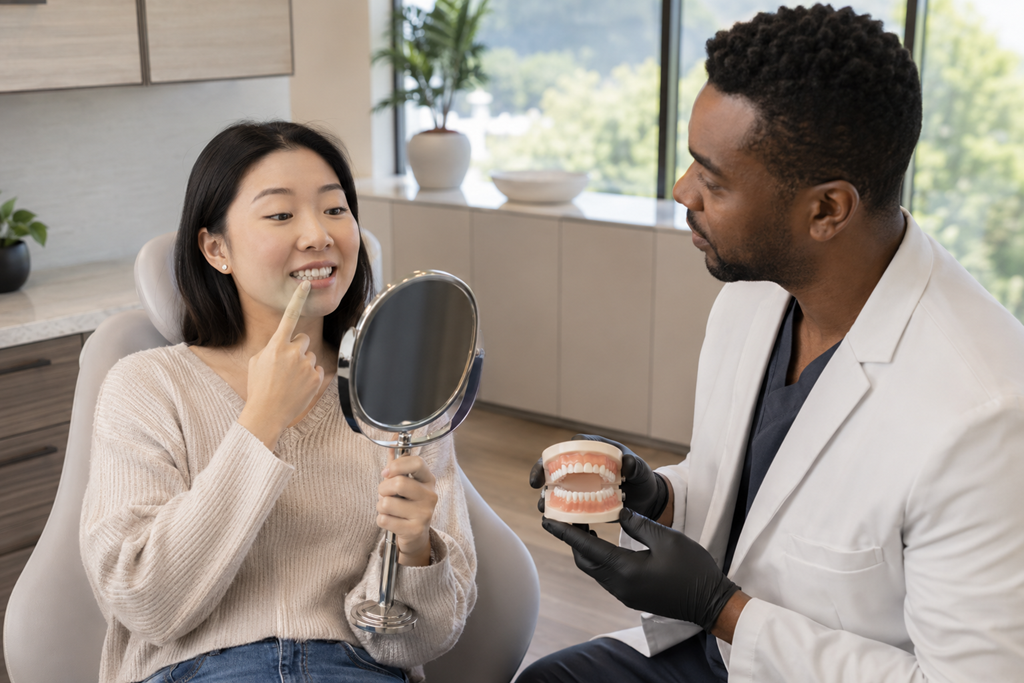
Cosmetic dentistry may be worth exploring when a change to your smile would address a specific concern that affects how you feel, speak, eat, or present yourself—but the right choice depends on more than wanting a brighter or straighter-looking smile. The useful question is whether the expected benefit, treatment limits, cost, maintenance, and possible risks match your personal goals.
That decision can feel surprisingly difficult. You may know that something about your smile bothers you without knowing exactly what should change. You may also be comparing several treatments that appear to promise similar results but involve very different commitments.
Before scheduling treatment, it helps to separate the result you want from the procedure being offered. A consultation should help you understand the concern, consider reasonable options, and decide whether making a change is worthwhile for you.
Start with the change you actually want
“I want a better smile” is understandable, but it is too broad to guide a useful treatment discussion.
A more specific goal might involve tooth color, a visible gap, uneven edges, worn teeth, an old restoration, or the appearance of one tooth that does not match the others. Some people want a subtle improvement that still looks familiar. Others are interested in a more noticeable change.
Being specific does not mean diagnosing the problem yourself. It simply gives the dentist a clearer picture of what you notice and what outcome matters to you.
Consider whether your concern is focused on one feature or your entire smile. A single discolored tooth, for example, creates a different decision than wanting several teeth to appear more uniform. The narrower the concern, the easier it may be to discuss options without automatically moving toward a larger treatment plan.
It is also useful to ask what would feel meaningfully different afterward. Would you feel more comfortable smiling in photographs? Are you hoping an old repair will look less noticeable? Do you want a change that is subtle enough that other people may not immediately recognize it?
A clear personal goal helps keep the consultation centered on what matters to you rather than on everything that could potentially be changed.
A cosmetic concern may not be purely cosmetic
Something that looks like an appearance issue can sometimes involve oral health, tooth structure, gum health, bite forces, enamel wear, or an older dental restoration.
A chipped edge might seem like a simple shape concern, but the reason it chipped may affect which options are appropriate. Uneven teeth could reflect natural variation, wear, positioning, or a bite-related issue. Discoloration may respond differently depending on its cause.
This does not mean that every cosmetic concern signals a larger problem. It means that appearance alone may not tell the full story.
A qualified dentist should evaluate the condition of your teeth and gums before recommending cosmetic treatment. That evaluation can help distinguish between a preference-based change, a functional concern, and an oral health issue that may need attention first.
This article is educational and is not a substitute for personalized dental advice, diagnosis, or treatment planning.
The right option depends on more than the final appearance
Cosmetic dental treatments can differ in how they affect natural tooth structure, how long the process takes, how much maintenance they require, and whether the change can be reversed.
Depending on the concern, a dentist may discuss approaches such as whitening, bonding, veneers, crowns, orthodontic treatment, or replacing an older restoration. These options are not interchangeable, even when photographs make their results appear similar.
One approach may add material to a tooth, while another may require reshaping it. One may be relatively easy to adjust later, while another creates a longer-term commitment. Some changes may be completed within a limited treatment area, while others work best as part of a broader plan.
The most appropriate discussion is not simply, “Which option looks best?” It is, “Which option addresses my goal with tradeoffs I understand and accept?”
Decide how natural you want the result to feel
Cosmetic dentistry does not have to create a dramatic transformation. Many people are looking for a result that appears balanced, healthy, and consistent with their existing features.
Tooth color, shape, proportion, surface texture, and symmetry all affect how a result looks. A shade that appears attractive in a photograph or under bright lighting may feel different in ordinary daylight. Perfect uniformity may also look less natural than small variations in shape or color.
During a consultation, explain whether you want a subtle refinement or a more visible change. Reference images may help communicate preferences, but they should not be treated as guarantees. Another person’s tooth shape, facial proportions, enamel, gumline, and starting condition may differ from yours.
A provider should be willing to discuss what is realistically achievable rather than promising to reproduce someone else’s smile.
Think beyond the first day
The appearance immediately after treatment is only part of the decision. Long-term care matters too.
Some cosmetic work can stain, chip, wear, loosen, or eventually need repair or replacement. Natural teeth may also continue to change around restorations. Habits such as grinding, biting hard objects, smoking, or frequently consuming staining foods and drinks may influence how certain results hold up.
Maintenance expectations vary by treatment and by patient. Before committing, ask what routine care may be needed, what could shorten the result’s useful life, and how future repairs would be handled.
The answer should be more specific than “it lasts a long time.” A useful explanation acknowledges that dental work does not come with a permanent guarantee and that individual outcomes vary.
A treatment may still be worthwhile even when future upkeep is expected. The important point is to understand that commitment before making the decision.
Consider whether the benefit feels proportionate
Cosmetic dentistry may be a reasonable conversation when one particular concern has remained meaningful to you and you understand that treatment involves limitations.
It may be a better fit when:
- You can describe the specific change you hope to achieve.
- Your oral health has been properly evaluated.
- You understand the available alternatives.
- Your expectations are realistic.
- You are comfortable with the cost and likely maintenance.
- You have had enough time to consider the recommendation without pressure.
The benefit does not need to be medically necessary to matter. Personal preferences can be valid. At the same time, wanting a cosmetic change does not require you to accept the most extensive option presented.
A smaller treatment, a staged approach, or choosing not to proceed may also be reasonable depending on your priorities and the dentist’s evaluation.
Slow down when the recommendation moves faster than the explanation
A cosmetic consultation should give you enough information to understand why a particular treatment is being recommended.
Be cautious when a provider presents a major treatment plan before carefully discussing your concern, oral health, alternatives, and desired outcome. Other warning signs include guaranteed perfection, pressure to commit quickly, unclear pricing, or little discussion of maintenance and possible complications.
You should also understand whether a suggested procedure is reversible and whether healthy tooth structure would need to be changed. When treatment is irreversible, the explanation should be especially clear.
Before-and-after photographs can help demonstrate a provider’s work, but they do not predict your result. Images may be affected by lighting, angle, camera settings, temporary conditions, or differences in each patient’s starting point.
A trustworthy discussion should include limitations as well as benefits.
Questions to bring to a cosmetic dentistry consultation
A short set of focused questions can help Sacramento-area patients compare providers and understand what they are considering:
- Is my concern cosmetic, functional, health-related, or a combination?
- What options could address my specific goal?
- Which option preserves the most natural tooth structure?
- Is the proposed change reversible?
- What outcome is realistic for my starting condition?
- What maintenance, repairs, or replacement might be needed later?
- What risks or limitations should I understand?
- What is included in the estimated cost?
- What would happen if I chose to wait or do nothing?
- What experience do you have with this specific treatment?
Pay attention not only to the answers but also to how they are delivered. Clear explanations should make the decision easier to understand, even when no option is perfect.
Look for a provider who separates preferences from needs
A constructive consultation should leave room for your preferences without presenting every cosmetic difference as a defect.
The dentist should listen to what bothers you, evaluate your oral health, and explain which parts of the recommendation are necessary for health or function and which are elective appearance choices.
That distinction is important. It helps you decide where your priorities begin and end.
When comparing Sacramento cosmetic dentistry providers, look for someone who explains alternatives, discusses long-term implications, answers questions without defensiveness, and avoids pressuring you toward a larger plan. Written treatment details can also make it easier to compare recommendations accurately.
You should leave the consultation knowing what the proposed treatment is intended to change, what it cannot guarantee, and what commitment it creates.
Cosmetic dentistry is right when the tradeoffs fit your goal
Cosmetic dentistry may be right for you when the concern is specific, the expected improvement feels meaningful, and you understand the treatment’s health considerations, limitations, cost, and future maintenance.
It may not be the right time when the goal remains unclear, the recommendation feels more extensive than expected, or you do not yet understand the alternatives.
The purpose of a consultation is not simply to select a procedure. It is to determine whether a proposed change fits your priorities. Taking time to define the result you want and compare the tradeoffs can help you make a more informed decision before committing to treatment with a Sacramento-area provider.