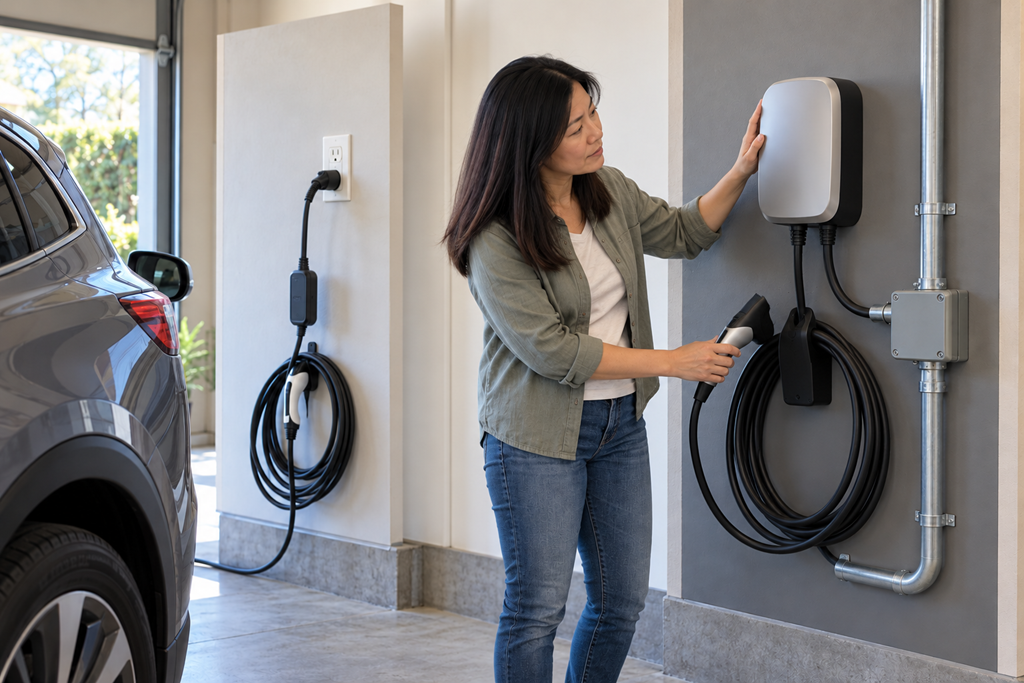
Choosing the right home EV charging speed starts with understanding how much you drive, how long your vehicle stays parked, and how much driving range you need to recover before your next trip. A faster charger may offer greater flexibility, but it is not automatically necessary for every household. For Sacramento-area drivers, the practical goal is to find a charging arrangement that supports everyday transportation without paying for more charging capability than the household is likely to use.
A home charging decision can feel more complicated than expected because charging equipment is often described by its electrical capacity rather than by how it fits someone's schedule. A homeowner may hear that a particular charger is faster without knowing whether that additional speed would make a meaningful difference in daily life.
The useful comparison is not simply how quickly a charger could refill an almost-empty battery. It is whether the charging arrangement can routinely replace the energy used during normal driving, accommodate occasional changes in schedule, and work with the property's electrical system.
Understanding that relationship can help you decide whether basic home charging is sufficient, whether faster charging offers worthwhile convenience, and what to discuss with an EV charging installation professional before making a commitment.
Start with the miles you actually drive
The most important information is not necessarily your vehicle's maximum driving range. It is how much energy you typically use between opportunities to charge.
Someone who drives a relatively short distance each day may have very different home charging requirements from someone who regularly makes extended trips across the Sacramento region.
Before comparing charging equipment, consider three parts of your routine.
Your normal daily driving distance
Think about the distance you travel on an ordinary weekday.
This might include commuting, school transportation, errands, appointments, and other repeated trips.
Then consider how much your driving varies. Some households follow a predictable schedule, while others have days with substantially more travel.
A useful starting point is to identify:
- Your approximate driving distance on a typical day.
- Your longest regularly occurring driving day.
- How often you take additional trips without returning home for long.
- Whether your schedule includes unpredictable travel.
The longest drive you could possibly take is not necessarily the distance your home charger must recover every night.
For example, a household that occasionally takes an extended weekend trip may not need home charging equipment sized around that unusual trip. Public charging, an additional charging session, or several days of normal home charging may provide reasonable alternatives.
The important distinction is between a recurring requirement and an occasional exception.
When the vehicle returns home
Consider whether your vehicle normally returns home at approximately the same time each evening.
A predictable schedule creates a dependable charging opportunity. An irregular schedule may leave less time to recover the energy used during the day.
Someone who regularly parks at home overnight may be able to use slower charging more effectively than someone whose vehicle is only home for short periods.
Whether your driving is concentrated into certain days
Not every household drives the same distance seven days a week.
You might make several longer trips on certain weekdays and drive very little on others. Alternatively, your weekday commute may be short while weekends involve considerable travel.
Look at the complete weekly pattern instead of assuming every day requires an identical amount of charging.
An arrangement that does not completely replace one day's energy use may still support the household over several days if longer charging opportunities follow.
That flexibility matters when evaluating whether a charging upgrade is necessary.
Understand what Level 1 and Level 2 charging actually change
For most residential charging decisions, the primary comparison is between Level 1 and Level 2 charging.
Both can support regular home charging, but they deliver energy at different rates.
Charging consideration | Level 1 charging | Level 2 charging |
|---|---|---|
General setup | Uses compatible 120-volt charging equipment | Uses compatible 240-volt equipment |
Charging pace | Slower energy recovery | Faster energy recovery |
Typical fit | Shorter driving distances and longer parking periods | Longer driving distances, shorter charging windows, or greater flexibility |
Installation considerations | May use a suitable existing outlet and circuit | Commonly requires dedicated electrical installation or evaluation |
Main tradeoff | Lower charging capability, potentially simpler setup | Greater charging capability, potentially more installation work |
The actual charging rate depends on the vehicle, equipment, electrical supply, and charging conditions. These distinctions are consistent with guidance from the U.S. Department of Energy and Environmental Protection Agency.
Level 1 charging may be enough for some routines
Level 1 charging is sometimes dismissed because it is substantially slower than Level 2 charging.
However, slow charging is not automatically inadequate.
Consider a driver who travels relatively short distances most weekdays and parks at home for many consecutive hours. If the available charging arrangement routinely replaces the energy used, faster equipment may provide little additional benefit during ordinary weeks.
Level 1 charging may be worth evaluating when:
- Daily driving distances are relatively modest.
- The vehicle remains parked at home overnight.
- Charging needs are predictable.
- The household can tolerate gradual energy recovery.
- There is a suitable electrical outlet and circuit for the intended equipment.
Plug-in hybrid vehicles may also have different charging needs because their batteries and driving patterns can differ from those of fully electric vehicles.
However, the presence of an ordinary-looking outlet does not automatically mean that the outlet, wiring, and circuit are appropriate for sustained EV charging.
A qualified electrician should evaluate electrical suitability when there is uncertainty. Extension cords or improvised charging arrangements should not be used as substitutes for an appropriate installation.
Level 2 charging offers more scheduling flexibility
Level 2 charging can replenish energy more quickly, making it appealing for drivers who use more range between charging sessions.
It may be especially useful when a household has substantial daily mileage, unpredictable schedules, limited time at home, or multiple electric vehicles.
The additional charging capability can also reduce the need to plan several days ahead after an unusually long drive.
Yet two Level 2 charging installations do not necessarily deliver the same practical charging speed.
The charging equipment's rating, available electrical capacity, vehicle limitations, and installation configuration all influence the results.
That is why the decision should not end with choosing between Level 1 and Level 2. It should also consider how much Level 2 capability the household actually needs.
Match charging time to your available parking window
A charging system only has the time your vehicle is parked and available to charge.
This makes the overnight parking window one of the most useful factors in selecting home charging speed.
Suppose you normally arrive home in the early evening and do not need the vehicle until the following morning.
That creates a much longer charging opportunity than a schedule where the vehicle arrives late and leaves again a few hours later.
The practical question becomes:
Can the charging arrangement replace the energy used during your driving routine within the time you normally have available?
Compare three illustrative routines
The following examples are hypothetical. They illustrate how different schedules can influence the decision, not guaranteed charging performance.
Routine A: A shorter, predictable commute
A driver travels approximately 20 miles most weekdays and generally has a long overnight parking window.
If the vehicle and electrical arrangement can replace that energy overnight, Level 1 charging may be sufficient. Faster charging would offer additional capacity, but the household may not need it.
Routine B: A longer commute with evening commitments
A driver travels approximately 65 miles on workdays and sometimes leaves again after returning home.
Here, the household needs to replace more energy while potentially having fewer charging hours available. Level 2 charging may provide a more practical fit.
Routine C: Irregular driving with occasional extended trips
A driver normally travels a modest distance but occasionally makes much longer trips.
The choice depends partly on how often those extended trips occur and how quickly the vehicle must be ready afterward.
A faster home charger could be useful, but the household might also manage those exceptions through planning or occasional public charging.
The examples reveal an important distinction: two drivers with the same vehicle may have different charging requirements because their schedules are different.
Allow for actual charging conditions
It is helpful to avoid treating advertised charging rates as exact promises.
The amount of driving range added during a charging session can vary with vehicle efficiency, energy consumption, equipment capability, battery conditions, and other factors.
Air-conditioning use, driving speed, and weather can also influence how much energy the vehicle uses during a trip.
For Sacramento-area drivers, summer heat may affect energy consumption when climate control is used extensively. The influence will vary by vehicle and driving conditions.
A sound charging plan leaves reasonable flexibility rather than depending on ideal performance every night.
Consider how your battery and vehicle affect charging speed
The largest charger is not necessarily the fastest useful choice for your specific vehicle.
Home AC charging speed is limited by what the vehicle can accept, as well as what the charging equipment and electrical installation can provide.
A charging unit with a higher advertised capacity cannot automatically make every vehicle charge at that full rate.
Battery size changes how much energy may need replacing
Two electric vehicles driven the same distance may use different amounts of energy.
Differences in vehicle efficiency, weight, driving conditions, and other characteristics affect energy consumption.
Battery size also influences how long it may take to recharge from one battery level to another.
However, a larger battery does not necessarily mean the household needs faster charging.
A driver with a large-battery vehicle and a short daily commute may need to replace only a small portion of the battery's capacity each evening.
Focus on routine energy use rather than assuming the vehicle's maximum battery capacity must be replenished every night.
The vehicle's AC charging limit matters
Different electric vehicles support different maximum AC charging rates.
If your vehicle cannot accept the maximum power offered by a particular Level 2 charger, purchasing higher-capacity equipment may not improve its actual charging speed.
Before selecting equipment, check your vehicle manufacturer's charging specifications.
Useful information includes:
- The vehicle's supported AC charging capability.
- The compatible charging connector or approved adapter.
- Any manufacturer guidance affecting home charging.
- Whether the vehicle allows charging schedules or charging limits to be configured.
These details can help an installation professional recommend equipment that makes practical sense.
A full battery every morning is not always the objective
Many drivers do not need to start every day with the battery at its maximum possible charge.
Vehicle manufacturers may provide model-specific recommendations for routine charging limits and battery management.
Following those recommendations while maintaining enough range for expected driving may be more appropriate than planning around a complete recharge every night.
For most households, the useful objective is to have adequate energy available for the next planned driving period.
Decide how much flexibility your household needs
Charging speed is not only about an ordinary commute.
It also affects how easily your household can accommodate changes.
Think about what happens when the usual routine is interrupted.
You may return home later than expected, make an unplanned trip, or need the vehicle sooner than usual the next morning.
A faster charger can offer additional flexibility in those circumstances.
However, that flexibility has value only in relation to how often the household needs it.
When faster charging provides a meaningful advantage
Level 2 charging may deserve stronger consideration when:
- You regularly drive substantial distances.
- You have limited overnight charging time.
- Your schedule changes frequently.
- You sometimes need to recover substantial range between trips.
- Two or more household vehicles need home charging.
- You expect your driving requirements to increase.
If these conditions describe your routine, extra charging capability may reduce scheduling constraints.
When additional speed may offer limited everyday value
Faster charging may be less important when:
- Your vehicle consistently sits unused for long periods.
- Daily driving distances are short.
- The existing charging arrangement meets your needs.
- Occasional longer trips can be accommodated without major inconvenience.
- Electrical installation changes would be substantial compared with the benefit received.
This does not mean slower charging is always the better choice.
It means the value of faster equipment should be measured against a real household requirement rather than a general preference for maximum capability.
Account for a second vehicle or future changes
A home charging setup that works for one driver may become less convenient when another electric vehicle is added.
For example, a household may initially charge one vehicle overnight without difficulty.
If another driver later needs the same charging location, both vehicles may compete for charging time.
That creates a different planning question.
Instead of asking only whether one vehicle can recover its daily energy use, the household must consider how the available charging hours will be shared.
One charging location versus multiple vehicles
When two vehicles share one charger, their parking schedules and energy needs matter.
If one vehicle drives relatively little and the other regularly travels longer distances, alternating charging sessions might work.
Other households may prefer a system that accommodates more than one vehicle.
The appropriate arrangement depends on parking locations, electrical capacity, vehicle compatibility, and charging equipment capabilities.
Some equipment supports coordinated charging or power sharing, but these features must be evaluated for compatibility and suitable installation.
Do not assume that adding another charging unit is automatically practical simply because there is physical room for it.
Plan for realistic future needs
Future flexibility can be worthwhile, especially when you are already planning an electrical installation.
Nevertheless, it is easy to overestimate what the household may eventually require.
A useful distinction is between changes you reasonably expect and possibilities that remain uncertain.
If you already plan to add another electric vehicle or anticipate a meaningful commuting change, discuss that with the installer.
If future needs are unclear, ask what practical upgrade options would remain available without automatically committing to the highest-capacity system today.
Check whether your property can support the charging arrangement
Once you understand the charging capability that would suit your routine, the next question is whether your parking location and electrical system can accommodate it.
This is where the home charging decision becomes property-specific.
An attractive charger specification does not establish that the installation will be simple.
Electrical capacity and installation scope
A qualified electrical professional may need to evaluate the home's electrical panel, available capacity, circuit requirements, wiring routes, and intended charging equipment.
Some properties may accommodate a proposed charging setup with relatively straightforward work.
Others may require additional planning, changes to the proposed charging configuration, or electrical upgrades.
An installer may also discuss alternatives that operate within the property's available capacity.
A more powerful charger is not automatically the most sensible option if the household's routine does not require its full capability.
Distance from the electrical panel to the parking area
The location of the charging equipment affects installation planning.
A garage or parking area close to a suitable electrical supply may create a different scope of work from a location farther away.
Routing, accessibility, finished surfaces, and equipment placement may influence complexity.
These considerations can affect installation cost even when the proposed charging equipment is identical.
Outdoor parking and shared-property situations
Some Sacramento-area residents park outdoors, in carports, or in shared parking areas rather than private garages.
Outdoor charging may be possible with appropriately rated equipment and a suitable installation, but placement and environmental exposure require consideration.
Renters and residents of multifamily properties may also need to coordinate with a property owner, management company, or other responsible party.
Before purchasing equipment, clarify which installation options are actually available for your parking arrangement.
A professional evaluation is the appropriate place to determine electrical feasibility, required safety measures, and applicable installation requirements.
Compare the cost of charging speed with the convenience it delivers
A faster charger may improve convenience, but its value depends on the complete installation and your driving habits.
The purchase price of the charging equipment is only one part of the decision.
Other potential cost factors include:
- The electrical work necessary to support the selected charging rate.
- The distance and routing between the electrical supply and charging location.
- Whether existing electrical capacity is sufficient.
- Required equipment or installation changes.
- Whether additional household vehicles must be accommodated.
- The installation's compatibility with future needs.
A lower-priced charger may not produce the lowest overall installed cost.
Similarly, an expensive or high-capacity charger does not automatically create a better everyday charging experience.
Compare the actual proposed charging capability
When reviewing recommendations, pay attention to what each proposed system can realistically deliver at your property.
Two quotes may involve different equipment capabilities or different amounts of electrical work.
One provider may recommend a higher-capacity installation. Another may suggest a lower-capacity arrangement that still meets your daily needs.
A fair comparison should consider both options against the same driving routine.
Ask whether the additional charging capability would materially improve the household's schedule.
If the faster arrangement offers little practical benefit, the extra installation scope may be difficult to justify.
If the slower arrangement regularly creates scheduling problems, the additional capability could provide worthwhile value.
Separate charging speed from electricity expense
Faster charging does not automatically mean that the vehicle uses less electricity for the same driving.
The amount of energy required depends primarily on the vehicle's consumption and driving conditions, with charging losses also affecting the electricity drawn from the home.
Charging equipment, efficiency, and scheduling may affect the overall result.
Electricity rates or time-based charging arrangements may also matter when considering when to charge.
Those questions are separate from whether a charger has enough capacity to recover your daily energy use.
Avoid evaluating charging speed only through claims about electricity savings.
Prepare a useful charging profile before contacting an installer
You do not need to become an electrical expert to have a productive conversation with a local EV charging professional.
You do, however, benefit from understanding how your household intends to use the equipment.
Before requesting an installation estimate, gather the information that will help the professional connect the proposed system to your actual needs.
Your household charging profile
Prepare the following:
- Vehicle information: Make, model, and relevant charging specifications.
- Typical daily driving: Approximate miles traveled on ordinary days.
- Longer regular trips: The driving days that create greater charging needs.
- Parking window: When the vehicle normally returns home and when it is needed again.
- Parking arrangement: Garage, driveway, carport, or other location.
- Existing charging experience: Whether you currently charge at home and what limitations you have noticed.
- Additional vehicles: Whether another vehicle needs to use the same charging location.
- Future expectations: Any reasonably anticipated changes in commuting or vehicle ownership.
If you already have an electric vehicle, your charging history may help you understand its actual energy use.
If you are planning to purchase one, manufacturer specifications and your current driving routine can provide a starting point.
The goal is not to make the installation decision yourself. It is to give the professional enough useful context to explain an appropriate recommendation.
Questions that connect the installer's recommendation to your routine
A useful discussion with a qualified EV charging installer should go beyond asking which charger is fastest.
Consider these questions:
- Based on my normal daily mileage and parking hours, what charging capability would you recommend? This encourages a recommendation connected to actual use.
- Could Level 1 charging reasonably meet my needs, or would Level 2 provide a meaningful improvement? This helps distinguish necessity from convenience.
- Will my vehicle be able to use the charging rate you're proposing? This addresses vehicle-specific limitations.
- What charging performance should I realistically expect from this installation? Ask the professional to explain assumptions rather than promise a fixed result.
- What electrical work is included, and what conditions could change the installation scope? This makes it easier to compare estimates.
- Would a lower-capacity Level 2 arrangement be sufficient? This can reveal options between basic charging and maximum-capacity equipment.
- How would this setup accommodate an additional vehicle or changing driving routine? This helps evaluate flexibility without automatically overspending.
The strongest explanation connects equipment capability, vehicle limitations, the parking window, and property conditions.
A provider who simply recommends the highest available charging rate without discussing those factors may not have fully established what your household needs.
That is a reason to request clarification or seek another assessment, rather than automatically conclude that the recommendation is inappropriate.
Make the decision around the next ordinary week, not the rarest trip
When comparing home charging options, imagine how each would work during a normal week.
Would the vehicle recover the energy it typically uses?
Would it be ready when someone in the household needs it?
What happens after an occasional longer driving day?
Would the additional charging speed solve a recurring inconvenience, or would the vehicle usually finish charging long before its next trip regardless?
The answers help separate a useful investment from unused charging capacity.
For some Sacramento-area households, a suitable Level 1 arrangement may support daily driving comfortably. Others may benefit substantially from Level 2 charging, especially when driving distances, parking schedules, or multiple vehicles place greater demands on the available charging time.
The appropriate choice is not necessarily the slowest or fastest charger. It is the charging arrangement that provides enough dependable capability for the household's actual routine, works with the vehicle, and can be installed appropriately at the property.
Before committing, use your driving profile and a qualified professional's property-specific assessment to understand what the proposed charging speed will accomplish.